


Microelectronics Cleaning Equipment Market Technology Trends and Outlook
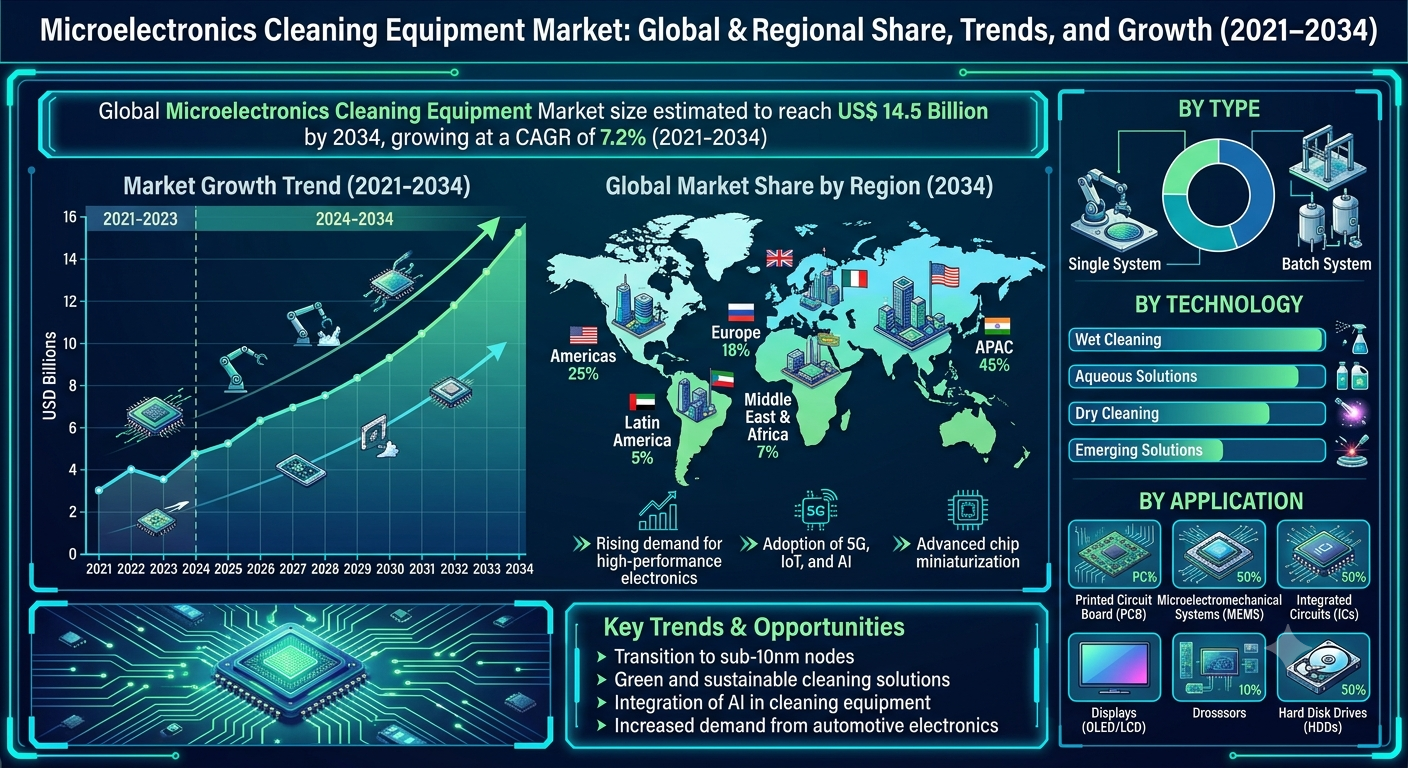
The growing emphasis on semiconductor quality, manufacturing yield, and device reliability is increasing demand for advanced cleaning technologies. Contaminants introduced during fabrication can negatively affect sensitive electronic structures and contribute to defects or performance issues. Microelectronics cleaning equipment provides controlled solutions for removing particles, residues, and other impurities from wafers, integrated circuits, MEMS components, PCBs, and displays. As manufacturers pursue higher production standards and increasingly complex electronic designs, precision cleaning is becoming an integral part of manufacturing workflows.
The Microelectronics Cleaning Equipment Market Size was valued at US$657.31 million in 2025 and is projected to reach US$1,034.69 million by 2034, expanding at a CAGR of 5.17% from 2026 to 2034. The total addressable market is estimated at US$7,676.16 million during 2026–2034. According to The Insight Partners, demand is being supported by increasing semiconductor device production, electronic device miniaturization, stringent cleanliness requirements, and expanding applications in advanced packaging and display technologies. The report covers single and batch systems across wet, aqueous, dry, and emerging cleaning technologies, with applications spanning PCBs, MEMS, integrated circuits, displays, and hard disk drives.
Download Sample PDF Link:https://www.theinsightpartners.com/sample/TIPRE00039527
Market Report Drivers
Increasing Demand for Semiconductor Devices
The expanding use of semiconductors in smartphones, artificial intelligence systems, Internet of Things devices, automotive electronics, data infrastructure, and industrial equipment is a major growth driver. Semiconductor manufacturing involves multiple highly controlled processes, including photolithography, deposition, etching, and wafer preparation, where contamination can affect device performance and manufacturing yield. Cleaning equipment helps remove particles and residues between critical process steps, supporting consistent fabrication and product quality. As semiconductor production capacity expands, equipment suppliers are expected to benefit from continued requirements for reliable and precise cleaning systems.
Miniaturization of Electronic Devices
The continued miniaturization of electronic components is increasing the importance of highly controlled surface-cleaning processes. Smaller device geometries and increasingly complex structures leave less tolerance for particulate contamination or chemical residues. Advanced semiconductor nodes and sophisticated component architectures require cleaning technologies capable of delivering precise contamination removal while minimizing damage to sensitive surfaces. This requirement is encouraging manufacturers to adopt specialized single-system and advanced cleaning solutions that can address increasingly demanding process conditions.
Stringent Cleanliness and Quality Requirements
Strict contamination-control requirements across semiconductor and microelectronics manufacturing are another important growth factor. Particles, organic residues, chemicals, and other contaminants can contribute to defects and affect the reliability and performance of electronic components. Consequently, manufacturers are investing in cleaning technologies designed to deliver consistent results across wafers, photomasks, chips, and other critical substrates. The emphasis on process control and manufacturing quality is expected to sustain equipment demand throughout the forecast period.
Technology and Application Opportunities
The industry is evolving beyond conventional cleaning approaches as manufacturers seek greater precision, efficiency, and environmental performance. Dry cleaning technologies, including plasma-based processes, are gaining attention because they can support controlled contamination removal while reducing dependence on liquid chemicals. Automation and integration are also becoming important as manufacturers seek higher throughput, repeatability, and reduced human intervention. Integrated washing, rinsing, and drying processes can improve production consistency and operational efficiency, while robotics and intelligent process controls can support more customized cleaning requirements.
Ultra-pure cleaning technologies represent another area of opportunity. Semiconductor fabrication increasingly requires ultra-pure water and high-purity chemical solutions to minimize contamination during wafer and photomask processing. At the same time, advanced display manufacturing and the expansion of 3D packaging are creating additional applications for specialized cleaning systems. The increasing complexity of stacked and high-performance electronic components makes contamination control particularly important for maintaining reliability and yield.
Top Players
The competitive landscape includes Panasonic Industry, Axcelis, Semitorr Group Inc., Axus Technologies, Cleaning Technologies Group, Ultra T Equipment Company Inc., SMTnet, SEMES Co. Ltd., Naura Akrion Inc., and TEL FSI Inc. These companies are represented in The Insight Partners' competitive coverage of the industry.
Broader industry sources also identify companies such as RENA Technologies, Dainippon Screen, Quantum Global Technologies, Speedline Technologies, Applied Materials, Lam Research, Tokyo Electron, Entegris, and SCREEN Holdings in the wider competitive landscape. Competition is centered on cleaning precision, process integration, automation, equipment reliability, contamination control, and the ability to address increasingly advanced semiconductor and microelectronics manufacturing requirements.
Future Outlook
The outlook through 2034 is shaped by continued semiconductor demand, ongoing electronic device miniaturization, advanced packaging, sophisticated display technologies, and increasing requirements for manufacturing cleanliness. The Insight Partners projects the industry to grow from US$657.31 million in 2025 to US$1,034.69 million by 2034, representing a 5.17% CAGR during 2026–2034. Automation, integrated cleaning workflows, dry-cleaning approaches, and ultra-pure cleaning technologies are expected to remain important areas of technological development. Expanding semiconductor manufacturing capacity and the adoption of advanced device architectures should also create opportunities for equipment providers capable of delivering precise and scalable cleaning solutions.
About The Insight Partners
The Insight Partners is a global market research and consulting firm providing syndicated research, customized research, and consulting services across technology, electronics and semiconductors, healthcare, energy and power, industrials, and other industries. Its research combines market analysis, industry expertise, company information, secondary research, and primary insights to support strategic business decisions.
Contact Us
The Insight Partners
Email: [email protected]
Phone: +1-646-491-9876
Website: https://www.theinsightpartners.com
Related Reports -
Submarine Fiber Cable Market Demand, Share & Growth by 2034
Automotive HVAC Market Size, Growth & Trends by 2034
Offshore Wind Cable Market Size, Growth & Trends by 2034

 English
 Arabic
 French
 Spanish
 Portuguese
 Deutsch
 Turkish
 Dutch
Dutch
 Italiano
 Russian
 Romaian
 Greek
Greek