


Voice Gateway Market Forecast, Opportunities and Industry Analysis
The rapid transformation of enterprise communication infrastructure is increasing the need for reliable technologies that connect traditional telephony environments with IP-based communication networks. Organizations across commercial and institutional sectors are upgrading communication systems to improve connectivity, scalability, interoperability, and operational efficiency. The transition from legacy telephony toward Voice over Internet Protocol (VoIP), cloud communication platforms, and unified communications is creating a stronger requirement for gateway technologies capable of managing voice traffic across diverse networks.
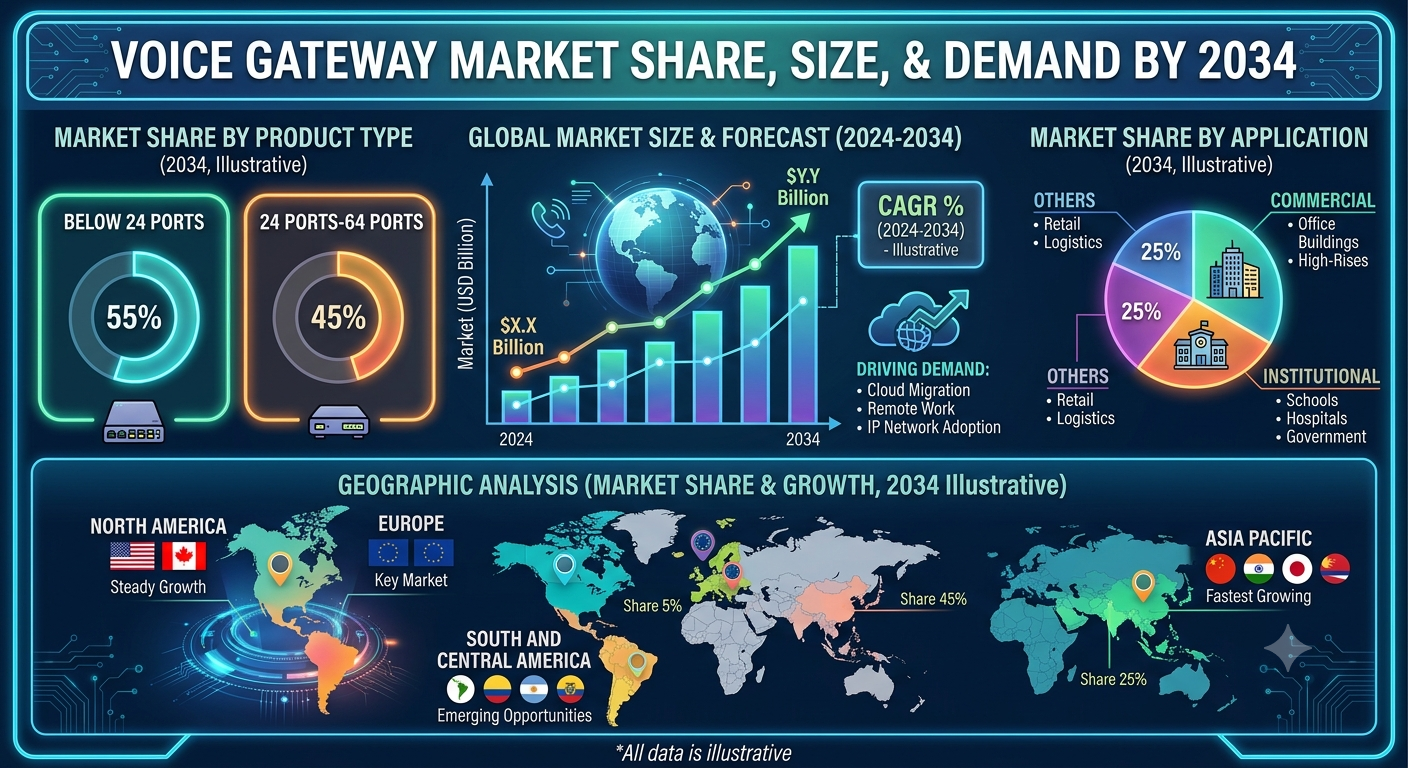
The Voice Gateway Market Size is projected to increase from US$1.61 billion in 2025 to US$3.57 billion by 2034, registering a CAGR of 9.27% from 2026 to 2034. The addressable opportunity is estimated at US$23.17 billion during 2026–2034, highlighting the potential for continued investment in voice connectivity infrastructure. The report covers product types including below 24 ports and 24 ports–64 ports, with applications spanning commercial and institutional environments.
Download Sample PDF Link:https://www.theinsightpartners.com/sample/TIPRE00023399
Voice Gateway Market Report Drivers
One of the major drivers is the continued migration from conventional circuit-switched communication toward IP-based networks. Voice gateways provide an important bridge between legacy telephone equipment and modern IP infrastructure, allowing organizations to continue using existing investments while gradually adopting next-generation communication platforms. This capability is particularly relevant for enterprises that need to modernize communications without replacing their entire installed telephony base.
The increasing adoption of cloud-based communication is another significant growth driver. Hosted private branch exchange, unified communications as a service, and other cloud communication models are encouraging organizations to connect distributed employees, offices, and applications through IP networks. Voice gateways can support interoperability between legacy endpoints, analog devices, digital telephony infrastructure, and newer cloud-based platforms. This flexibility can help organizations manage migration projects while maintaining business continuity.
Growing Demand for Seamless Business Communication
Demand for seamless communication across geographically distributed organizations is also supporting adoption. Businesses increasingly require voice infrastructure that can integrate with enterprise networks and communication applications while supporting reliable call quality. Commercial organizations are deploying communication technologies across offices, customer-service environments, branch locations, and other facilities, creating demand for scalable gateway solutions.
Technological development is further influencing adoption. Modern voice gateway solutions increasingly emphasize interoperability, network management, security, and integration with IP communication environments. As enterprises connect more communication endpoints to digital networks, gateway capabilities become increasingly important for managing voice traffic and maintaining connectivity between different generations of infrastructure.
Enterprise Modernization and Infrastructure Migration
Enterprise modernization is creating additional opportunities for voice gateway providers. Many organizations operate a mixture of analog phones, fax machines, legacy PBX systems, digital interfaces, and IP-based communication platforms. Replacing all legacy equipment at once can require substantial investment and create operational disruption. Gateway technologies provide an intermediate connectivity layer that can support phased migration.
The application landscape is divided into commercial and institutional segments, reflecting demand across organizations with different communication requirements. Commercial users can benefit from scalable connectivity for offices and distributed operations, while institutions can use gateway infrastructure to integrate existing communication equipment with newer network architectures.
Voice Gateway Market Competitive Landscape
Competition includes established networking, telecommunications, enterprise communication, and specialized voice technology providers. According to The Insight Partners, key companies profiled in the report include Cisco Systems Inc., D-Link, IBM, Sangoma Technologies Corporation, Multi-Tech, Matrix Comsec, Cognigy, REDCOM LABORATORIES, INC., Fortinet, and Arris International.
Other industry sources identify companies such as AudioCodes, Ribbon Communications, Huawei Technologies, Oracle, Grandstream Networks, and Dialogic as active participants in voice gateway and related IP communications solutions. Competition is shaped by product interoperability, network performance, security capabilities, integration with cloud platforms, product reliability, and support for different telephony environments.
Future Outlook
The future outlook remains closely connected with the evolution of enterprise communication networks. Greater adoption of cloud communications, unified communications, VoIP, and hybrid networking environments is expected to create continuing demand for technologies that connect legacy and IP-based systems. AI-enabled communication applications and increasingly integrated digital workplaces may also encourage vendors to develop gateways with stronger interoperability, security, monitoring, and management capabilities.
Small and medium-sized enterprises can represent an important opportunity as communication technologies become more accessible and cloud-based deployment models reduce infrastructure complexity. At the same time, larger organizations are likely to continue requiring sophisticated gateway infrastructure as they modernize distributed communication environments.
The global Voice Gateway Market is therefore positioned for sustained expansion, with its value expected to reach US$3.57 billion by 2034 from US$1.61 billion in 2025. The projected 9.27% CAGR during 2026–2034 reflects the continuing transition toward IP-based communication and the need for flexible connectivity between legacy and modern voice systems.
About The Insight Partners
The Insight Partners is a global market research and consulting firm providing actionable intelligence across technology, healthcare, chemicals and materials, semiconductor and electronics, industrial, and other industries. Its research combines market analysis, industry expertise, competitive intelligence, and strategic insights to support informed business decisions.
Contact Us
The Insight Partners
Email: [email protected]
Phone: +1-646-491-9876
Website: https://www.theinsightpartners.com
Related Reports -
Submarine Fiber Cable Market Demand, Share & Growth by 2034
Aircraft Wiring Harness Market Dynamics and Trends by 2030
SCADA Oil and Gas Market Size, Trends & Growth by 2034

 English
 Arabic
 French
 Portuguese
 Deutsch
 Turkish
 Dutch
Dutch
 Italiano
 Russian
 Romaian
 Portuguese (Brazil)
 Greek
Greek