


Rising Awareness and Technology Shape Autoimmune Diagnostics Market Growth
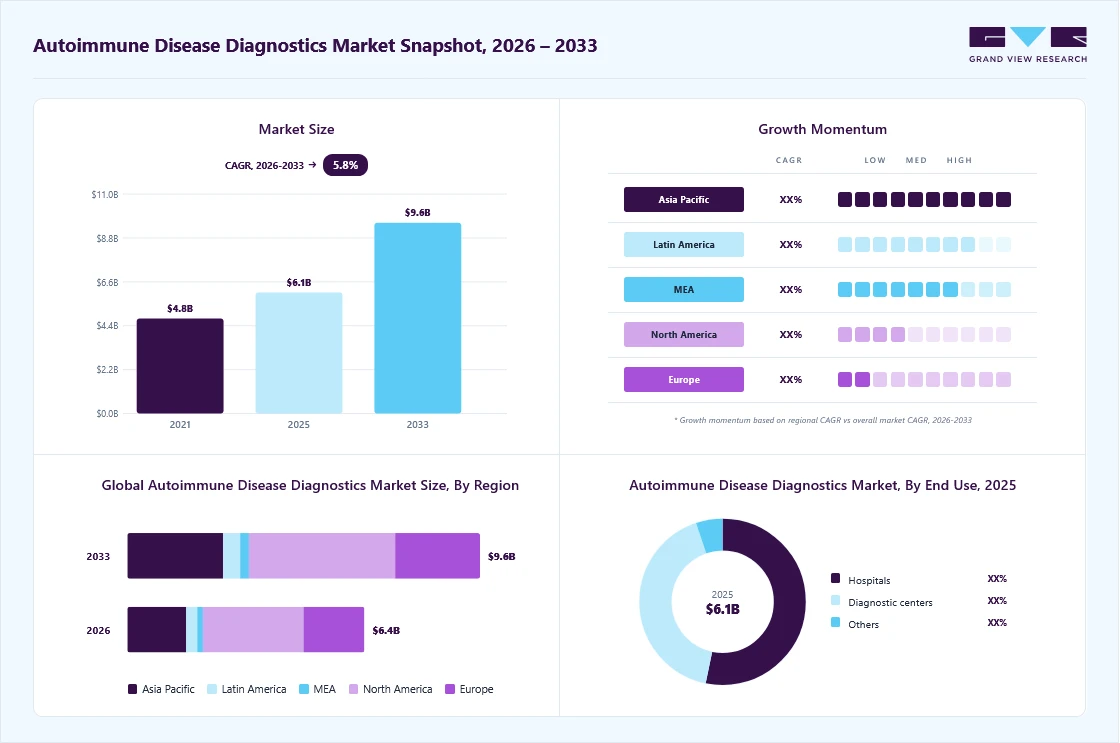
The autoimmune disease diagnostics market is gaining momentum as the growing burden of autoimmune disorders increases demand for early, accurate, and efficient disease detection. The market was valued at USD 6.1 billion in 2025 and is estimated to reach USD 6.4 billion in 2026. It is projected to expand to USD 9.6 billion by 2033, registering a CAGR of 5.8% from 2026 to 2033.
The increasing prevalence of autoimmune disorders, demand for rapid diagnostics, greater research investments, and advancements in diagnostic technologies are shaping market development. Autoimmune diseases involve complex diagnostic requirements, making accurate testing important for disease identification, monitoring, and treatment decisions.
Market Breakdown at a Glance
Several segments are contributing to the development of the autoimmune disease diagnostics industry. By type, localized autoimmune disease diagnostics accounted for the largest revenue share of 63.8% in 2025. By product, consumables and assays led with 70.7%, reflecting the recurring requirement for test kits, reagents, antibodies, and specialized assays.
By test, antinuclear antibody tests represented the largest revenue share at 42.8% in 2025. By end use, hospitals accounted for the leading share of 53.2%, supported by the increasing number of testing and treatment procedures conducted within healthcare facilities.
Market Dynamics & Growth Drivers
The rising burden of autoimmune diseases remains a major factor supporting demand for diagnostic solutions. Conditions such as rheumatoid arthritis, systemic lupus erythematosus, multiple sclerosis, psoriasis, and autoimmune thyroid disorders are contributing to sustained demand for accurate diagnostic testing.
Healthcare systems are placing greater emphasis on timely disease identification to support patient management and treatment selection. Increasing investments in autoimmune disease research and funding are also supporting the development of diagnostic technologies.
Technological advancement is another important influence. Clinicians are adopting advanced diagnostic technologies that allow multiple tests to be conducted simultaneously while improving testing speed and precision. Laboratory automation, multiplex immunoassays, biomarker discovery, and advanced autoantibody testing are contributing to more efficient diagnostic workflows.
Precision Medicine and Diagnostic Innovation
The increasing adoption of precision medicine is creating additional opportunities for autoimmune disease diagnostics. Healthcare providers are focusing on diagnostic solutions capable of identifying disease-specific biomarkers and supporting patient stratification.
Advances in immunology research, multiplex testing, and biomarker discovery are helping improve disease characterization and diagnostic accuracy. The market is also seeing increasing interest in artificial intelligence and machine learning algorithms, digital health technologies, wearables, mobile applications, and telemedicine platforms for diagnosis, monitoring, and early detection.
Product innovation remains an important competitive strategy. Companies are developing new diagnostic tests, expanding testing portfolios, improving assay sensitivity, and introducing automated systems designed to provide faster turnaround and more reliable clinical decision-making.
Challenges Affecting Market Development
Despite technological progress, diagnostic complexity remains an important challenge. Many autoimmune disorders share overlapping symptoms such as fatigue, inflammation, joint pain, and organ dysfunction, making differential diagnosis difficult, particularly during early disease stages.
The absence of highly specific biomarkers for some autoimmune conditions can require healthcare providers to combine autoantibody testing, laboratory assessments, imaging procedures, and clinical evaluation. This multi-step process can increase diagnostic time and healthcare expenditure.
Regulatory requirements can also affect product development. Diagnostic companies must address requirements involving clinical trials, data submission, and product approvals, which can increase development costs and timelines.
Regional Market Outlook
North America dominated the autoimmune disease diagnostics market with the largest revenue share of 42.6% in 2025. Increased healthcare spending, greater awareness, the burden of autoimmune diseases, and government support are contributing to the region's market position.
The U.S. held the largest share within North America in 2025. Europe is expected to experience significant growth, supported by increasing disease prevalence, awareness of early diagnosis, personalized medicine, and diagnostic technology advancements.
Asia Pacific is expected to witness significant market growth during the forecast period, supported by the increasing burden of autoimmune diseases, improving awareness, healthcare infrastructure development, and adoption of advanced diagnostic technologies. Latin America and the Middle East and Africa are also expanding as diagnostic infrastructure, awareness, specialized testing, and healthcare investments develop.
Competitive Landscape
Companies are focusing on product development, collaborations, partnerships, automated systems, high-throughput technologies, and enhanced assay sensitivity. These strategies are aimed at expanding diagnostic portfolios and improving testing efficiency across autoimmune disease applications.
Market Outlook
The autoimmune disease diagnostics market is positioned for steady expansion as disease prevalence, early detection requirements, precision medicine, biomarker research, laboratory automation, and diagnostic technology continue to influence demand. With the market expected to reach USD 9.6 billion by 2033, continued innovation in testing platforms and diagnostic workflows will remain central to market development.
FAQs
How big is the autoimmune disease diagnostics market?
The market was valued at USD 6.1 billion in 2025, is estimated at USD 6.4 billion in 2026, and is projected to reach USD 9.6 billion by 2033, growing at a CAGR of 5.8% from 2026 to 2033.
Which segment leads the autoimmune disease diagnostics market?
Localized autoimmune disease diagnostics led by type with a 63.8% revenue share in 2025. Consumables and assays led by product with 70.7%, antinuclear antibody tests led by test with 42.8%, and hospitals led by end use with 53.2%.
Key Autoimmune Disease Diagnostics Companies:
· F. Hoffmann-La Roche Ltd
· Siemens Healthineers AG
· Abbott
· Beckman Coulter, Inc.
About us:
Grand View Research, a market research and consulting company, provides syndicated research reports, customized research reports, and consulting services. Grand View Research database is used by the world's renowned academic institutions and Fortune 500 companies to understand the global and regional business environment. Our database features thousands of statistics and in-depth analysis on 46 industries in 25 major countries worldwide.

 English
 French
 Spanish
 Portuguese
 Deutsch
 Turkish
 Dutch
Dutch
 Italiano
 Russian
 Romaian
 Portuguese (Brazil)
 Greek
Greek