


How to Understand UPSC Sociology Optional Question Directives and Write Better Mains Answers
Preparing for UPSC Sociology Optional requires more than completing the syllabus and memorising sociological theories. Candidates must understand what a question demands and present their knowledge in a clear, analytical and relevant manner.
Aspirants often know the concepts but lose marks because they do not interpret the question correctly. A question asking you to critically examine a theory requires a different approach from one asking you to describe or explain it.
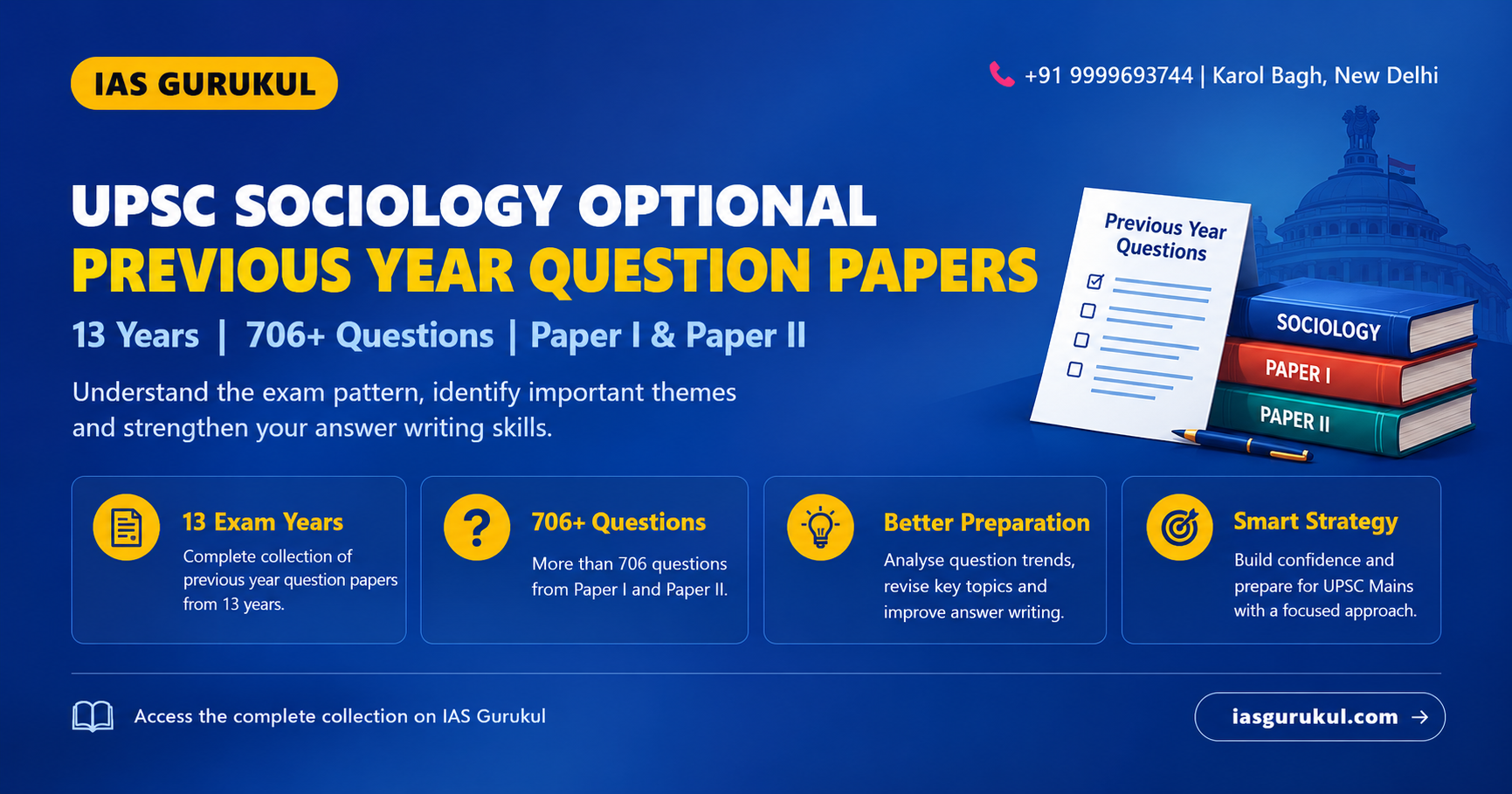
Previous Year Questions (PYQs) are particularly useful for developing this skill. The IAS Gurukul Sociology Optional Question Papers provide an opportunity to study the examination pattern across 13 examination years and more than 706 questions from Paper I and Paper II.
Why Question Directives Matter in Sociology Optional
Question directives indicate the type of response expected from candidates. They help determine whether an answer should be descriptive, explanatory, comparative or critical.
For example, writing a simple definition when the question asks you to critically evaluate a sociological theory may result in an incomplete answer.
Understanding directives helps candidates:
-
Identify the actual demand of a question.
-
Select relevant sociological thinkers and concepts.
-
Organise arguments logically.
-
Avoid unnecessary information.
-
Include appropriate examples and criticism.
-
Develop balanced conclusions.
Aspirants can use the IAS Gurukul website to explore Sociology Optional preparation resources and structured learning options.
Important Question Directives and How to Approach Them
1. Discuss
The directive "Discuss" requires a detailed explanation of the topic from relevant perspectives.
Example: Discuss Durkheim's concept of social facts.
A suitable answer structure:
-
Introduce social facts.
-
Explain their characteristics.
-
Discuss externality and constraint.
-
Provide relevant examples.
-
Explain their importance in sociological analysis.
Avoid limiting the answer to a short definition.
2. Critically Examine
This directive requires both explanation and evaluation. Candidates should discuss the strengths, limitations and relevance of an argument.
Example: Critically examine Marx's theory of class struggle.
A strong answer should explain Marx's argument, discuss its contribution to understanding capitalism and include relevant criticisms or alternative perspectives.
3. Explain
"Explain" requires clarity about how or why something happens.
Example: Explain Weber's concept of social action.
Define the concept, describe its different types and use examples to demonstrate their meaning.
4. Analyse
Analysis involves breaking a topic into its major components and examining the relationship between them.
Example: Analyse the relationship between education and social mobility.
Discuss how education can influence opportunities, status and mobility while also considering inequalities in access and outcomes.
5. Examine
"Examine" requires a closer investigation of a concept, theory or social phenomenon.
Example: Examine the changing nature of family in contemporary Indian society.
Discuss traditional family structures, emerging patterns, economic influences and social transformations.
6. Compare
Comparison requires identifying similarities and differences between two or more perspectives.
Example: Compare Marx and Weber's approaches to social stratification.
A comparative answer can cover class, status, power, inequality and the different explanations offered by both thinkers.
7. Evaluate
Evaluation requires judging the contribution, relevance or limitations of an argument using logical reasoning.
Example: Evaluate the relevance of Durkheim's theory of division of labour in modern society.
Explain the theory, assess its contribution and discuss its relevance in contemporary social settings.
How to Use PYQs to Understand Directives
Simply reading previous year questions is not enough. Candidates should examine how different directives change the expected answer.
Follow this practical method:
Step 1: Collect topic-wise questions
Use the IAS Gurukul PYQ archive to organise questions according to syllabus topics.
Step 2: Highlight the directive
Identify the main instruction in every question, such as discuss, analyse, compare or critically examine.
Step 3: Identify the question's scope
Determine which concepts, thinkers and arguments are necessary to answer it.
Step 4: Prepare an answer framework
Create a short introduction, relevant analytical points, examples and a balanced conclusion.
Step 5: Practise different approaches
Try writing answers on the same topic using different directives. This improves flexibility and conceptual understanding.
Example of Different Directives on One Topic
Consider the topic of social stratification.
| Directive | Expected approach |
|---|---|
| Define | Provide the meaning and key features |
| Explain | Describe how social stratification operates |
| Discuss | Present its major dimensions and perspectives |
| Compare | Contrast Marxist and Weberian approaches |
| Critically examine | Discuss the argument and its limitations |
| Analyse | Examine its causes, consequences and relationships |
This exercise helps aspirants understand that the same topic can be examined from different angles.
Improve Your Sociology Answer-Writing Practice
Effective answer writing requires conceptual understanding, relevant examples and consistent evaluation.
The IAS Gurukul Classroom Course is a resource for aspirants seeking structured Sociology Optional learning.
Candidates can also explore the 70-Day Sociology Optional Test Series and the Sociology Optional course information to review available practice and learning options.
Understanding the faculty's academic background can also help aspirants learn more about the institute. Visit the Pranay Aggarwal profile.
For additional preparation information, return to the IAS Gurukul homepage and review its available resources.
Common Mistakes While Interpreting Directives
-
Treating every directive as an instruction to write a general essay.
-
Ignoring words such as critically, compare and analyse.
-
Including unrelated thinkers and theories.
-
Writing lengthy introductions without addressing the question.
-
Presenting only one perspective when a balanced evaluation is required.
-
Ending answers without a relevant conclusion.
The solution is regular practice. Review each answer and check whether every paragraph addresses the actual directive.
Frequently Asked Questions
1. Why are directives important in UPSC Sociology Optional?
Directives explain what kind of response UPSC expects, helping candidates structure relevant and focused answers.
2. What is the difference between discuss and critically examine?
Discuss requires a detailed treatment of a topic, while critically examine requires explanation along with evaluation of strengths and limitations.
3. How can I improve my analytical answer writing?
Practise topic-wise PYQs, use relevant sociological thinkers, include examples and evaluate arguments rather than simply describing them.
4. Should every Sociology Optional answer include thinkers?
Relevant thinkers should be included where they strengthen the argument. Avoid adding names without explaining their contribution.
5. Where can I practise Sociology Optional previous year questions?
Aspirants can use the IAS Gurukul Sociology Optional PYQ resource to practise questions from both papers.
Conclusion
Understanding question directives is an important part of Sociology Optional preparation. Candidates who identify the exact demand of a question can organise their knowledge more effectively and develop focused, analytical answers.
Make directive-based PYQ practice part of your weekly routine. Combine it with conceptual learning, revision and regular answer writing to strengthen your preparation for UPSC Mains.
Explore IAS Gurukul for Sociology Optional learning resources and take a more structured approach to your preparation.

 English
 Arabic
 French
 Spanish
 Portuguese
 Deutsch
 Dutch
 Italiano
 Russian
 Romaian
 Portuguese (Brazil)
 Greek