


How Mobile App Development Transforms Ideas Into Successful Apps
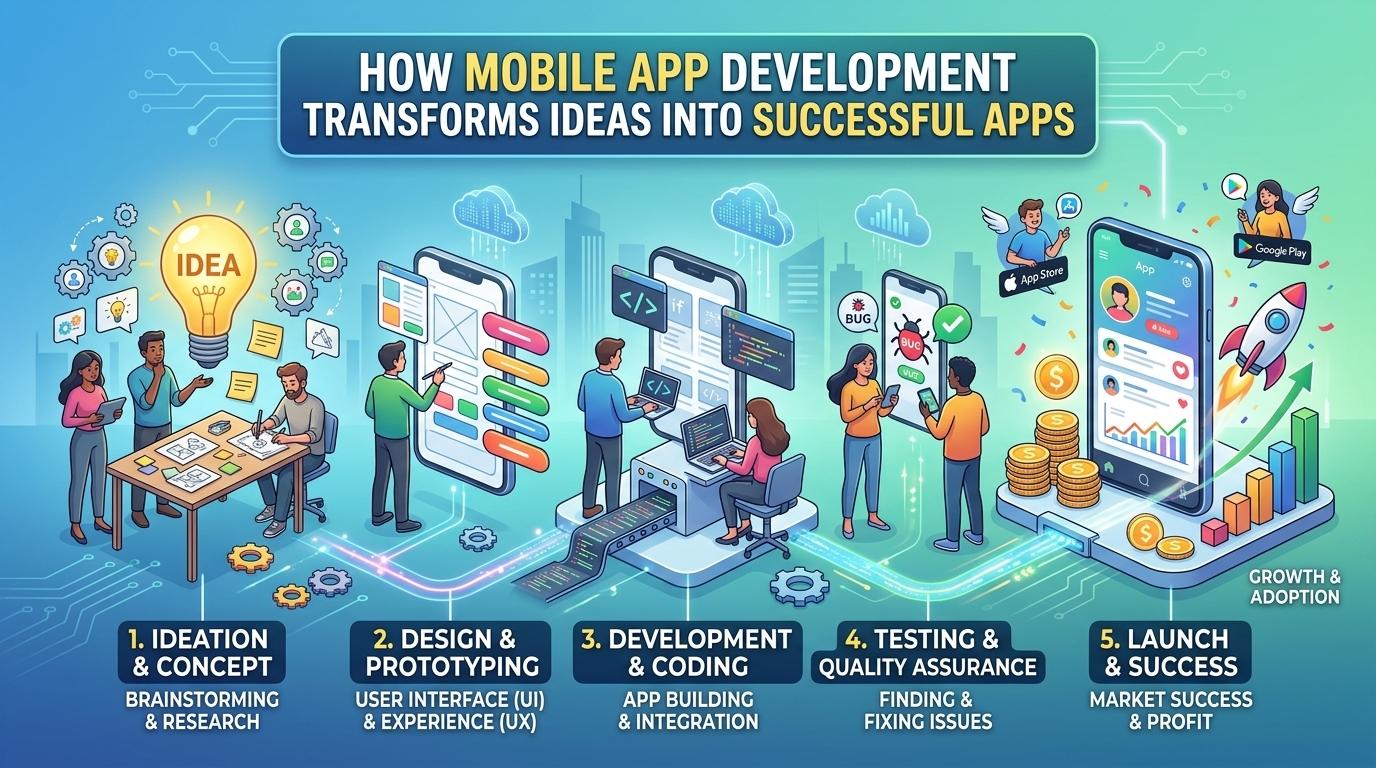
A successful mobile application rarely starts with code. It starts with a clear understanding of the problem, the people who will use the product, and the business outcome it needs to achieve. Turning an early concept into a functional, scalable app requires decisions about features, platforms, user experience, technology, security, and long-term growth.
This is where Mobile App Development Consulting can provide valuable direction. Instead of moving directly from an idea to development, consulting helps businesses evaluate the concept, define product requirements, prioritize features, select appropriate technologies, and create a practical roadmap.
What Is Mobile App Development Consulting?
Mobile App Development Consulting is a strategic service that helps businesses make informed decisions before and during the development of a mobile application.
A consultant examines the product idea from both business and technical perspectives. This can include understanding the target audience, evaluating market opportunities, defining the minimum viable product (MVP), selecting the right platform, planning the technical architecture, and identifying potential development risks.
The goal is not simply to produce a list of technologies. Effective consulting connects business objectives with practical product and technology decisions.
For example, an organization may have an idea for a healthcare, e-commerce, fintech, or on-demand application but be uncertain whether it should begin with native development, cross-platform development, or a progressive web application. A consulting process can evaluate the requirements and help determine an appropriate direction.
Turning an Idea Into a Clear Product Strategy
An initial app idea is often broad. It may describe a problem and several potential features without explaining which functionality is essential for the first release.
Mobile app consulting helps turn that concept into a structured product strategy.
The process can define:
- Target users and their needs
- Core problems the app should solve
- Primary user journeys
- Essential features
- Business objectives
- Platform requirements
- Monetization considerations
- Product milestones
- Long-term development goals
This creates a stronger foundation for design and development. Instead of building every possible feature immediately, businesses can focus resources on functionality that supports the primary purpose of the application.
Validating the App Idea Before Development
Building an application requires time and resources, so validating the concept before development can help identify weaknesses early.
Product discovery may involve competitor research, audience analysis, user interviews, market research, and technical feasibility assessments. These activities can reveal whether the proposed solution addresses a genuine user problem and whether the planned features are realistic.
Validation does not guarantee market success. Its purpose is to replace assumptions with better information before significant development resources are committed.
This can also help identify opportunities to differentiate the product. For example, research may show that competitors offer similar functionality but provide a poor onboarding experience, limited integrations, or inefficient workflows. Those findings can influence the product strategy and feature priorities.
Creating an Effective MVP
A minimum viable product is not simply a smaller version of a complete application. It is a focused release designed to deliver the core value of the product while allowing the business to learn from real users.
Mobile app development consulting can help determine which features belong in the initial release and which can be introduced later.
A practical MVP roadmap might prioritize:
- User registration and authentication
- The application's primary user journey
- Essential content or functionality
- Required payments or integrations
- Basic analytics
- Core administrative capabilities
Nonessential features can be moved to later development phases.
This approach can make the development process more manageable and provide businesses with an opportunity to gather feedback before expanding the product.
Choosing the Right Technology and Platform
Technology decisions can have a long-term impact on an application's performance, maintenance requirements, development speed, and scalability.
Depending on the project, businesses may consider native iOS development, native Android development, cross-platform frameworks such as Flutter or React Native, or alternative approaches such as progressive web applications.
There is no single technology that is appropriate for every product.
The decision should consider factors such as:
- Target platforms
- Required device capabilities
- Performance requirements
- User experience expectations
- Development resources
- Budget
- Integration requirements
- Future scalability
- Maintenance needs
A technology recommendation should therefore be based on product requirements rather than simply following current development trends.
Planning UI/UX Around Real User Needs
An application can have excellent technology and still struggle if users find it difficult to navigate.
UI/UX consulting helps businesses translate product requirements into intuitive user journeys and interfaces. This may involve information architecture, wireframes, prototypes, navigation planning, accessibility considerations, and usability reviews.
The objective is to make important actions clear and reduce unnecessary friction.
For example, an e-commerce application should make product discovery, checkout, payment, and order tracking straightforward. A healthcare application may need to prioritize appointment scheduling, patient information, notifications, and secure access.
Good UX decisions should be connected to how users actually interact with the product rather than focusing only on visual appearance.
Designing a Scalable Technical Architecture
A mobile application is usually connected to more than the interface users see. It may depend on APIs, databases, cloud infrastructure, authentication systems, payment gateways, analytics platforms, third-party services, and administrative tools.
Mobile App Development Consulting can help define how these components should work together.
Technical architecture planning considers areas such as:
- Backend services
- APIs and integrations
- Database structure
- Authentication
- Cloud infrastructure
- Data management
- Security controls
- Scalability
- Application performance
Planning these components early can reduce the likelihood of major architectural changes later.
A scalable architecture does not mean building an unnecessarily complex system from day one. It means making reasonable technical decisions that support the product's current requirements while leaving room for future growth.
Improving Security and Risk Management
Security should be considered throughout the product lifecycle rather than treated as a final testing step.
Consulting can help identify potential risks involving authentication, authorization, sensitive data, third-party integrations, API access, and infrastructure.
The appropriate security approach depends on the application and the information it handles. Applications operating in areas such as healthcare, finance, and ecommerce may also have additional regulatory or compliance considerations.
Early risk assessment allows businesses to identify important requirements before development decisions become difficult or expensive to change.
Creating a Practical Development Roadmap
Once the product strategy, features, technology, UX, and architecture are defined, these decisions can be organized into a development roadmap.
A useful roadmap establishes priorities rather than attempting to predict every detail months in advance.
It can include:
- Discovery and requirements
- UX research and wireframing
- UI design
- Technical setup
- Development milestones
- API and integration work
- Quality assurance
- Beta testing
- Deployment
- Post-launch improvements
The roadmap provides stakeholders and development teams with a shared understanding of what needs to happen and in what order.
Supporting Existing Mobile Applications
Mobile App Development Consulting is not limited to new products.
Businesses with existing applications may need consulting when an app becomes difficult to maintain, experiences performance issues, requires new features, or needs modernization.
An application audit can examine code quality, architecture, performance, user experience, security, integrations, and technical debt.
Based on the findings, the business can determine whether to optimize the existing application, modernize specific components, migrate technologies, or gradually rebuild parts of the product.
This provides a structured way to improve an existing application without automatically replacing everything.
Measuring the Success of a Mobile App
Launching an application is only one stage of the product lifecycle. After release, businesses need reliable information to understand how users interact with it.
Relevant metrics can include:
- User acquisition
- Activation rate
- Retention
- Conversion rate
- Session frequency
- Crash rate
- Feature adoption
- Customer feedback
- App store ratings
The appropriate metrics depend on the product's objectives.
Analytics can reveal where users encounter problems and which features provide the most value. These insights can then influence future product improvements and the mobile app development roadmap.
From Concept to a Successful Digital Product
Transforming an idea into a successful application requires more than development skills. It requires a structured process that connects business goals, user needs, product strategy, technology, and continuous improvement.
Mobile App Development Consulting provides that strategic layer. By validating the idea, defining an MVP, selecting appropriate technologies, planning the user experience, addressing technical risks, and creating a development roadmap, businesses can approach app development with greater clarity.
The strongest mobile products are not necessarily those with the largest number of features. They are products that solve a clear problem, provide a useful experience, perform reliably, and evolve according to real user needs.
A thoughtful consulting process helps establish those foundations before development decisions become difficult to change.

 English
 Arabic
 French
 Portuguese
 Deutsch
 Turkish
 Dutch
Dutch
 Italiano
 Russian
 Romaian
 Portuguese (Brazil)
 Greek
Greek