


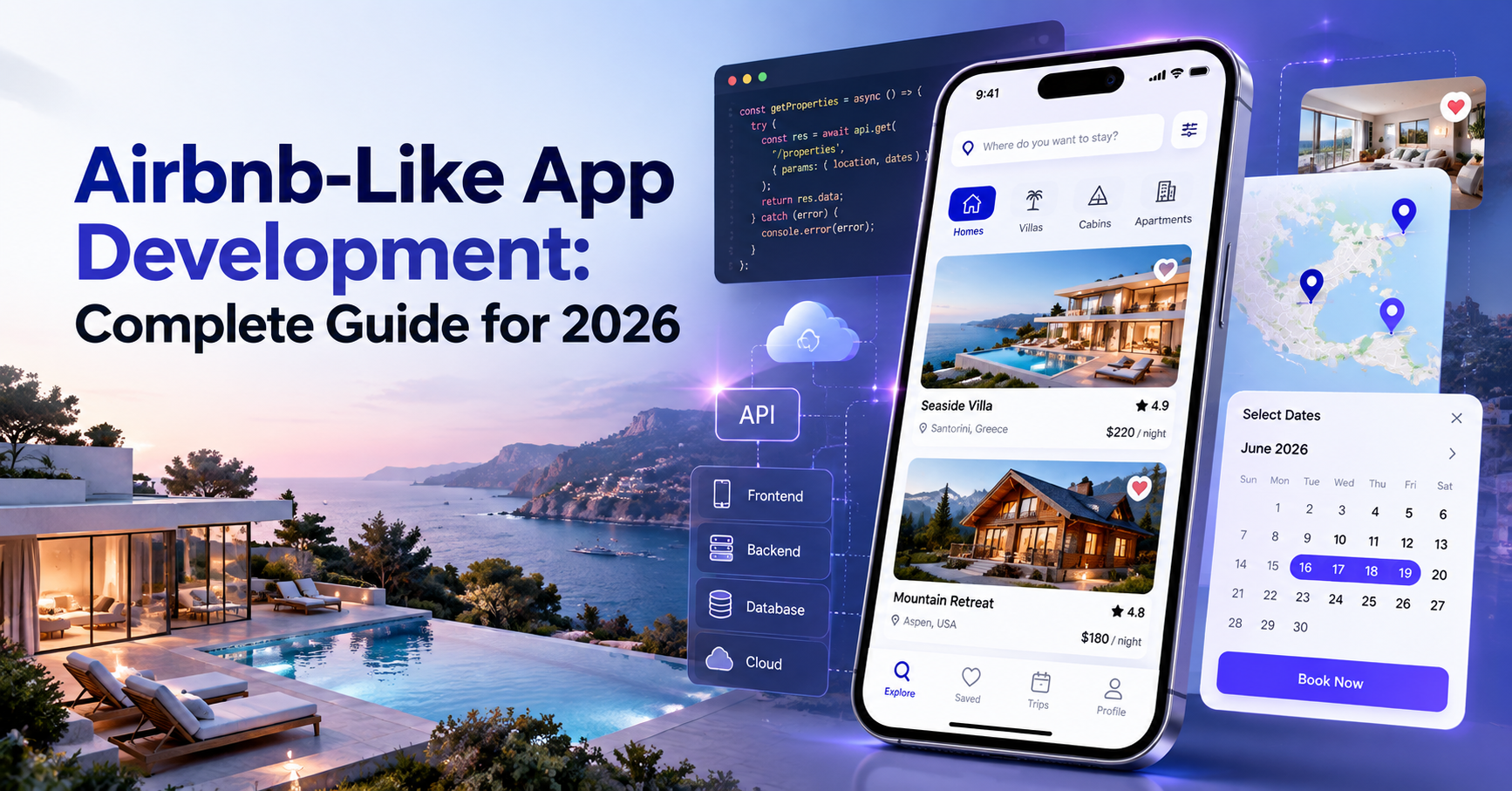
Airbnb-Like App Development: Complete Guide For 2026
The vacation rental and short-term accommodation industry has transformed the way people travel, work remotely, and find places to stay. Platforms like Airbnb have demonstrated how a well-designed marketplace can connect property owners with travellers while creating new opportunities for the hospitality industry.
As demand for flexible accommodation grows, entrepreneurs are increasingly exploring Airbnb-like app development to build their own property-rental marketplaces. Whether you want to create a local vacation rental platform, a niche accommodation marketplace, or a global booking application, understanding the development process is essential.
This complete guide explains everything you need to know about developing an Airbnb-like app in 2026, including features, technology, development costs, monetisation strategies, and the development process.
What Is an Airbnb-Like App?
An Airbnb-like app is an online marketplace that connects property owners or hosts with customers looking for short-term or long-term accommodation.
Unlike a traditional hotel booking application, a rental marketplace generally allows individual property owners to list apartments, houses, villas, rooms, vacation homes, and other accommodation types.
A typical platform has three primary components:
-
Guest app: Allows users to search, compare, book, and review properties.
-
Host app: Enables property owners to list properties, manage availability, communicate with guests, and receive payments.
-
Admin panel: Gives platform administrators control over users, listings, bookings, payments, disputes, commissions, and platform operations.
The combination of these components creates a two-sided marketplace where hosts supply accommodations and guests generate booking demand.
Why Build an Airbnb-Like App in 2026?
The growing preference for personalised travel experiences and flexible accommodation creates opportunities for specialised rental marketplaces.
Instead of competing directly with established global platforms, businesses can focus on specific markets or customer segments. For example, an app could specialise in:
-
Luxury vacation homes
-
Budget-friendly accommodations
-
Business travel
-
Pet-friendly properties
-
Student housing
-
Long-term rentals
-
Remote-work stays
-
Eco-friendly accommodations
-
Regional or destination-specific properties
A focused business model can help a startup differentiate itself through specialised features, pricing, customer service, and property categories.
Essential Features of an Airbnb-Like App
The success of an accommodation marketplace depends heavily on its user experience. The following features are commonly required.
1. User Registration and Profiles
Users should be able to register using email, phone numbers, or supported social login options. Profiles can contain names, profile photos, contact information, preferences, verification details, and booking history.
2. Property Listings
Hosts need an intuitive interface for creating and managing listings. They should be able to upload photographs, add descriptions, specify amenities, set prices, define availability, and provide location information.
3. Advanced Search and Filters
Guests should be able to search accommodations based on:
-
Destination
-
Check-in and check-out dates
-
Number of guests
-
Price range
-
Property type
-
Amenities
-
Ratings
-
Accessibility requirements
Location-based search and map integration can make property discovery considerably easier.
4. Property Details
Each property page should provide comprehensive information, including photographs, descriptions, amenities, pricing, cancellation policies, reviews, host information, and location.
5. Booking System
A reliable booking engine is one of the most important components of the platform. It should handle availability, booking requests, confirmations, cancellations, pricing calculations, and booking history.
6. Secure Payments
The application should integrate trusted payment infrastructure so guests can pay securely while hosts can receive payouts according to the platform's payment rules.
Depending on the target market, multiple currencies and payment methods may also be required.
7. In-App Messaging
A communication system allows hosts and guests to discuss check-in instructions, property details, special requirements, and other booking-related questions.
8. Reviews and Ratings
Reviews help create transparency within the marketplace. Guests can review properties and hosts, while hosts may also be able to review guests depending on the platform's business model.
9. Push Notifications
Notifications can inform users about booking confirmations, payment updates, messages, cancellations, reminders, promotional offers, and other important events.
10. Admin Dashboard
Administrators need centralised control over users, hosts, properties, bookings, payments, reviews, commissions, promotions, complaints, and reports.
Advanced Features to Consider in 2026
Modern rental marketplaces can go beyond basic booking functionality by incorporating emerging technologies and automation.
AI-powered recommendations can analyse user preferences and booking behaviour to suggest relevant properties.
AI-assisted search can allow users to describe what they want in natural language, such as a quiet beachfront property suitable for a family vacation.
Dynamic pricing tools can help hosts adjust prices based on demand, seasonality, local events, and availability.
Digital check-in can streamline guest arrival through smart locks, access codes, and automated instructions where appropriate.
Fraud detection can help identify suspicious accounts, unusual transactions, or potentially fraudulent listings.
These features should be introduced based on actual business requirements rather than adding technology simply for novelty.
Technology Stack for Airbnb-Like App Development
The technology stack depends on the platform's requirements, development budget, scalability goals, and target devices.
A possible stack may include:
-
Frontend: React, Next.js, Flutter, or React Native
-
Backend: Node.js, Python, Java, or similar technologies
-
Database: PostgreSQL, MySQL, MongoDB, or another suitable database
-
Cloud infrastructure: AWS, Google Cloud, Microsoft Azure, or equivalent providers
-
Maps: Google Maps Platform or another mapping provider
-
Payments: Stripe, Adyen, PayPal, or region-specific payment gateways
-
Notifications: Firebase Cloud Messaging or equivalent services
-
Analytics: Product analytics and business intelligence platforms
-
Authentication: Secure OAuth, phone verification, and token-based authentication
The final architecture should be selected according to expected traffic, geographic coverage, integrations, security requirements, and development expertise.
Airbnb-Like App Development Process
Developing a rental marketplace generally involves several stages.
Step 1: Market Research
Identify your target audience, competitors, geographical market, accommodation categories, and unique value proposition.
Step 2: Define the MVP
Start with essential functionality such as registration, property listings, search, booking, payments, messaging, reviews, and administration.
Step 3: UI/UX Design
Create user flows, wireframes, prototypes, and visual designs for guests, hosts, and administrators.
Step 4: Development
Develop the frontend, backend, APIs, database, payment integration, authentication, notifications, and administrative functionality.
Step 5: Testing
Conduct functional, usability, performance, security, compatibility, and payment testing before launch.
Step 6: Deployment
Deploy the application to the appropriate app stores and cloud infrastructure while configuring monitoring, analytics, backups, and security controls.
Step 7: Continuous Improvement
After launch, analyse user behaviour and feedback to identify problems and prioritise new features.
How Much Does Airbnb-Like App Development Cost?
The cost of building an app like Airbnb varies significantly depending on functionality, design complexity, technology, development location, integrations, and platform requirements.
A basic MVP will generally cost considerably less than a full-scale marketplace with advanced AI, sophisticated pricing systems, multilingual functionality, multiple payment gateways, and extensive administrative tools.
Development expenses can be divided into:
-
UI/UX design
-
Mobile and web development
-
Backend development
-
Third-party integrations
-
Cloud infrastructure
-
Quality assurance
-
Security
-
Deployment
-
Maintenance and updates
Instead of focusing only on the initial development price, businesses should also budget for ongoing infrastructure, support, security, marketing, and product improvements.
Monetization Strategies
An Airbnb-like marketplace can generate revenue through several approaches.
Commission model: Charge hosts, guests, or both a percentage of each successful booking.
Service fees: Add transaction or service fees to reservations.
Featured listings: Allow hosts to pay for enhanced visibility.
Subscription plans: Offer premium plans with additional tools or benefits for hosts.
Advertising: Provide relevant promotional opportunities to businesses operating within the travel ecosystem.
The best monetisation strategy depends on the target market and the value provided to both sides of the marketplace.
Security and Compliance
Security should be considered from the beginning of development. The application may process personal information, payment data, identity documents, property details, and private communications.
Important considerations include secure authentication, encryption, access controls, payment security, data protection, fraud prevention, secure APIs, logging, and regular security testing.
Businesses should also identify privacy, consumer protection, tax, payment, short-term rental, and accommodation regulations applicable to every market where the platform operates.
Final Thoughts
Airbnb-like app development in 2026 is not simply about replicating an existing booking platform. The strongest opportunity lies in creating a marketplace designed around a specific audience, location, accommodation category, or customer problem.
Start with a clearly defined MVP, build a reliable booking and payment experience, prioritise trust and security, and use data from real users to guide future development. Advanced capabilities such as AI recommendations, intelligent search, dynamic pricing, and automated workflows can then be introduced as the platform grows.
With the right business model, technology architecture, user experience, and continuous product strategy, an Airbnb-like application can become a scalable digital marketplace in the modern travel and accommodation industry.

 English
 Arabic
 French
 Portuguese
 Deutsch
 Turkish
 Dutch
Dutch
 Italiano
 Russian
 Romaian
 Portuguese (Brazil)
 Greek
Greek