


IGF-1 LR3 1mg: Laboratory Research and Molecular Insights
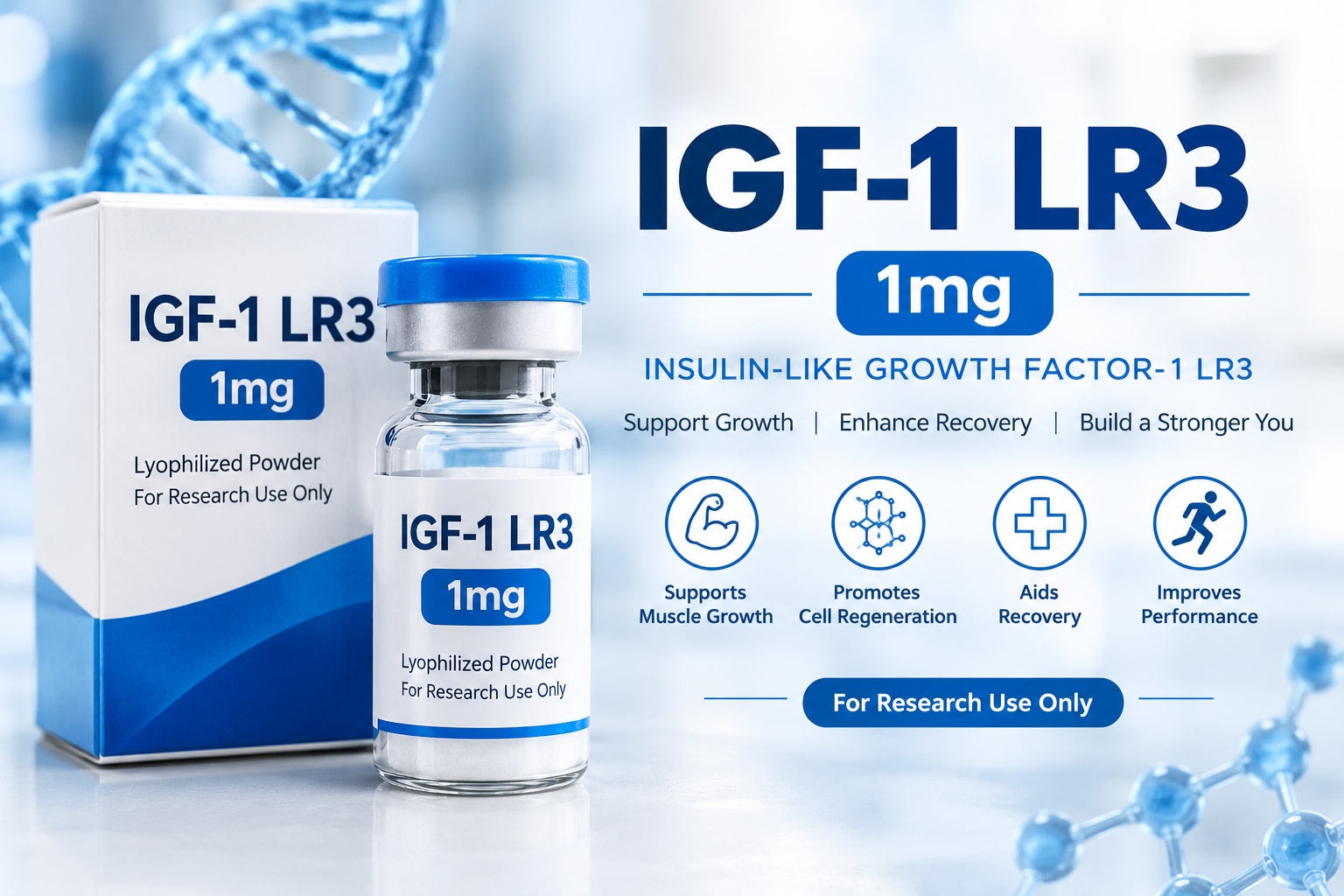
Research involving insulin-like growth factor signaling has become an important area of molecular biology, cellular research, and endocrinology. Within this field, Long R3 IGF-1, commonly abbreviated as LR3 IGF-1, is particularly interesting because structural modifications distinguish it from native IGF-1 and alter its interactions with IGF-binding proteins.
For laboratories, universities, biotechnology groups, and independent research teams in the United States, understanding the molecular characteristics of LR3 IGF-1 is important before designing experiments involving receptor signaling, cell culture, protein characterization, or comparative studies.
This guide examines igf-1 lr3 1mg from a research perspective, including its molecular structure, interaction with binding proteins, receptor activity, analytical considerations, storage concepts, experimental design, and important limitations of the available evidence.
Ageless Vitality Research provides research-oriented materials for laboratory applications and scientific investigation. Research materials should be handled according to appropriate institutional procedures and applicable regulations and are not intended for human consumption.
What Is IGF-1 LR3?
Long R3 IGF-1 is a modified form of insulin-like growth factor-I. The designation “LR3” refers to two important structural characteristics: an N-terminal extension and a substitution involving arginine at position 3. These modifications were developed as tools for studying how the structure of IGF-I affects its interactions with IGF-binding proteins and receptors.
Research published in the Journal of Endocrinology describes LR3 IGF-I as an analogue with substantially reduced affinity for IGF-binding proteins while retaining activity at the IGF-I receptor. This distinction makes LR3 useful for investigating the relationship between ligand structure, binding-protein interactions, and receptor-mediated signaling.
Rather than viewing LR3 IGF-1 simply as another form of IGF-I, researchers can consider it a molecular tool for studying the IGF signaling system. The 1mg quantity is a product amount rather than a statement about biological activity. For laboratory work, the actual experimental significance of a material depends on identity, purity, concentration, formulation, handling, assay conditions, and the specific research model being used.
Understanding the IGF Signaling System
The insulin-like growth factor system is a complex biological network involving IGF-I, IGF-II, IGF receptors, and multiple IGF-binding proteins.
IGF-I receptor signaling is particularly important in studies of cellular growth, differentiation, metabolism, and intracellular signaling. Research models demonstrate that structural differences between IGF-I analogues can change their interaction with binding proteins while preserving receptor-related activity. This makes the system valuable for controlled laboratory comparisons.
For researchers examining growth-factor signaling, it can be useful to evaluate ligand behavior alongside other signaling-related research materials. Ageless Vitality Research's CJC-1295 5mg + Ipamorelin 5mg Blend can be considered separately when designing studies involving secretagogue-related molecular research, although its mechanism and experimental applications differ from those of LR3 IGF-1.
A careful experimental design should avoid treating different research compounds as interchangeable simply because they are associated with growth-factor biology.
Why the “LR3” Modification Matters
One of the most important research characteristics of LR3 IGF-I is its altered relationship with IGF-binding proteins.
Native IGF-I interacts strongly with several binding proteins that influence ligand distribution, availability, and biological activity. LR3 IGF-I was developed partly to investigate what happens when those interactions are substantially reduced.
A published study comparing IGF-I and Long R3 IGF-I in cultured bovine embryos reported that LR3 had dramatically lower affinity for IGF-binding proteins. The researchers also observed different effects on IGF-related gene expression and embryo development depending on the ligand used.
This provides an important research lesson: changing ligand structure can affect more than one biological parameter.
Researchers should therefore evaluate LR3 IGF-I based on the particular experimental question rather than assuming that results obtained with native IGF-I will automatically apply to LR3.
Molecular Structure of Long R3 IGF-1
Molecular structure is central to understanding why LR3 IGF-I behaves differently from native IGF-I.
Structural research using nuclear magnetic resonance methods has examined Long-[Arg3]IGF-I and identified conformational characteristics within its extended structure. The study deposited structural information for Long R3 IGF-I in the Protein Data Bank under accession 3LRI.
For laboratory scientists, structural information can be useful when considering:
-
Protein folding
-
Conformational stability
-
Receptor interactions
-
Binding-protein interactions
-
Analytical identification
-
Comparative ligand studies
-
Structure-function relationships
A molecular modification may appear relatively small when described chemically, yet it can produce meaningful changes in how a protein interacts with its biological environment.
This is one reason analytical verification is valuable when working with modified research proteins.
IGF-1 Receptor Activity
The IGF-I receptor, commonly abbreviated IGF-IR, is a major component of the IGF signaling pathway.
Research involving Long R3 IGF-I has demonstrated that the modified molecule can activate IGF-I receptors in experimental systems. A cell-culture study using HEK293 cells reported activation of both IGF-I and insulin receptors in response to Long R3 IGF-I, with stronger receptor activation at lower concentrations compared with certain comparison treatments in that experimental model.
These findings are useful for understanding receptor pharmacology, but they should not be interpreted as universal outcomes across every cell type.
Cell-line characteristics, receptor expression, culture conditions, ligand concentration, exposure duration, and assay methodology can all influence observed signaling.
Consequently, researchers should document experimental conditions carefully when comparing LR3 IGF-I with native IGF-I or other IGF-related molecules.
IGF-1 LR3 1mg for Laboratory Research
When evaluating an igf-1 lr3 1mg research material, the stated quantity should be considered only one component of quality assessment.
A laboratory evaluation may involve several categories of information:
Identity
Researchers should establish whether the material corresponds to the intended molecular entity.
Depending on the laboratory setup, identity assessment may involve mass spectrometry or other appropriate analytical techniques.
Purity
Purity testing helps determine the proportion of the intended material relative to detectable impurities.
High-purity material can be particularly important in experiments where unintended components could influence results.
Concentration
The stated amount and measured concentration should be distinguishable concepts.
A 1mg vial describes the amount supplied. Experimental concentration depends on how the material is prepared for a specific laboratory assay.
Documentation
Batch-specific documentation can provide researchers with information relevant to material traceability and analytical evaluation.
Storage History
Temperature exposure, repeated handling, moisture, and inappropriate storage conditions may affect laboratory materials. Researchers should follow the supplier's documentation and their own institutional procedures for storage and handling.
Analytical Evaluation of IGF-1 LR3
Analytical characterization is an important part of responsible laboratory research. Different analytical methods answer different questions. No single test necessarily provides every piece of information needed to characterize a research material.

Mass Spectrometry
Mass spectrometry can provide molecular-mass information and support identity confirmation. For a modified protein such as Long R3 IGF-I, mass-based analysis can be particularly useful because the expected molecular characteristics can be compared against analytical results.
Chromatographic Analysis
Chromatographic methods can help researchers examine purity and identify additional peaks associated with impurities, degradation products, or other components.
Immunological Methods
Depending on the research objective, immunoassays can provide another method of detection. Published work has described an ELISA approach capable of distinguishing LR3IGF-I from endogenous IGF-I and IGF-II in experimental plasma samples.
Combined Testing
For research-quality evaluation, combining complementary analytical approaches can provide a more informative picture than relying on one measurement alone. Researchers should consider identity, purity, concentration, and stability as related but separate analytical questions.
Research Applications of IGF-1 LR3
Long R3 IGF-I has been investigated in several experimental contexts.
Cell Culture Research
Cell culture systems can be used to examine receptor activation, intracellular signaling, cellular proliferation, differentiation, and other molecular responses. A published HEK293 study specifically investigated Long R3 IGF-I as a signaling molecule in serum-free culture and examined its effects on IGF-I and insulin receptor activation. Such studies can help researchers investigate receptor biology under controlled conditions.
Binding-Protein Research
The reduced affinity of LR3 IGF-I for IGF-binding proteins makes it useful in experiments designed to examine the functional role of those proteins. Comparing native IGF-I with LR3 IGF-I can help researchers explore whether a particular observed response depends on ligand availability or binding-protein interactions.
Developmental Biology
Experimental research has also investigated LR3 IGF-I in embryo culture systems. For example, a bovine embryo study compared recombinant IGF-I with Long R3 IGF-I and found differences in developmental parameters and expression of IGF-system components. These results are specific to the experimental model and should not be generalized automatically to other biological systems.
Comparative Receptor Research
LR3 IGF-I can also be useful in comparative experiments examining IGF-I receptor behavior. Researchers can compare ligand concentration, receptor activation, downstream signaling, and cellular responses across carefully controlled conditions.
IGF-1 LR3 Versus Native IGF-1
The distinction between native IGF-I and LR3 IGF-I is especially important for experimental design. Native IGF-I naturally interacts with several IGF-binding proteins. LR3 IGF-I has substantially reduced affinity for these binding proteins. This difference can change the experimental environment surrounding receptor activation.
A historical research study comparing several IGF-I analogues found that structural modifications affecting IGF-binding protein affinity were associated with differences in biological potency across experimental systems. Another study examining Long R3 IGF-I in guinea pigs reported changes in organ weights and circulating IGF-related measurements, while overall growth was not stimulated. These findings reinforce an important principle: biological activity is model-dependent.A result observed in one animal or cellular model should not automatically be interpreted as a predictable outcome in another.
Designing a Research Study With LR3 IGF-I
A strong experimental design begins with a clearly defined research question. For example, a laboratory may be investigating:
-
Receptor activation
-
Ligand-binding behavior
-
Binding-protein interactions
-
Cellular signaling
-
Protein stability
-
Comparative molecular activity
-
Concentration-response relationships
-
Structure-function relationships
The experimental design should then define appropriate controls and measurable endpoints. A vehicle control, native IGF-I comparison, and LR3 IGF-I experimental condition may be appropriate in some study designs, depending on the research question. Researchers should also consider biological replicates, technical replicates, assay sensitivity, exposure conditions, and statistical methodology.
Concentration and Experimental Variables
This article intentionally does not provide a human-use dosing protocol. For laboratory research, concentration should be determined from the scientific question, validated experimental system, relevant literature, and institutional methodology.
Researchers should distinguish among:
-
Amount of material supplied
-
Reconstituted concentration
-
Experimental concentration
-
Exposure duration
-
Cellular or model-system response
Confusing these variables can make otherwise well-designed experiments difficult to interpret. Published studies have demonstrated that LR3 IGF-I responses can vary considerably according to the experimental model and administration method. For example, research in pigs reported effects on circulating IGF-related markers and growth characteristics that differed from findings in other animal models. Such differences demonstrate why experimental context matters.
IGF-1 LR3 and Receptor Signaling Research
Receptor signaling is one of the most scientifically interesting areas associated with LR3 IGF-I.
When a ligand interacts with a receptor, downstream pathways can produce measurable molecular responses. Researchers may examine these pathways using methods such as:
-
Western blotting
-
Phosphorylation assays
-
Immunoassays
-
Gene-expression analysis
-
Reporter assays
-
Cell proliferation assays
-
Receptor-binding experiments
The appropriate method depends on the research question.
Researchers studying broader metabolic signaling may also investigate other molecular systems independently. For example, Ageless Vitality Research lists MOTS-c as another research material with a distinct molecular background. Comparing unrelated molecules should be based on experimentally defined endpoints rather than broad claims about biological similarity.
Relationship Between IGF Signaling and Other Research Areas
The IGF system intersects with numerous areas of molecular and cellular biology.
These include:
-
Cellular proliferation
-
Protein synthesis
-
Metabolic regulation
-
Differentiation
-
Tissue development
-
Receptor signaling
-
Gene expression
-
Growth-factor biology
Because these systems are interconnected, researchers should be cautious when interpreting individual experimental measurements. For example, a change in receptor phosphorylation does not necessarily establish a long-term cellular outcome. Likewise, a change in gene expression does not automatically establish a functional physiological effect. Good research separates observed measurements from broader interpretations.
Quality Considerations When Selecting a Research Material
Researchers evaluating an IGF-1 LR3 material may consider several quality indicators.
Clear Molecular Identification
The material should be clearly identified so the laboratory knows what molecule is being evaluated.
Batch Traceability
Batch information can make it easier to associate analytical results with a particular material.
Analytical Documentation
Documentation can help researchers evaluate available identity and purity information.
Appropriate Packaging
Protein-based research materials require appropriate handling and packaging to help maintain material integrity.
Supplier Transparency
A transparent supplier should clearly distinguish laboratory research materials from products intended for human or veterinary use. Ageless Vitality Research maintains a research-oriented catalog designed around laboratory applications and scientific investigation.
Storage and Handling Considerations
Researchers should follow the product-specific documentation supplied with their material as well as applicable laboratory procedures. Protein stability can be affected by environmental conditions including temperature, moisture, repeated handling, and formulation. Laboratories should establish documented procedures for:
-
Receiving materials
-
Labeling
-
Inventory tracking
-
Storage
-
Sample preparation
-
Experimental use
-
Disposal
Appropriate laboratory practices also help preserve reproducibility between experiments.
Comparing IGF-1 LR3 With Other Research Materials
Comparisons between research materials should focus on molecular structure and experimental purpose rather than marketing terminology. For example, Tesamorelin 10mg is associated with a different molecular mechanism from LR3 IGF-I. It therefore should not be treated as a direct substitute in an experimental protocol. Likewise, GLP1-S represents a different research area and should be evaluated according to its own molecular characteristics.
The same principle applies to Semax 10mg and Selank 10mg, which involve different research questions and biological systems. A meaningful comparison should specify the endpoint being measured.
What Does 1mg Actually Tell a Researcher?
The “1mg” designation tells a researcher the nominal quantity supplied.
It does not by itself establish:
-
Molecular purity
-
Structural integrity
-
Biological activity
-
Stability
-
Experimental concentration
-
Receptor potency
-
Suitability for a particular assay
These properties require additional information or testing. For that reason, researchers should consider the complete analytical profile rather than selecting a material solely based on quantity.
Why Research Documentation Matters
Reproducibility is a fundamental principle of scientific research. When a laboratory repeats an experiment, researchers should be able to identify important variables associated with the original study.
Documentation can include:
-
Product identification
-
Batch or lot information
-
Quantity
-
Analytical results
-
Storage conditions
-
Experimental date
-
Preparation method
-
Assay conditions
-
Instrument settings where applicable
A clear documentation process reduces ambiguity and helps researchers investigate unexpected experimental results.
Limitations of Current Evidence
Research involving LR3 IGF-I spans cell culture, animal models, analytical studies, and molecular investigations. However, evidence from one experimental system cannot automatically be transferred to another. For example, research in rodents, pigs, guinea pigs, bovine embryos, or cultured human-derived cells may produce different outcomes because each system has different receptor expression, metabolism, binding proteins, physiology, and experimental conditions. A study involving Long R3 IGF-I in cultured cells therefore should not be presented as proof of a particular human outcome. The available literature is most useful when interpreted according to the model, experimental conditions, endpoints, and limitations reported by the investigators.
Research Safety and Responsible Use
IGF-related research materials should be treated as laboratory materials and handled by appropriately trained personnel. Ageless Vitality Research materials are intended for laboratory and research use and are not intended for human consumption.
Researchers should follow institutional safety requirements, applicable federal and state regulations, laboratory standard operating procedures, and appropriate waste-disposal practices. Human or veterinary administration should not be inferred from laboratory research literature.
Conclusion
IGF-1 LR3 represents an important research tool for investigating the relationship between molecular structure, IGF-binding proteins, and receptor signaling.
Its distinguishing characteristics make it particularly interesting for controlled studies examining ligand-receptor interactions and the influence of binding proteins on experimental responses. Published research has demonstrated that Long R3 IGF-I can behave differently from native IGF-I across cellular, developmental, and animal models, emphasizing the importance of experimental context.
For laboratories evaluating igf-1 lr3 1mg, the most useful approach is to look beyond the stated quantity and consider identity, analytical documentation, purity, storage, traceability, and suitability for the intended research application.
Ageless Vitality Research supports a research-focused approach in which laboratory materials are evaluated according to documented molecular characteristics and appropriate scientific methodology. Researchers should rely on validated experimental procedures, primary literature, institutional requirements, and applicable regulations when planning studies involving IGF-related research materials.
Frequently Asked Questions
What is IGF-1 LR3?
IGF-1 LR3, or Long R3 IGF-I, is a structurally modified form of IGF-I used in scientific research. Its modifications reduce its affinity for several IGF-binding proteins while retaining activity at the IGF-I receptor in experimental systems.
What does IGF-1 LR3 1mg mean?
The 1mg designation refers to the nominal quantity of research material supplied. It does not describe an experimental concentration or establish biological activity.
Why is LR3 different from native IGF-I?
LR3 IGF-I contains structural modifications that substantially reduce its interaction with IGF-binding proteins. This property makes it useful for studying the relationship between binding proteins and receptor-mediated IGF signaling.
Can LR3 IGF-I activate the IGF-I receptor?
Experimental studies have reported IGF-I receptor activation by Long R3 IGF-I in cultured cells. The magnitude of the response depends on the experimental model and conditions.
Is IGF-1 LR3 the same as IGF-I?
No. LR3 IGF-I is a modified analogue of IGF-I with structural differences that affect its interaction with IGF-binding proteins and experimental behavior.
What research can use LR3 IGF-I?
Published research has examined LR3 IGF-I in cell culture, receptor signaling, binding-protein studies, developmental biology, and animal research.
Does 1mg indicate potency?
No. Quantity and potency are separate characteristics. Potency must be evaluated using appropriate analytical or biological testing.
How should researchers evaluate the quality of IGF-1 LR3?
Researchers can consider molecular identity, purity, analytical documentation, batch traceability, storage history, and the suitability of the material for the intended research model.
Is there a standard laboratory protocol for LR3 IGF-I?
There is no single protocol suitable for every research application. Experimental concentration, assay design, exposure conditions, and controls should be established according to the specific scientific question and validated laboratory methodology.
Can results from animal studies be applied directly to humans?
No. Animal and cell-culture studies provide experimental evidence within defined models. Their results should not automatically be interpreted as evidence of human effects.
Where can researchers learn more about the molecular structure?
Structural literature and databases such as the Protein Data Bank provide useful resources. A published NMR study of Long-[Arg3]IGF-I reports structural information associated with PDB entry 3LRI.
Is IGF-1 LR3 intended for human consumption?
No. Research materials from Ageless Vitality Research are intended for laboratory and research use and are not intended for human consumption.

 English
 Arabic
 French
 Spanish
 Portuguese
 Turkish
 Dutch
Dutch
 Italiano
 Russian
 Romaian
 Portuguese (Brazil)
 Greek
Greek