


Radiation Hardened Feedback Sensors Market Outlook, Opportunities and Key Players
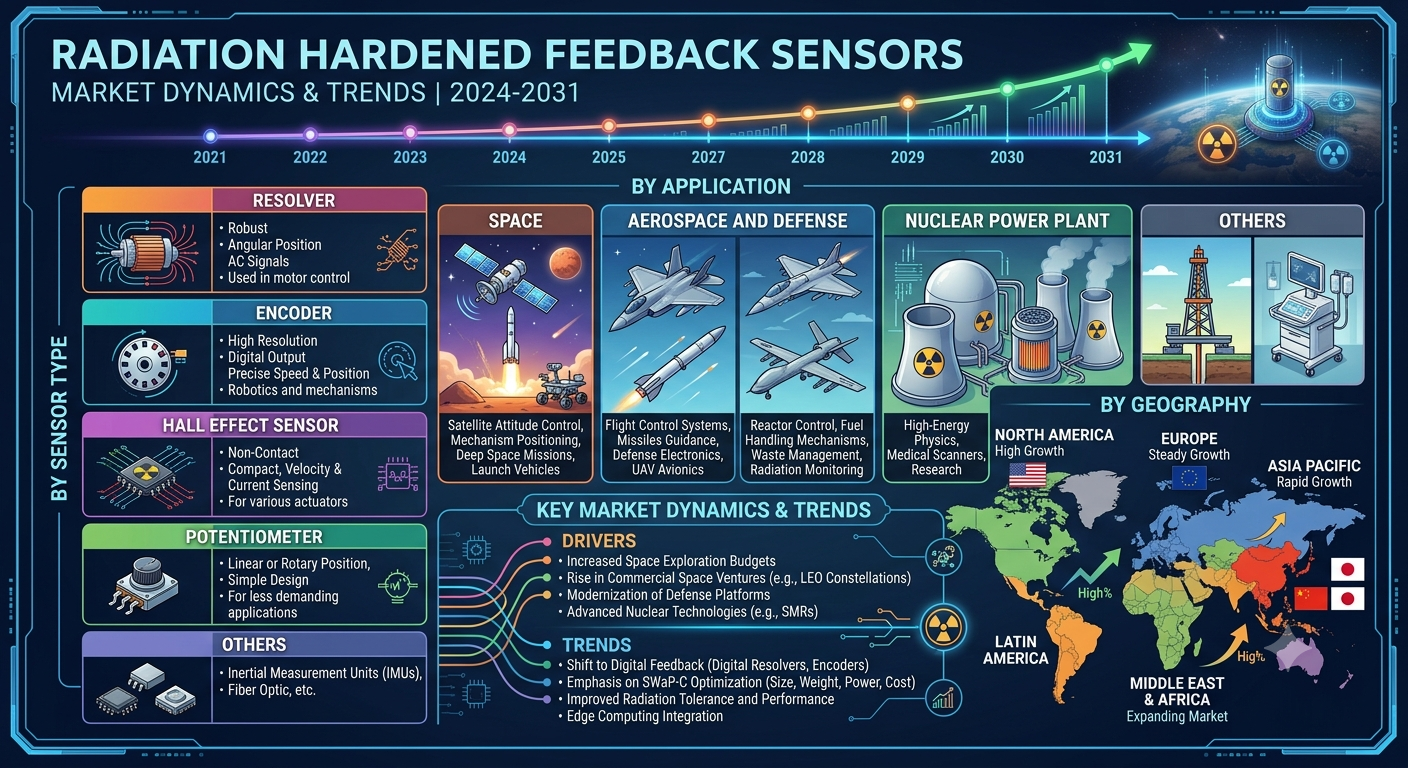
The growing adoption of sophisticated spacecraft and defense electronics is driving the need for feedback sensors capable of operating under challenging radiation conditions. These sensors provide critical measurements related to position, velocity, rotation, and movement, enabling precise control of aerospace equipment. Radiation-hardened solutions help improve the resilience of sensing systems against radiation-related disruptions, making them increasingly relevant for satellites, spacecraft, launch vehicles, and other mission-critical applications.
The Radiation Hardened Feedback Sensors Market Size was valued at US$133.80 million in 2023 and is projected to reach US$189.37 million by 2031, registering a CAGR of 4.4% during 2023–2031. The addressable market is estimated at US$1,305.60 million for 2024–2031. Increasing investments in space exploration, satellite communications, defense electronics, and radiation-tolerant systems are among the key factors supporting demand for advanced feedback sensing solutions.
Download Sample PDF Link:https://www.theinsightpartners.com/sample/TIPRE00039084
Radiation Exposure and Reliability Requirements
One of the major drivers of the radiation hardened feedback sensors industry is the growing requirement for dependable electronic components in high-radiation environments. Satellites and spacecraft can encounter various forms of radiation during operation, particularly beyond the protection provided by Earth's atmosphere and magnetic field. Exposure can affect electronic circuits and sensing systems, creating the need for components designed to withstand radiation while maintaining functional accuracy.
Feedback sensors are used in control systems where precise information regarding position, rotation, velocity, or movement is essential. In aerospace applications, sensor failure can affect the performance of actuators, motors, robotic mechanisms, antenna positioning systems, and other mission-critical equipment. Consequently, system designers increasingly consider radiation tolerance as an important parameter when selecting sensing technologies for spaceborne and defense applications.
Growing Investments in Space and Satellite Infrastructure
The expansion of satellite infrastructure is another important driver. Governments, space agencies, and private companies are investing in satellite communications, Earth observation, navigation, scientific missions, and deep-space exploration. These applications require electronic components capable of operating reliably for extended periods with limited opportunities for maintenance or replacement.
The increasing number of commercial and government space missions is encouraging the development of more sophisticated spacecraft architectures. As these systems incorporate higher levels of automation, precision control, and electromechanical functionality, the requirement for reliable feedback sensors is also increasing. Radiation-hardened sensing solutions can support the operational requirements of motors, actuators, robotic systems, and other moving components used in spacecraft.
Defense and Mission-Critical Applications
Defense electronics represent another significant growth area. Military aircraft, missiles, spacecraft, unmanned systems, and other advanced platforms require sensing components capable of delivering consistent feedback under demanding operating conditions. Radiation-hardened technologies can be particularly relevant in systems exposed to elevated radiation levels or designed for operation in challenging environments.
The increasing emphasis on autonomous operation and precision control is also encouraging the integration of advanced sensing technologies into defense platforms. Feedback sensors can provide essential information for closed-loop control systems, helping equipment maintain accurate movement and positioning. This creates opportunities for manufacturers offering robust sensors with enhanced radiation tolerance and long-term reliability.
Technological Development in Radiation-Hardened Electronics
Technological advancements are contributing to the development of smaller, more reliable, and more capable radiation-hardened components. Sensor manufacturers are focusing on improving durability, signal accuracy, operating stability, and integration capabilities while addressing the demanding requirements of aerospace and defense applications.
The development of advanced semiconductor technologies and radiation-tolerant electronic architectures is supporting the integration of sensing and control functions into increasingly sophisticated systems. Improvements in sensor design can help system manufacturers address constraints related to size, weight, power consumption, and reliability, which are particularly important in spacecraft and other mission-critical platforms.
Top Players
Key companies operating in or associated with the radiation hardened feedback sensors landscape include Honeywell International Inc., TE Connectivity Ltd., Texas Instruments Incorporated, Analog Devices, Inc., Renishaw plc, Heidenhain GmbH, Sensata Technologies Holding plc, Novanta Inc., Vishay Intertechnology, Inc., and Curtiss-Wright Corporation. These companies focus on sensor technologies, position measurement, electronic components, motion-control solutions, and high-reliability products serving aerospace, defense, industrial, and other demanding applications.
Future Outlook
The future outlook for radiation hardened feedback sensors is closely connected with continued investments in space exploration, satellite infrastructure, defense modernization, and high-reliability electronic systems. The expansion of commercial space activities is expected to create additional opportunities for components that can support long-duration missions and demanding operating environments.
Growing interest in autonomous spacecraft, advanced robotics, satellite servicing, precision actuation, and next-generation defense platforms may further increase the need for accurate and reliable feedback technologies. At the same time, manufacturers are expected to continue improving radiation tolerance, miniaturization, integration, and energy efficiency. These developments can strengthen the role of radiation hardened feedback sensors in future mission-critical control architectures.
About The Insight Partners
The Insight Partners is a global market research and consulting firm providing actionable intelligence across technology, healthcare, semiconductors and electronics, aerospace and defense, energy, chemicals, and other industries. Its research supports organizations in understanding industry trends, emerging opportunities, competitive developments, and technology-driven changes.
Contact Us
The Insight Partners
Email: [email protected]
Phone: +1-646-491-9876
Website: https://www.theinsightpartners.com
Related Reports -
Submarine Fiber Cable Market Demand, Share & Growth by 2034
Automotive HVAC Market Size, Growth & Trends by 2034
Offshore Wind Cable Market Size, Growth & Trends by 2034

 English
 Arabic
 French
 Portuguese
 Deutsch
 Turkish
 Dutch
Dutch
 Italiano
 Russian
 Romaian
 Portuguese (Brazil)
 Greek
Greek