


Industrial Wireless Control Switches Market: Advancing Flexible Industrial Control Systems
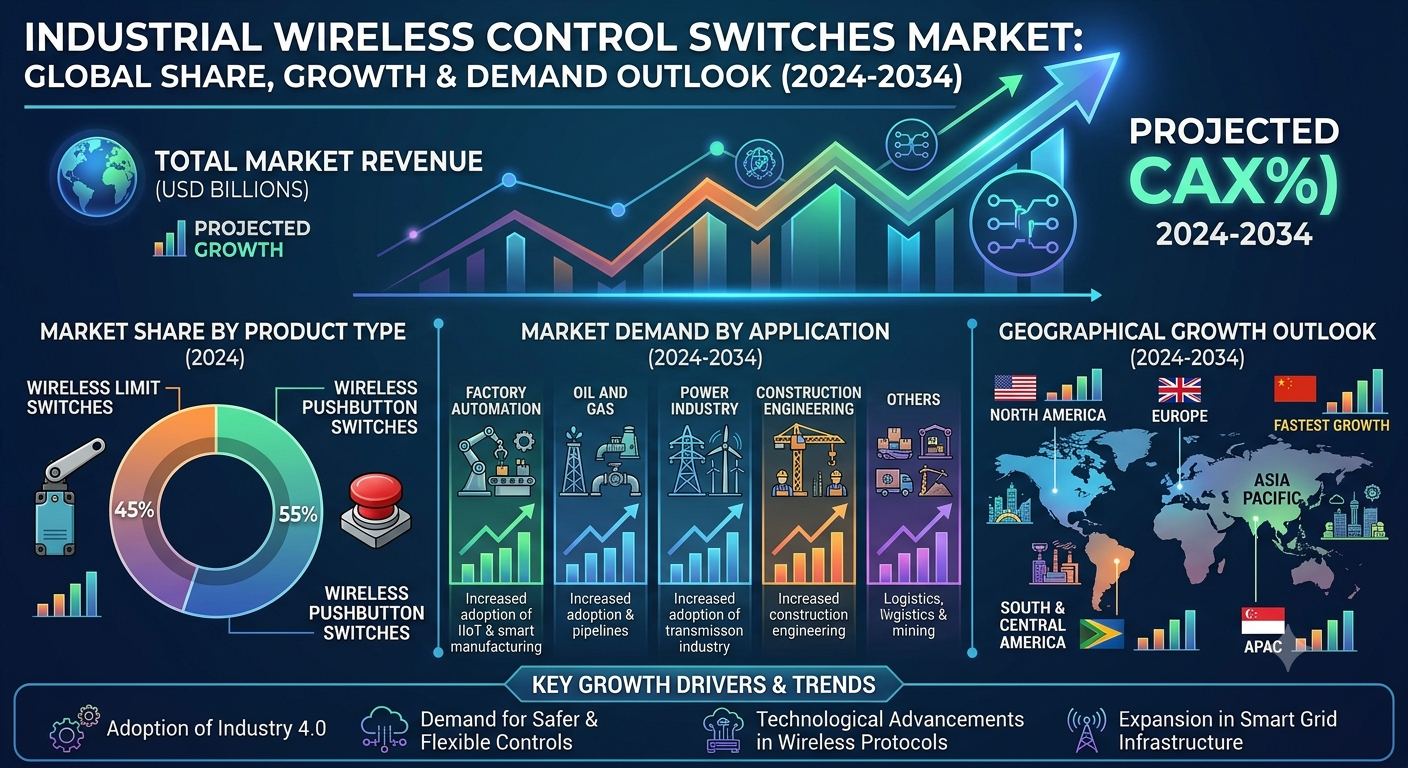
Rising investments in industrial automation are encouraging companies to adopt wireless switching technologies for machinery and equipment control. Wireless control switches offer greater installation flexibility and can support remote operation without requiring extensive physical wiring. Their suitability for challenging installation locations, mobile equipment, and changing production environments is driving interest across manufacturing, power generation, oil and gas, and construction applications.
The global Industrial Wireless Control Switches Market Size is projected to increase from US$220.75 million in 2025 to US$329.14 million by 2034, registering a CAGR of 4.54% during 2026–2034. The expansion is supported by industrial automation, the transition toward flexible wireless architectures, increasing emphasis on operational safety, and demand for connected control solutions. The addressable market is estimated at approximately US$2,496.93 million during 2026–2034, highlighting opportunities for manufacturers and technology providers.
Download Sample PDF: https://www.theinsightpartners.com/sample/TIPRE00020419
Industrial Automation and Wireless Connectivity Drive Adoption
The increasing deployment of factory automation is a major driver for industrial wireless control switches. Manufacturers are modernizing production facilities with automated machinery, connected equipment, remote monitoring systems, and smart manufacturing platforms. Wireless switches provide a flexible interface for controlling machines and equipment where conventional wired connections can create installation challenges. They can be particularly useful in applications involving mobile machinery, rotating equipment, difficult-to-access locations, or production environments that require frequent layout changes.
The growing integration of industrial Internet of Things technologies is further supporting demand. Wireless control switches can operate as part of interconnected automation architectures, working alongside sensors, indicators, gateways, remote I/O systems, and control platforms. Advances in low-power radio technology, battery management, industrial enclosures, and wireless communication are improving the practicality of these solutions for industrial environments.
Reduced Installation Complexity and Operational Flexibility
Traditional wired control systems often require extensive cabling, conduits, connectors, and installation labor. In large industrial facilities, wiring can increase installation time and make future equipment relocation or production-line modifications more complicated. Wireless control switches provide an alternative that can reduce physical infrastructure requirements and improve flexibility.
This advantage is particularly relevant to construction engineering, material-handling equipment, and manufacturing environments where machines may be relocated or reconfigured. Wireless solutions can also help address applications where installing cables is technically difficult or where machinery is exposed to continuous movement and mechanical stress. As manufacturers seek scalable automation architectures, wireless control interfaces are becoming an important component of flexible industrial equipment designs.
Safety and Remote Equipment Control
Safety and operator accessibility represent another important growth driver. Industrial facilities often require control points to be positioned at convenient or safer locations away from machinery. Wireless switches can facilitate remote operation, allowing operators to control equipment without remaining immediately adjacent to moving machinery or other operational hazards.
Demand is also supported by applications in oil and gas, power infrastructure, and other demanding industrial environments. Product design increasingly emphasizes reliable wireless communication, durable housings, battery performance, coverage, and compatibility with existing automation systems. These characteristics are important for maintaining dependable operation in environments where equipment reliability and control responsiveness are critical.
Growth Opportunities Across Key Applications
The industry is segmented by product type into wireless limit switches and wireless pushbutton switches. Wireless limit switches support machine-positioning and equipment-status applications, while wireless pushbutton switches provide flexible operator interfaces for machinery and industrial systems. The report further evaluates applications across the power industry, oil and gas, factory automation, and construction engineering.
Factory automation represents an important opportunity as manufacturers expand connected production systems and pursue greater operational flexibility. Oil and gas facilities can benefit from wireless control solutions where physical cabling presents installation or maintenance challenges. Power infrastructure and construction engineering can similarly use wireless switches for remote equipment control and applications involving mobile machinery.
Competitive Landscape and Top Players
The competitive landscape includes established automation companies as well as specialized wireless-control technology providers. Key companies profiled in the report include Banner Engineering Corp, EPG Companies Inc, Georg Schlegel GmbH and Co. KG, Honeywell International Inc, Humanistic Robotics Inc, Kar-Tech Inc, OMRON Corp, Schneider Electric, steute Technologies GmbH and Co. KG, and ZF Friedrichshafen.
Competition is increasingly focused on wireless reliability, integration with industrial automation ecosystems, product durability, application-specific functionality, and ease of deployment. Established automation suppliers can leverage existing relationships with machine manufacturers and industrial customers, while specialized companies can differentiate through application-focused wireless control solutions.
Future Outlook
The future outlook remains centered on the continued modernization of industrial control architectures and increasing adoption of connected automation technologies. Manufacturers are expected to seek control solutions that offer greater installation flexibility, support mobile equipment, and integrate efficiently with sensors, remote I/O, gateways, and broader automation platforms. Enhanced wireless security, improved battery management, robust industrial designs, and greater interoperability are also expected to influence product development.
Opportunities are likely to extend across smart factories, energy infrastructure, construction equipment, and demanding industrial environments. The combination of automation modernization, remote-control requirements, and demand for adaptable equipment architectures is expected to support sustained adoption through 2034.
About The Insight Partners
The Insight Partners is a global market research and consulting firm providing reliable and actionable insights across technology, healthcare, chemicals and materials, semiconductor and electronics, energy and power, manufacturing, and other industries. Its research combines proprietary analysis with industry databases, company reports, government publications, investor presentations, and expert interviews to support strategic business decisions.
Contact Us
The Insight Partners
Email: [email protected]
Phone: +1-646-491-9876
Website: https://www.theinsightpartners.com
Related Reports -
Submarine Fiber Cable Market Demand, Share & Growth by 2034
Automotive HVAC Market Size, Growth & Trends by 2034
Offshore Wind Cable Market Size, Growth & Trends by 2034

 English
 Arabic
 French
 Spanish
 Portuguese
 Deutsch
 Turkish
 Dutch
Dutch
 Italiano
 Russian
 Portuguese (Brazil)
 Greek
Greek