


7 Ways CRM Software Can Improve Real Estate Sales
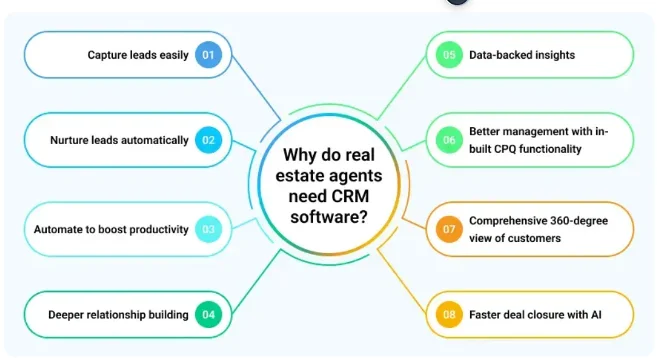
The real estate industry is highly competitive, and managing leads effectively can make a major difference to business growth. Real estate agents deal with a constant flow of inquiries from property buyers, sellers, investors, and tenants. Without an organized system, it can become difficult to track conversations, follow up with prospects, manage property information, and convert leads into customers.
This is where CRM software for real estate agents becomes valuable. A real estate CRM brings lead management, communication, follow-ups, sales activities, and customer information into one centralized platform. Instead of relying on spreadsheets, notebooks, emails, or multiple disconnected tools, agents can manage their entire sales pipeline more efficiently.
1. Centralized Lead Management
Real estate agents receive leads from numerous sources, including websites, property portals, social media, advertisements, referrals, and phone calls. Managing these leads manually can quickly become complicated.
A CRM allows agents to store and organize lead information in one place. Details such as the prospect's name, contact information, property preferences, budget, location, source, and communication history can be recorded and accessed whenever required.
With centralized lead management, agents can reduce the chances of losing important prospects and ensure that every inquiry receives appropriate attention.
2. Faster Lead Follow-Ups
Follow-up is one of the most important activities in real estate sales. A potential buyer may not be ready to make a decision during the first conversation. Regular and timely communication can help agents maintain relationships until the prospect is ready to move forward.
Real estate CRM software can help agents schedule follow-up reminders, organize tasks, and track previous conversations. Instead of manually remembering when to contact every prospect, agents can use automated reminders and workflows.
This makes the follow-up process more consistent and helps sales teams stay engaged with potential customers.
3. Better Organization of Property Buyers
Every real estate lead has different requirements. Some buyers may be looking for apartments, while others may be interested in villas, commercial properties, plots, or investment opportunities.
A CRM enables agents to record these preferences and segment leads according to factors such as:
- Property type
- Preferred location
- Budget
- Buying timeline
- Investment requirements
- Financing status
- Lead source
This information allows agents to understand prospects better and present properties that are more relevant to their requirements.
4. Improved Sales Pipeline Visibility
A real estate sales process often involves several stages, from initial inquiry to property visits, negotiations, documentation, and final booking.
Without a structured system, agents may find it difficult to understand which prospects are active and which opportunities require attention.
CRM software provides a visual sales pipeline that allows agents and managers to monitor opportunities at different stages. They can identify new leads, qualified prospects, scheduled site visits, negotiations, and potential closures from a single dashboard.
This visibility helps teams organize their daily activities and prioritize opportunities.
5. Automated Tasks and Workflows
Real estate professionals spend significant time performing repetitive administrative activities. Sending follow-up messages, assigning leads, updating records, and setting reminders can consume valuable working hours.
CRM automation can simplify many of these tasks. Depending on the CRM platform, businesses can create automated workflows for lead assignment, follow-up reminders, notifications, and other routine activities.
Automation does not replace the relationship-building aspect of real estate sales. Instead, it gives agents more time to focus on conversations, property presentations, negotiations, and customer service.
6. Better Customer Communication
Real estate sales often involve multiple interactions before a transaction is completed. Agents may communicate with customers through phone calls, emails, messaging platforms, and meetings.
A CRM helps maintain a history of customer interactions so that agents can understand what has already been discussed. When a customer contacts the business again, the agent can review previous information instead of starting the conversation from the beginning.
This creates a more organized and consistent customer experience.
7. Lead Qualification and Prioritization
Not every lead has the same level of buying intent. Some prospects may simply be researching properties, while others may be ready to schedule a site visit or make a purchase.
CRM software can help teams categorize and prioritize leads based on information such as engagement, budget, requirements, and stage in the sales journey.
Lead qualification allows agents to spend more time on prospects that require immediate attention while continuing to nurture leads that may convert later.
8. Real-Time Reporting and Analytics
Data plays an important role in improving real estate sales operations. Managers need to understand where leads are coming from, how many prospects are being contacted, how many site visits are being scheduled, and how opportunities are progressing.
A CRM can provide reports and dashboards covering important sales metrics. Businesses can use this information to identify trends, evaluate sales activities, and understand where improvements may be needed.
For example, if a particular marketing channel generates many inquiries but few qualified opportunities, the team can review its strategy and resource allocation.
9. Better Team Collaboration
Real estate businesses often have multiple agents working on different leads and properties. Without a shared system, important customer information can become scattered between individual employees.
A centralized CRM allows authorized team members to access relevant lead information and sales activities. Leads can be assigned to specific agents, tasks can be tracked, and managers can monitor progress.
This improves coordination and reduces dependency on individual spreadsheets or personal records.
10. Scalability for Growing Real Estate Businesses
A small real estate business may initially manage leads using spreadsheets or basic tools. However, as the number of properties, agents, and inquiries increases, manual processes become harder to maintain.
A CRM provides a structured foundation that can scale with the business. New users, leads, properties, workflows, and sales activities can be managed within the same system.
For growing real estate agencies, builders, brokers, and property sales teams, this can support a more organized approach to managing increasing sales activity.
How Leadynest Can Help Real Estate Teams
Leadynest is designed to help real estate businesses manage leads and sales activities through a centralized CRM environment. By bringing lead management, follow-ups, customer information, and sales processes together, a real estate team can create a more systematic workflow.
Whether an agency is handling a limited number of inquiries or managing a larger sales operation, having structured information and clearly defined processes can make day-to-day operations easier to manage.
Conclusion
Real estate agents need more than a list of customer contacts to manage a successful sales operation. They need a system that helps them capture leads, organize customer information, schedule follow-ups, monitor opportunities, and understand sales performance.
CRM software for real estate agents provides this centralized approach. It can reduce manual work, improve lead organization, support timely follow-ups, and provide better visibility into the sales pipeline.
As competition in the real estate market continues to evolve, adopting a structured CRM approach can help agencies and sales teams manage their customer relationships more efficiently. With solutions such as Leadynest, real estate professionals can bring their sales activities into one organized platform and build processes that are easier to manage as their business grows.

 English
 Arabic
 French
 Spanish
 Portuguese
 Turkish
 Dutch
Dutch
 Italiano
 Russian
 Romaian
 Portuguese (Brazil)
 Greek
Greek