


Can Professors Really Tell If You Used ChatGPT?
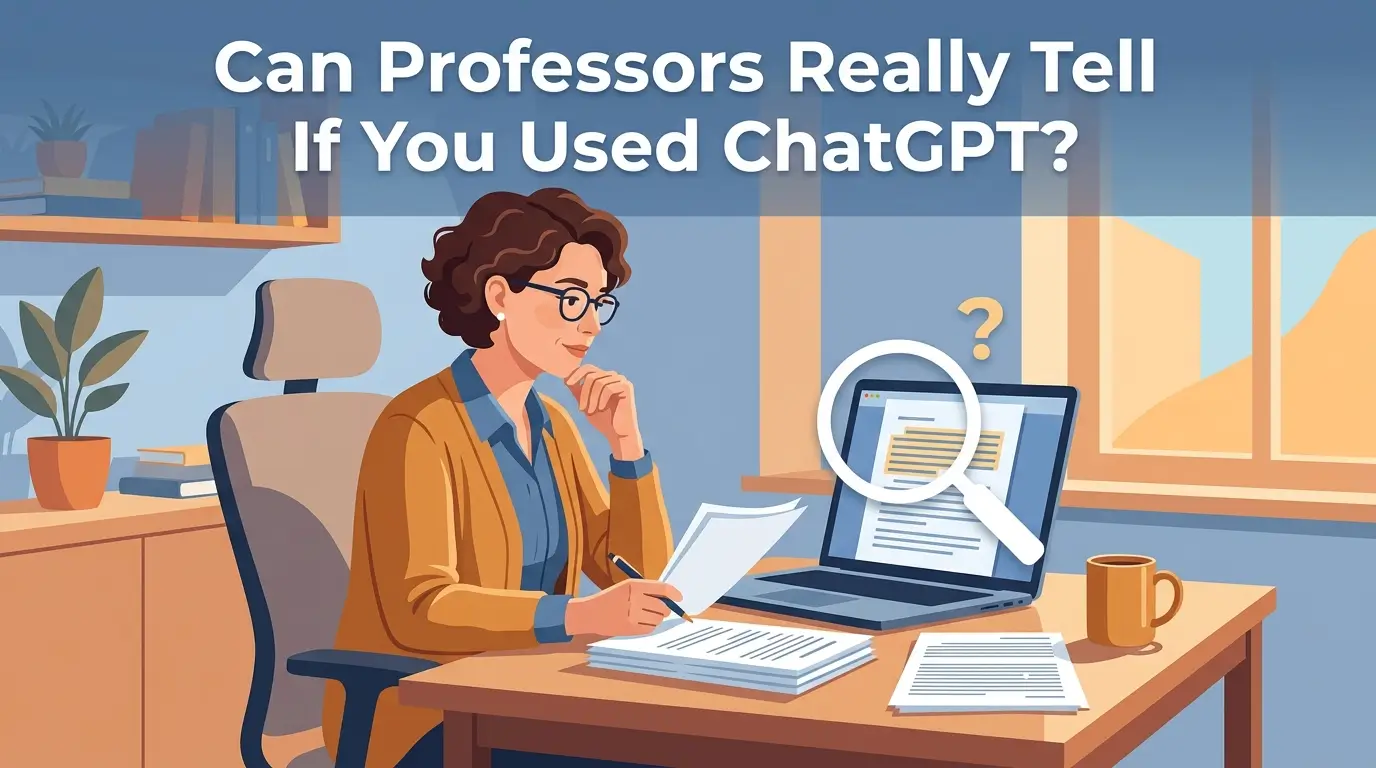
Since ChatGPT became widely available, a question has followed nearly every college writing assignment: can professors detect ChatGPT? Students want to know how much risk they're taking, and instructors want to know how much they can actually trust. The honest answer sits somewhere in between confident claims on both sides. Professors can often tell, but not always the way students assume, and not through a single infallible tool. Here's what's actually happening on the other side of that essay submission.
The Short Answer: Sometimes, and Not Always the Way You'd Expect
Professors detect AI-written work through a mix of software tools, experience-based instinct, and institutional processes, not one guaranteed method. Some flagged essays get caught by detection software. Others get caught because an instructor simply notices the writing doesn't sound like the student who wrote it. And plenty of AI-assisted work, especially lightly edited work, slips through entirely.
This inconsistency is exactly why the question doesn't have a clean yes-or-no answer.
What AI Detection Tools Actually Do
Many universities now use software like Turnitin's AI detection feature, GPTZero, or similar tools that analyze writing for statistical patterns associated with machine-generated text, things like unusually uniform sentence structure, predictable word choices, and a lack of the small irregularities that mark real human writing.
These tools return a probability score, not a verdict. A high score suggests AI involvement is likely, not certain. That distinction matters enormously, because detection tools have well-documented weaknesses.
Why Detection Tools Aren't as Reliable as Students Assume
AI detectors produce both false positives and false negatives, and both happen often enough to matter. Human-written essays get flagged as AI-generated, particularly from non-native English speakers, students who write in a formal or heavily structured style, or anyone whose writing was polished with grammar-checking software. At the same time, AI-generated text that's been paraphrased or lightly edited can slip past the same tools undetected.
Because of this, most universities explicitly warn faculty against using a detection score as standalone proof of misconduct. A flag is typically treated as a starting point for further review, not a conclusion.
The Human Side: What Professors Actually Notice
Ask most experienced instructors, and they'll tell you the software isn't usually what tips them off first. A sudden, unexplained jump in writing quality compared to earlier assignments is one of the most common signals. So is an essay that's technically correct but strangely generic, full of broad statements with no specific examples, personal voice, or original argument.
Other common signs include citations or quotes that turn out not to exist, an argument that doesn't quite answer the actual prompt, and writing that reads smoothly but falls apart the moment a professor asks the student to explain a specific point out loud.
None of these signs alone is proof. Together, though, experienced instructors say they form a pattern that's often more reliable than any single software score.
Google Docs and Version History: The Quiet Detection Method
Many professors now require assignments to be written in Google Docs specifically because of a feature that has nothing to do with AI detection software: revision history. A document that appears fully formed in a single paste, with no gradual drafting, edits, or backtracking, looks very different from one built incrementally over several sessions.
This method doesn't catch every case. But for professors who suspect an issue, checking the edit history is often faster and more revealing than running text through a detector, and it's much harder to fake convincingly.
Can Editing AI Text Help It Avoid Detection?
Yes, to a meaningful degree, and it's worth understanding why. Genuine restructuring, adding specific personal details, and varying sentence rhythm all change the underlying patterns detectors look for, not just the surface wording. Students curious about the actual mechanics behind this, or professors trying to understand what a suspicious flag might really mean, can look at this breakdown of how to rewrite text to avoid AI detection, which covers why simple word-swapping doesn't work but deeper rewriting often does.
This cuts both ways for professors: it means a clean detector score doesn't rule out AI involvement, and a flagged score doesn't confirm it either.
How Accurate Are the Tools Professors Rely On?
Accuracy varies significantly between detection products, and claims from vendors themselves should be treated with some skepticism since accuracy marketing rarely reflects real-world performance across diverse writing styles. Independent testing consistently finds gaps between advertised accuracy and actual results. This look at whether JustDone's AI detector is accurate is a useful example of how a tool's real-world reliability can differ from what's promised, which is a pattern worth keeping in mind for any detector, not just this one.
What This Means for Students
Submitting AI-generated work as entirely your own carries real risk, not because detection is perfect, but because the combination of software flags, instructor pattern recognition, and version history checks catches more than most students expect. It's also worth remembering that most academic integrity policies focus on originality and honesty, not just detection scores, so a clean tool result doesn't automatically mean a policy wasn't violated.
If AI assistance is allowed under your school's policy, using it to brainstorm or check grammar is very different from submitting generated text unedited. Keeping your own drafts and notes along the way protects you either way, since genuine process is one of the hardest things to fake convincingly.
What This Means for Professors
Relying on a single detection score to make a grading decision is risky given the documented false-positive rate. A more defensible approach combines several signals: a detection tool result, a noticeable shift from a student's usual writing style, a check of the document's revision history, and, where there's real concern, a short conversation with the student about their argument or sources.
Conclusion
Can professors detect ChatGPT? Often, yes, but rarely through one single method. The real answer involves detection software with real limitations, instructor pattern recognition built from experience, and quieter tools like Google Docs version history that catch what algorithms miss. No system is foolproof in either direction. For students, the safest path is straightforward: use AI within your school's stated policy, keep evidence of your own process, and make sure the final work genuinely reflects your own thinking, because that's ultimately what both detection tools and professors are really trying to verify.
FAQs
1. Can professors really tell if I used ChatGPT?
Often, yes, though not with certainty every time. Professors combine detection software, familiarity with a student's usual writing style, and tools like document revision history to form a judgment, rather than relying on one method alone.
2. Are AI detectors used by universities accurate?
Accuracy varies by tool, and all detectors have documented false-positive and false-negative rates. Most universities treat a flagged score as a reason for further review, not standalone proof.
3. Can editing AI-generated text help it avoid detection?
Yes, genuine restructuring and added personal detail can lower detection scores meaningfully. However, this also means detector results alone can't be fully trusted in either direction.
4. Does Google Docs help professors catch AI-written essays?
Yes. Many professors check a document's revision history to see whether it was written gradually or pasted in all at once, which is often more revealing than detection software.
5. What happens if I'm falsely flagged as using ChatGPT?
Most schools have an appeals or review process, and keeping your own drafts, notes, and research trail is the strongest evidence you can offer if a false positive occurs.
6. Is it worth the risk to submit ChatGPT-written work as my own?
Given the combination of detection methods professors use, it carries real risk. Most schools also allow permitted AI use like brainstorming, so checking your specific policy is the safest first step.

 English
 Arabic
 French
 Spanish
 Portuguese
 Deutsch
 Turkish
 Italiano
 Russian
 Romaian
 Portuguese (Brazil)
 Greek
Greek