


Electric Gripper Market Demand, Applications and Growth Prospects by 2034
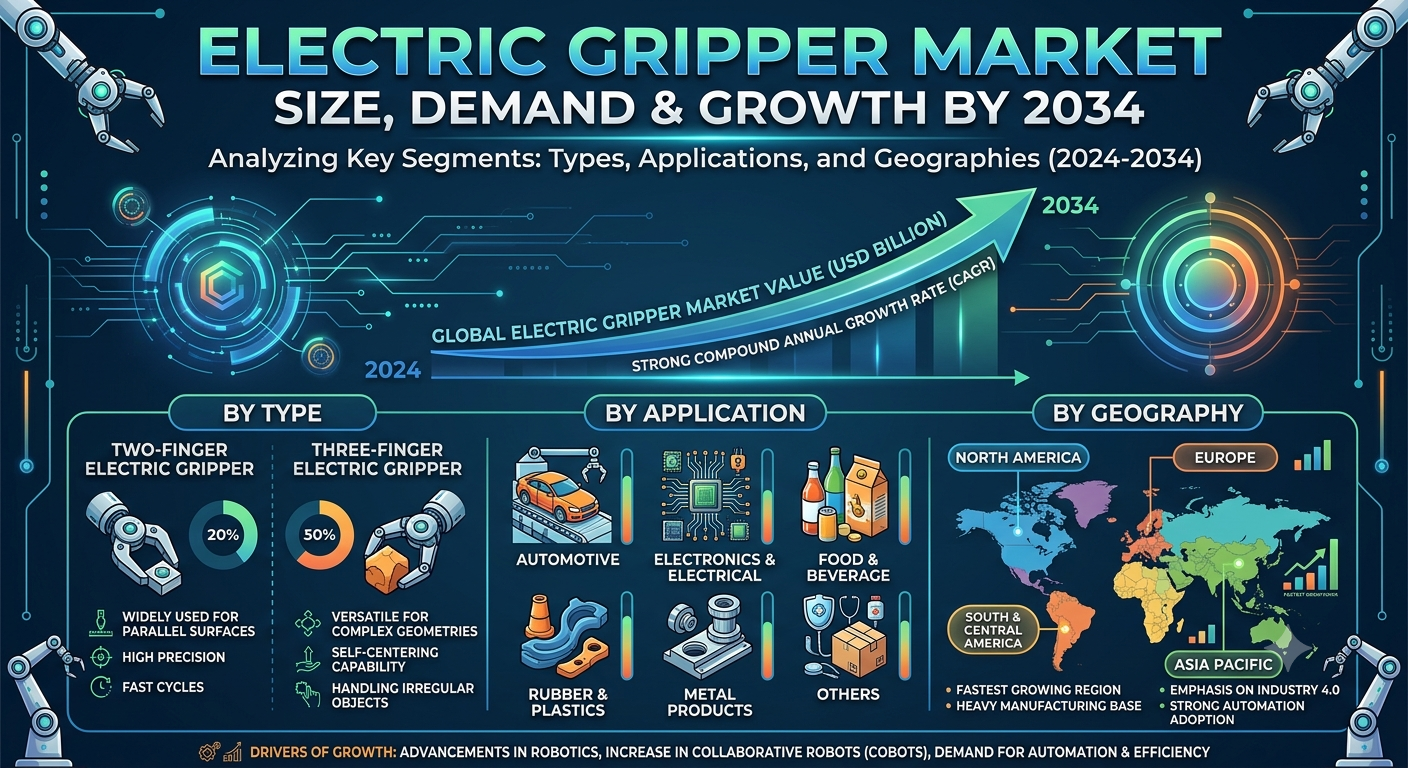
Manufacturers across various industries are investing in automation and robotic technologies to address the growing need for efficient, precise, and flexible production processes. Automated gripping systems are becoming an important part of this transformation by enabling robots to handle components and products with greater consistency and control. Electric grippers offer programmable gripping force, controlled motion, and integration capabilities that make them suitable for diverse industrial tasks. Increasing adoption in automotive, electronics, food and beverage, rubber and plastics, and metal products manufacturing is creating favorable conditions for their wider deployment.
The growing need for flexible and precise robotic handling is expected to support continued expansion through the forecast period. The Electric Gripper Market Size was valued at US$3.71 billion in 2025 and is projected to reach US$5.70 billion by 2034, registering a CAGR of 4.88% from 2026 to 2034. The total addressable market is estimated at approximately US$42.69 billion during 2026–2034. Electric grippers are gaining traction as manufacturers modernize production environments and deploy programmable end-of-arm tooling capable of handling different components with consistent accuracy.
Download Sample PDF Link:https://www.theinsightpartners.com/sample/TIPRE00007946
Increasing Adoption of Industrial Automation Drives Demand
One of the primary drivers of the Electric Gripper Market is the increasing adoption of industrial automation. Manufacturers across automotive, electronics, metal processing, plastics, and food and beverage industries are deploying robotic systems for pick-and-place, assembly, sorting, packaging, inspection, and material handling applications. Electric grippers provide precise control over gripping force and movement, allowing robotic systems to perform repetitive tasks with high consistency.
The shift toward automated production is also being encouraged by the need to improve throughput and operational efficiency. As manufacturers seek to optimize production lines and reduce manual intervention, electric grippers can be integrated with industrial robots and automated machinery to support repeatable handling processes. The ability to configure gripping parameters electronically also makes them suitable for production environments where multiple product variants must be handled on the same line.
Demand for Precision and Flexible Handling
Another significant growth driver is the rising requirement for precise and adaptable handling. Manufacturing processes increasingly involve components with different sizes, shapes, weights, and material characteristics. Electric grippers can provide controlled movement and adjustable gripping force, allowing automated systems to handle delicate or complex components while maintaining repeatability.
This capability is particularly relevant to electronics and electrical manufacturing, where small and sensitive components require accurate positioning. In automotive manufacturing, electric grippers can support component assembly and handling operations, while food and beverage producers can use automated gripping technologies for sorting, packaging, and product movement. The broad application potential across these industries contributes to demand for both two-finger and three-finger electric grippers.
Robotics and Collaborative Automation Create New Opportunities
Advancements in robotics are creating additional opportunities for electric gripper manufacturers. Collaborative robots, or cobots, are increasingly used for applications where robots and human workers operate in the same production environment. Electric grippers can complement these systems by offering programmable operation, compact designs, and precise control.
The integration of sensors, digital interfaces, and software-based controls is also expanding the functionality of modern grippers. Manufacturers are increasingly developing solutions that can monitor gripping conditions, adjust force parameters, and integrate with broader automation platforms. These developments are supporting the transition from conventional end-of-arm tooling toward more intelligent and flexible robotic systems.
Customization and Compact Designs Support Adoption
Customization represents another important opportunity. Different manufacturing applications require different gripping mechanisms, payload capabilities, dimensions, and force characteristics. Vendors are therefore focusing on configurable products that can be adapted to specific production requirements. Interchangeable fingers, adjustable gripping force, and application-specific configurations can help manufacturers accommodate different components without completely redesigning robotic cells.
The shift toward lightweight and compact grippers is also significant. Smaller end-effectors can be integrated into space-constrained robotic systems and collaborative automation cells. Compact designs can provide greater flexibility while supporting applications that require rapid movement and precise positioning. These developments are encouraging innovation in materials, actuators, sensors, and control technologies.
Key Players in the Electric Gripper Market
The competitive landscape includes established automation and robotics companies developing electric gripping technologies for industrial applications. Key players profiled in the report include DESTACO, EMI Corporation, Festo, IAI America, Inc., PARKER HANNIFIN CORP, PHD Inc., SCHUNK GmbH and Co. KG, SMAC Corporation, SMC Corporation of America, and Yamaha Motor Co., Ltd. These companies are focusing on product development, automation compatibility, precision handling, and application-specific solutions to strengthen their positions across industrial end-use sectors.
Future Outlook
The future outlook for electric grippers remains closely connected to the expansion of industrial automation, smart manufacturing, and robotics. As production systems become more flexible and digitally connected, demand is expected to increase for end-effectors that provide precise force control, repeatable motion, compact form factors, and compatibility with different robotic platforms.
The adoption of collaborative robots and automated handling systems is likely to create additional opportunities across electronics, automotive, food and beverage, and other industries. At the same time, developments in sensing, connectivity, lightweight materials, and intelligent control can broaden the range of tasks that electric grippers can perform. The Electric Gripper Market is therefore positioned for continued development as manufacturers increasingly prioritize flexible automation and precision handling.
About The Insight Partners
The Insight Partners is a global market research and consulting firm providing actionable intelligence across technology, healthcare, industrial, semiconductor, telecommunications, and other industries. Its research reports combine market analysis, industry trends, competitive assessments, forecasts, and strategic insights to help businesses understand changing market dynamics and identify potential opportunities.
Contact Us
The Insight Partners
Email: [email protected]
Phone: +1-646-491-9876
Website: https://www.theinsightpartners.com
Related Reports -
Submarine Fiber Cable Market Demand, Share & Growth by 2034
Automotive HVAC Market Size, Growth & Trends by 2034
Offshore Wind Cable Market Size, Growth & Trends by 2034

 English
 Arabic
 French
 Spanish
 Portuguese
 Deutsch
 Dutch
Dutch
 Italiano
 Russian
 Romaian
 Portuguese (Brazil)
 Greek
Greek