


Emerging Trends Transforming the Parking Access Control Market
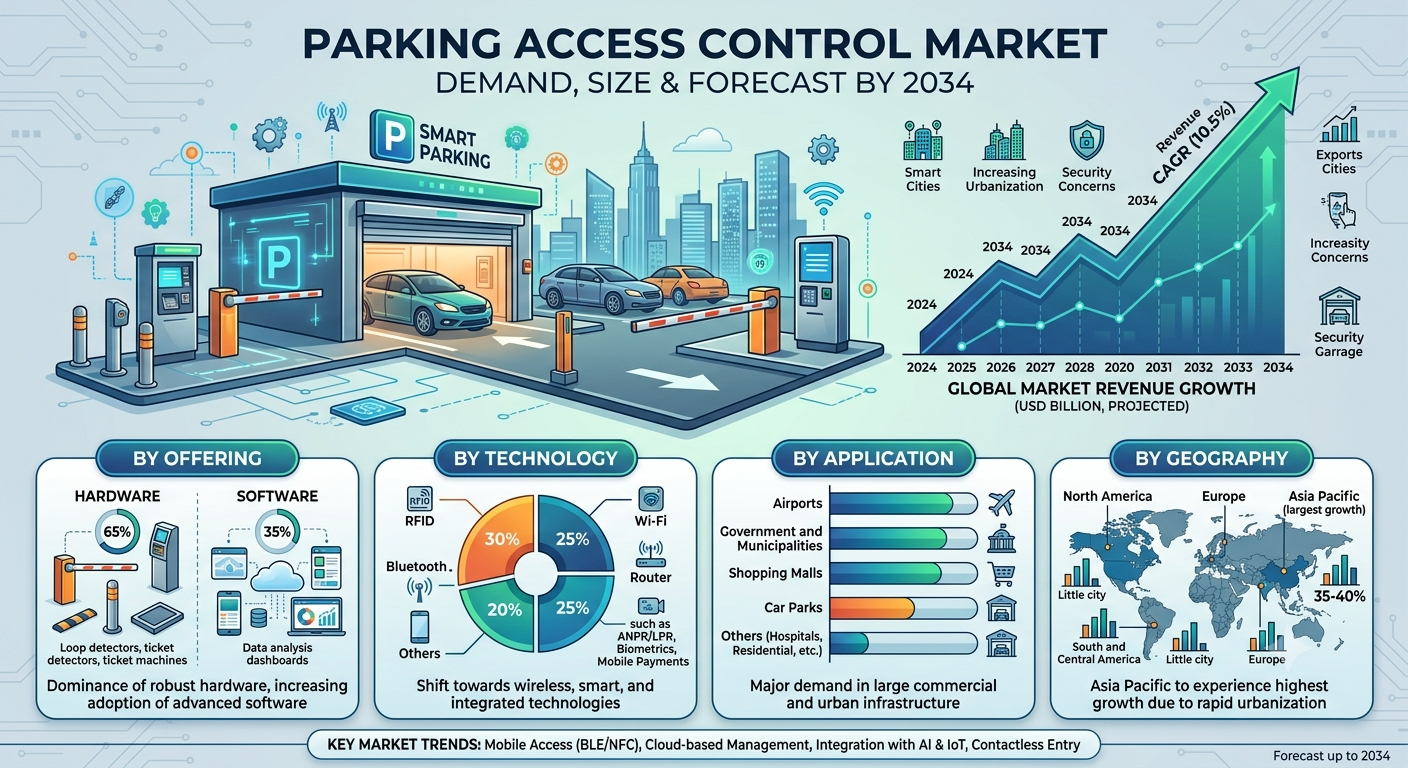
Rising urbanization and increasing vehicle ownership are prompting parking operators to move away from conventional, manually managed processes toward automated and connected solutions. Airports, hospitals, shopping centers, hotels, universities, office complexes, and government facilities are adopting advanced technologies to improve access management, payment collection, security, and operational visibility.
The Parking Access Control Market Size was valued at US$7.01 billion in 2025 and is projected to reach US$10.9 billion by 2034, expanding at a CAGR of 5.67% from 2026 to 2034. The addressable opportunity is estimated at US$83.97 billion during 2026–2034, reflecting the broad potential for automated access, payment, surveillance, identification, and parking management technologies across diverse end-use environments.
Download Sample PDF: https://www.theinsightpartners.com/sample/TIPRE00022485
Key Parking Access Control Market Drivers
Growing Adoption of Smart City Infrastructure
The expansion of smart city initiatives is one of the important factors supporting demand for parking access control solutions. Cities are increasingly investing in connected transportation infrastructure to improve traffic management, optimize parking utilization, reduce congestion, and enhance the overall mobility experience. Parking access control systems can connect entry barriers, ticketing equipment, cameras, sensors, payment platforms, and centralized management software, enabling operators to monitor and manage parking facilities more efficiently.
The integration of parking facilities with broader intelligent transportation systems is also encouraging technology upgrades. Real-time data generated by access control equipment can support parking availability information, occupancy monitoring, enforcement, and operational planning. As municipalities and private operators seek more connected infrastructure, automated parking control technologies are becoming an increasingly important component of modern mobility ecosystems.
Increasing Demand for Automated Parking Management
Traditional parking operations often depend on manual ticketing, physical payment collection, and staff-based access verification. These processes can create queues, increase operational workloads, and limit visibility into parking utilization. Automated access control addresses these challenges through technologies such as license plate recognition, RFID, Bluetooth, barcode ticketing, sensors, automated barriers, and digital payment systems.
License plate recognition is particularly relevant because it can enable vehicles to enter and exit facilities without requiring conventional paper tickets. Similarly, RFID and Bluetooth-based identification can support contactless access for authorized users. The growing emphasis on convenient and automated vehicle movement is therefore creating opportunities for technology providers across commercial and public parking facilities.
Rising Focus on Security and Surveillance
Security is another significant driver for adoption. Parking facilities can experience unauthorized access, vehicle-related incidents, payment disputes, and other security challenges. Integrated cameras, surveillance systems, access barriers, license plate recognition, and monitoring software can provide operators with greater control over vehicle movement.
Modern solutions increasingly combine access control with surveillance and analytics capabilities. This enables parking operators to record vehicle activity, identify unauthorized access attempts, and improve incident response. The integration of security technologies with access management is particularly relevant for airports, hospitals, government facilities, universities, and large commercial properties where controlled vehicle access is essential.
Expansion of Contactless and Digital Payments
The increasing adoption of digital payment technologies is transforming parking operations. Consumers increasingly expect fast and convenient payment experiences through cards, mobile applications, digital wallets, and other cashless methods. Parking access control platforms can integrate payment technologies with gates, ticketing systems, validation stations, and management software.
This integration can reduce dependence on cash-based processes while helping operators automate revenue collection and improve transaction visibility. The shift toward contactless experiences is expected to remain an important demand driver as parking facilities modernize their infrastructure.
Technology Integration Creates New Growth Opportunities
Technological advancements are expanding the capabilities of parking access control systems beyond basic gate automation. Cloud-based platforms can enable centralized monitoring and remote system management across multiple parking locations. Artificial intelligence and analytics can support vehicle recognition, occupancy monitoring, anomaly detection, and operational decision-making.
The integration of Internet of Things technologies is also creating opportunities for connected parking environments. Sensors and cameras can collect real-time information about vehicle movements and parking availability, while software platforms can use this data to improve facility management. These capabilities can support more efficient utilization of parking assets and provide operators with actionable operational information.
The increasing use of electric vehicles is another factor influencing parking infrastructure. As parking facilities incorporate EV charging stations, operators can integrate charging access with existing parking management and payment platforms. This creates opportunities for unified systems that manage vehicle entry, parking duration, charging access, and payment through connected infrastructure.
Top Players in the Parking Access Control Market
The competitive landscape includes established parking technology companies and access-control solution providers. Key players include SKIDATA, Amano Corporation, HUB Parking Technology, TIBA Parking Systems, SWARCO, FAAC, Conduent, DESIGNA, ACTi Corporation, Cass Parking, Electro Automation, Nortech Access Control, ZKTeco, and VersionX Innovations. These companies compete through product development, system integration, automation capabilities, geographic expansion, and technology partnerships.
Vendors are increasingly focusing on integrated platforms that combine access control, payment processing, license plate recognition, surveillance, parking guidance, and data analytics. This shift is increasing the importance of software capabilities and interoperability alongside conventional hardware performance.
Future Outlook
The future outlook for parking access control is closely connected with the broader digitization of transportation and property infrastructure. Demand is expected to increase as parking operators adopt cloud-connected platforms, contactless identification, automated payment systems, AI-enabled surveillance, and integrated license plate recognition.
Smart cities, airports, commercial properties, healthcare facilities, educational institutions, and municipalities are expected to continue upgrading parking infrastructure to improve operational efficiency and user experience. Greater integration with mobile applications, digital payment platforms, EV charging infrastructure, and intelligent transportation systems is likely to further expand the role of access control technologies.
The combination of automation, connectivity, security, and data-driven management is expected to shape the evolution of parking facilities through 2034.
About The Insight Partners
The Insight Partners is a globally recognized market research and consulting firm providing reliable and actionable insights across technology, industry, and business sectors. Its research supports organizations in understanding emerging trends, competitive landscapes, growth opportunities, and strategic developments across global industries.
Contact Us
The Insight Partners
Email: [email protected]
Phone: +1-646-491-9876
Website: https://www.theinsightpartners.com
Related Reports -
Submarine Fiber Cable Market Demand, Share & Growth by 2034
Automotive HVAC Market Size, Growth & Trends by 2034
Offshore Wind Cable Market Size, Growth & Trends by 2034

 English
 French
 Spanish
 Portuguese
 Deutsch
 Turkish
 Dutch
Dutch
 Italiano
 Russian
 Romaian
 Portuguese (Brazil)
 Greek
Greek