


Cold Chain Monitoring Expands as Companies Target Lower Product Losses
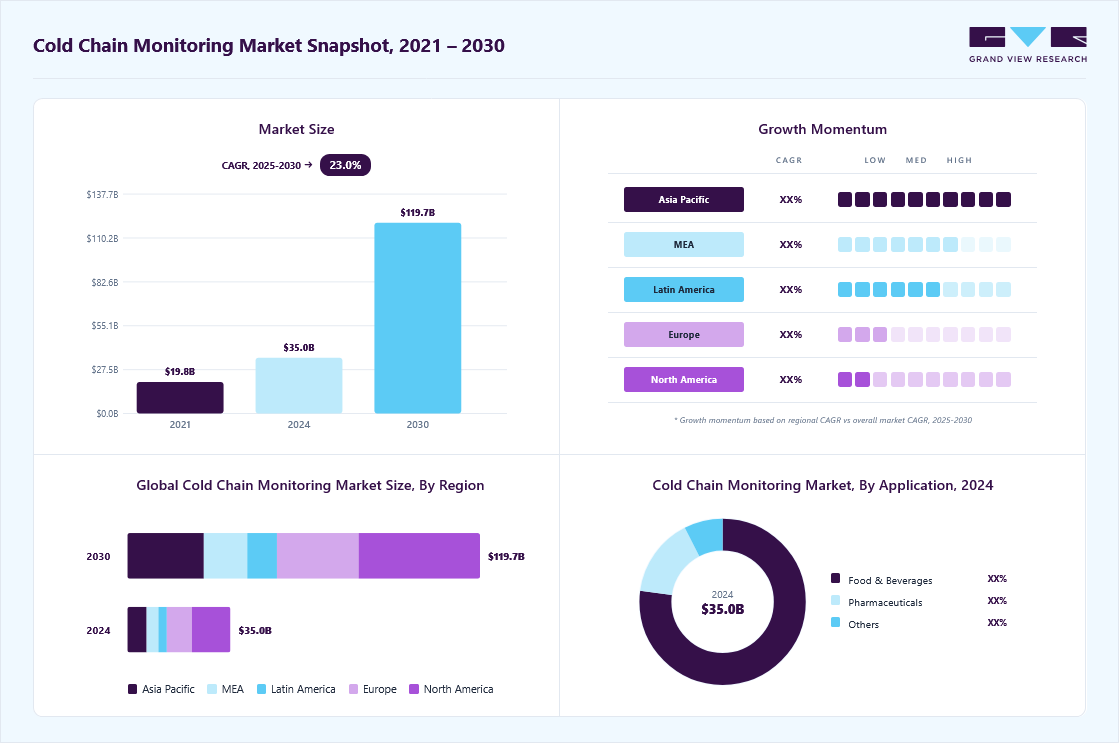
The cold chain monitoring market is expanding as pharmaceutical, food and beverage, healthcare, and other temperature-sensitive industries place greater emphasis on maintaining product quality throughout storage and transportation. The market was valued at USD 7.4 billion in 2025 and is projected to reach USD 17.6 billion by 2033, growing from USD 8.2 billion in 2026 at a 10.0% CAGR from 2026 to 2033. Increasing demand for real-time visibility, regulatory compliance, IoT-enabled monitoring, and reliable cold storage infrastructure is supporting this expansion.
Market Segmentation & Key Insights
The market is segmented by component, temperature type, application, and region. Hardware accounted for the largest component share, representing 62.8% of revenue in 2025. Hardware includes sensors, data loggers, RFID devices, telematics systems, and other monitoring equipment used to capture temperature and environmental conditions throughout cold chain operations. Software and services complement these systems by providing data management, analytics, alerts, and remote monitoring capabilities.
Frozen products represented the largest temperature segment, accounting for 42.9% of revenue in 2025. Frozen food, pharmaceuticals, biologics, and other temperature-sensitive products require continuous monitoring because temperature fluctuations can affect quality, safety, and shelf life. The refrigerated segment is also supported by demand for maintaining products within controlled temperature ranges during storage and transportation.
The pharmaceutical and healthcare application segment accounted for the largest share at 44.8% in 2025. The growing volume of temperature-sensitive medicines, vaccines, biologics, and other healthcare products is increasing the need for reliable monitoring solutions. Real-time temperature visibility can help identify excursions and support compliance across pharmaceutical logistics.
Food and beverage is another important application area. Perishable products require controlled temperatures from production through distribution and retail. Monitoring systems help operators identify temperature deviations and improve visibility across transportation and storage processes. The increasing complexity of food supply chains is therefore contributing to technology adoption.
Primary Market Drivers
The rising demand for temperature-sensitive products is a key growth driver. Pharmaceuticals, vaccines, biologics, fresh foods, frozen foods, and other perishable products require reliable temperature management. As supply chains become more complex and products travel longer distances, monitoring technologies are increasingly used to provide visibility into environmental conditions.
Regulatory requirements are also strengthening adoption. Pharmaceutical and food companies must maintain appropriate storage and transportation conditions to protect product quality and meet applicable standards. Monitoring systems can generate temperature records, alerts, and historical data that help organizations track conditions across different points in the cold chain.
IoT and connected technologies are transforming monitoring operations. Sensors and connected devices can continuously collect temperature and other environmental information, while cloud-based platforms allow users to access data remotely. Automated alerts can notify operators when temperatures move outside specified thresholds, enabling quicker intervention.
The growing focus on reducing food waste is another important factor. Temperature excursions can contribute to spoilage and product losses. Continuous monitoring provides greater visibility into storage and transportation conditions, helping companies identify potential problems before they result in significant waste or financial losses.
Regional Outlook
North America accounted for the largest regional revenue share of 36.1% in 2025. The region benefits from established cold chain infrastructure, strong pharmaceutical and food industries, regulatory requirements, and widespread adoption of connected monitoring technologies. The U.S. represents a major contributor to regional market development.
Asia Pacific is witnessing increasing demand for cold chain monitoring as pharmaceutical manufacturing, food distribution, e-commerce, and organized retail expand. Investments in cold storage infrastructure and logistics networks are creating additional opportunities for monitoring technology providers. Rising demand for temperature-sensitive products is also encouraging organizations to strengthen supply chain visibility.
Europe represents another significant market, supported by established pharmaceutical and food supply chains and strong emphasis on product safety and quality. Cold chain monitoring is increasingly integrated with digital logistics platforms, enabling companies to collect, analyze, and share temperature information across supply chain operations.
Technology and Market Outlook
The cold chain monitoring industry is moving toward connected, automated, and data-driven systems. IoT sensors, cloud platforms, wireless connectivity, RFID, GPS-enabled tracking, and analytics are helping organizations move beyond periodic temperature checks toward continuous visibility. These technologies can support proactive management by identifying deviations and enabling timely corrective actions.
Integration with broader supply chain management systems is another important development. Monitoring data can be connected with logistics, warehouse, transportation, and inventory platforms, giving businesses a more comprehensive view of temperature-sensitive shipments. Data analytics can also support performance evaluation and identification of recurring temperature-related issues.
FAQ
Which segment leads the cold chain monitoring market?
Hardware led the component segment with a 62.8% revenue share in 2025. Frozen products represented 42.9% of the temperature segment, while pharmaceutical and healthcare applications accounted for 44.8% of revenue.
What trends are shaping the cold chain monitoring market?
Major trends include IoT-enabled sensors, cloud-based monitoring, wireless connectivity, RFID, remote temperature visibility, automated alerts, data analytics, and integration with broader logistics and supply chain management platforms.
Key Cold Chain Monitoring Companies:
· Carrier
· ORBCOMM
· Geotab Inc.
· Controlant
About us:
Grand View Research, a market research and consulting company, provides syndicated research reports, customized research reports, and consulting services. Grand View Research database is used by the world's renowned academic institutions and Fortune 500 companies to understand the global and regional business environment. Our database features thousands of statistics and in-depth analysis on 46 industries in 25 major countries worldwide.

 English
 Arabic
 French
 Spanish
 Portuguese
 Deutsch
 Dutch
Dutch
 Italiano
 Russian
 Romaian
 Portuguese (Brazil)
 Greek
Greek