


From FCC to Hydrotreating: Technologies Driving Catalyst Market Growth
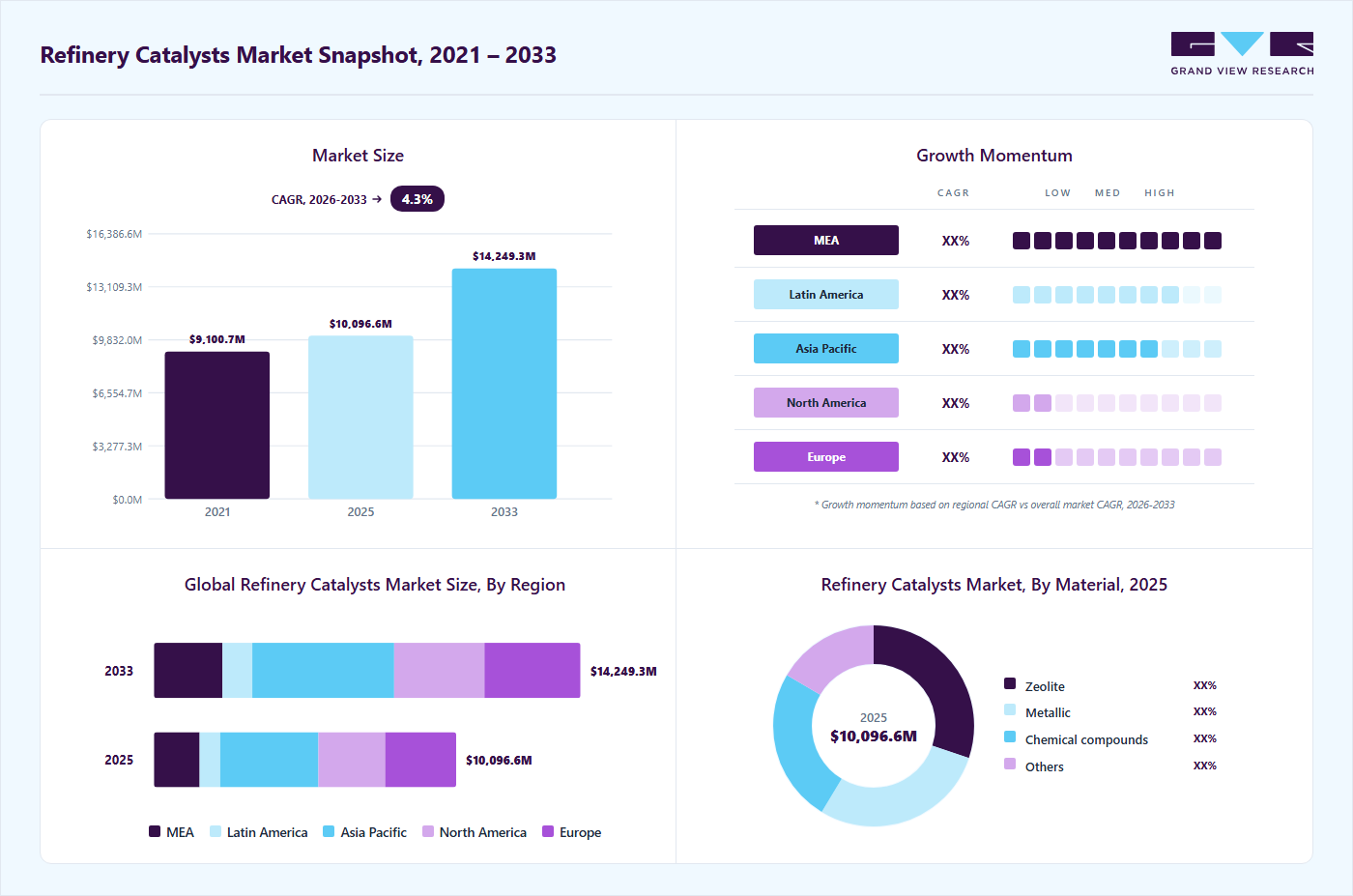
The refinery catalysts market is evolving as refiners respond to tighter fuel-quality standards, changing feedstocks, higher-value product requirements, and the growing emphasis on cleaner fuel production. The market was valued at USD 10.1 billion in 2025 and is projected to reach USD 14.3 billion by 2033, growing from USD 10.6 billion in 2026 at a 4.3% CAGR from 2026 to 2033. The market's development is closely connected with refining efficiency, fuel regulations, petrochemical integration, and demand for advanced catalyst technologies.
Key Market Segmentations
The refinery catalysts market is segmented by product and application. Zeolite held the largest product share, accounting for 28.7% of revenue in 2025. Zeolites are widely used as adsorbents and catalysts because of their porosity and large surface area. Commercially manufactured zeolites can incorporate different atoms to improve activity and performance for specific refining processes. Metallic catalysts and chemical compounds also form important product categories.
By application, FCC catalysts represented the largest share at 42.9% in 2025. Fluid catalytic cracking converts heavy and high-boiling hydrocarbons into lower-value fractions, with gasoline serving as a primary product. The process also generates diesel and C3 and C4 gaseous fractions, while lighter fractions can be processed through alkylation to produce high-octane gasoline components.
Hydrotreating is projected to record the fastest application growth, with a 4.7% CAGR from 2026 to 2033. The process removes chemically bound sulfur and other impurities, including metals, oxygen, and nitrogen, from petrochemical materials. It is used across multiple refinery stages involving products such as jet fuel, catalytic feed, reformer feed, and distillates.
Regional Highlights
Asia Pacific represented the largest regional market, holding a 30.9% revenue share in 2025. Refining expansion, private-sector participation, petrochemical development, and investment in oil and gas infrastructure are contributing to catalyst demand. China held the largest market share within the region in 2025. Middle East & Africa is identified as the fastest-growing regional market during the forecast period.
North America has a mature and technologically advanced refinery catalyst industry. Demand is supported by stringent environmental regulations, cleaner transportation fuel requirements, shale oil processing, and applications such as FCC, hydrocracking, and hydrotreating. The U.S. accounted for 77.7% of the North American market revenue in 2025, supported by its refining capacity, complex refineries, and shale oil production.
Europe's refinery catalysts industry is projected to grow at a 3.7% CAGR during the forecast period. Refiners face pressure from manufacturing costs and environmental regulations, while developments associated with tight oil and shale gas are influencing raw-material availability and refining opportunities.
Emerging Market Trends
Stricter fuel-quality standards are among the most important forces shaping refinery catalyst demand. Ultra-low sulfur diesel, low-sulfur gasoline, and IMO 2020 marine fuel standards increase the need for hydrotreating, hydrodesulfurization, and hydrocracking catalysts. Refiners are also seeking catalysts capable of reducing sulfur, nitrogen, aromatics, and other impurities while maintaining operational efficiency.
Another important trend is the shift toward higher conversion and higher-value product streams. Refiners are increasingly using FCC, reforming, and alkylation catalysts to maximize products such as propylene, aromatics, and high-octane components. The processing of heavier and sourer crude feeds is also increasing the need for catalysts capable of maintaining throughput and unit reliability.
Energy efficiency and emissions reduction are further encouraging catalyst innovation. Refiners are seeking longer catalyst cycles, lower coke formation, reduced carbon dioxide footprints, and improved unit economics. Renewable diesel and sustainable aviation fuel are creating additional opportunities for hydrotreating and isomerization catalysts designed for bio-feedstocks.
Technical Specifications
Refinery catalysts are manufactured using materials including zeolites, metals, and chemical compounds. Different compositions and combinations enable their use in FCC, alkylation, hydrotreating, and hydrocracking processes. Manufacturers are increasingly focused on catalysts that can handle diverse feedstocks while providing stable, reliable, and efficient performance.
Technical innovation is also being directed toward process efficiency and higher-value product yields. In May 2025, Johnson Matthey agreed to sell its Catalyst Technologies business to Honeywell for £1.8 billion, while in August 2024 BASF launched Fourtiva, an FCC catalyst designed to improve high-octane gasoline blending components while reducing coke and dry gas formation.
The market nevertheless faces pressure from alternative fuels, environmental policies, and raw-material availability. Growing demand for noble and other metals in applications outside refining can place additional pressure on catalyst raw-material supply. Meanwhile, biofuels and environmental initiatives can restrain conventional refinery catalyst demand.
Market Outlook
The refinery catalysts market is moving toward more specialized and performance-oriented solutions as refiners balance fuel-quality requirements, efficiency targets, feedstock complexity, and emissions reduction. With the market expected to reach USD 14.3 billion by 2033, catalyst development is likely to remain closely tied to cleaner fuels, advanced refining processes, higher-value product yields, and evolving refinery technologies.
FAQ
Which segment leads the refinery catalysts market?
Zeolite led the product segment with a 28.7% revenue share in 2025, while FCC catalysts led the application segment with a 42.9% share.
What trends are shaping the refinery catalysts market?
Key trends include tighter fuel-quality standards, demand for cleaner fuels, higher-value product conversion, processing of heavier crude feeds, energy-efficiency improvements, emissions reduction, and catalyst development for renewable diesel and sustainable aviation fuel.
Key Refinery Catalysts Companies:
· Albemarle Corporation
· BASF SE
· Johnson Matthey Plc
· W. R. Grace
About us:
Grand View Research, a market research and consulting company, provides syndicated research reports, customized research reports, and consulting services. Grand View Research database is used by the world's renowned academic institutions and Fortune 500 companies to understand the global and regional business environment. Our database features thousands of statistics and in-depth analysis on 46 industries in 25 major countries worldwide.

 English
 Arabic
 French
 Spanish
 Portuguese
 Deutsch
 Turkish
 Dutch
Dutch
 Italiano
 Romaian
 Portuguese (Brazil)
 Greek
Greek