


3D Machine Vision Market Growth Builds Around Automation and Real-Time Data
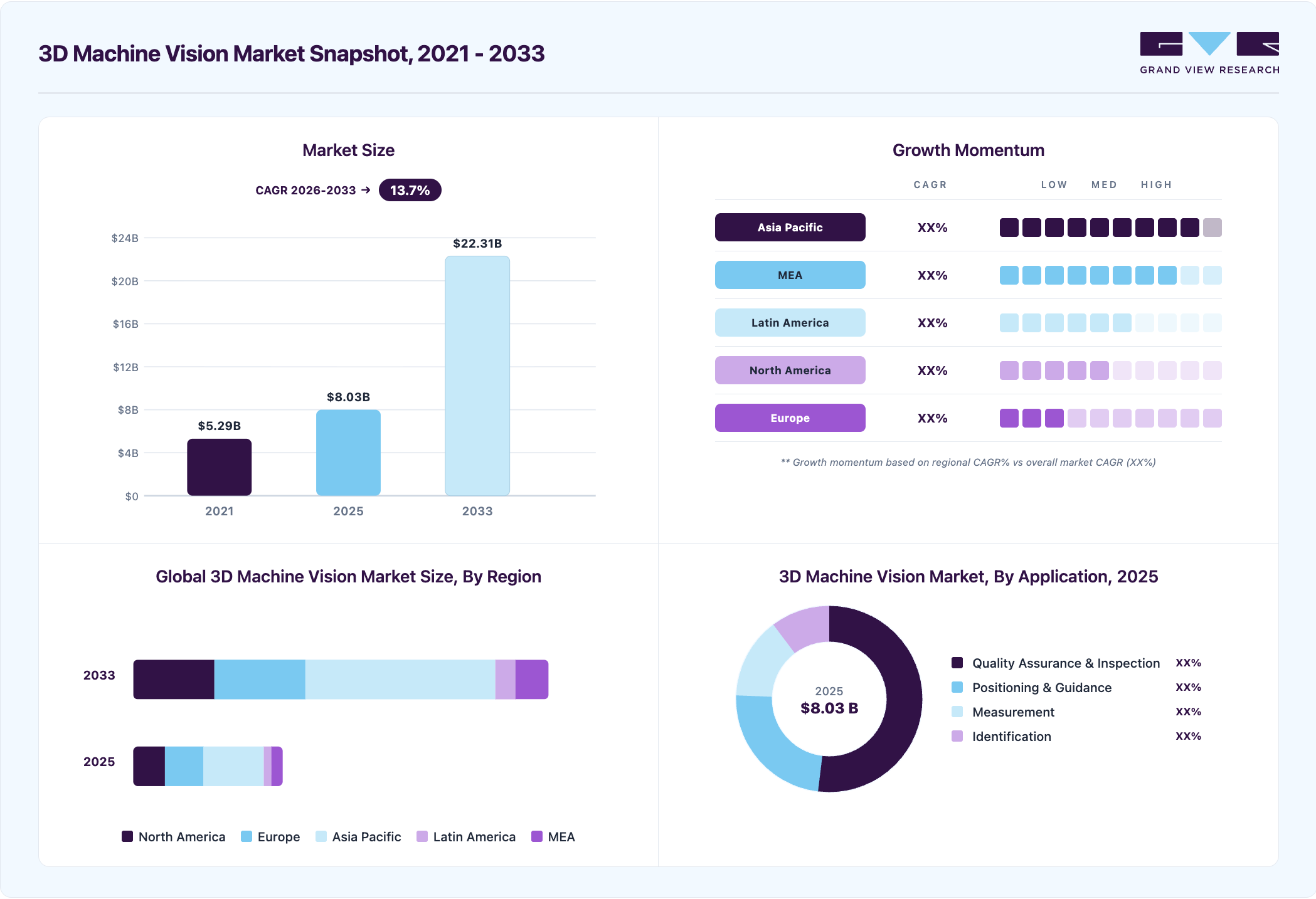
The 3D machine vision market is gaining momentum as manufacturers increasingly adopt automation, robotics, artificial intelligence, and smart factory technologies. The market was valued at USD 8.0 billion in 2025 and is projected to grow from USD 9.1 billion in 2026 to USD 22.3 billion by 2033, representing a 13.7% CAGR from 2026 to 2033. The expansion reflects growing demand for high-precision inspection, real-time defect detection, spatial analysis, and automated decision-making across manufacturing environments.
Market Sizing & Outlook by Firm
The market is developing around the increasing need for advanced imaging systems capable of capturing depth, shape, and spatial information. Unlike conventional inspection approaches, 3D machine vision enables manufacturers to analyze objects in three dimensions, supporting applications such as quality inspection, measurement, object recognition, robotic guidance, and automated handling. The technology is becoming increasingly important as production environments become more automated and complex.
The hardware segment accounted for the largest revenue share of 70.1% in 2025. Cameras, frame grabbers, optics, LED lighting, and processors form the foundation of these systems, while improvements in structured light, time-of-flight, and laser triangulation technologies are supporting adoption. The software segment is expected to register a CAGR of over 13.5% from 2026 to 2033, driven by demand for intelligent inspection, real-time analytics, adaptive decision-making, defect classification, and root-cause analysis.
PC-based products held the largest share in 2025, supported by their computational capabilities, flexibility, algorithm development potential, and suitability for complex manufacturing operations. At the same time, smart camera-based systems are expected to record the fastest CAGR from 2026 to 2033, supported by compact designs, simplified deployment, lower wiring complexity, and growing adoption of edge AI.
Key Industry Drivers & Core Trends
Increasing industrial automation is a central factor supporting market expansion. Manufacturers are deploying 3D machine vision to reduce manual intervention, improve inspection accuracy, increase production efficiency, and support faster operational decisions. The ability to capture depth and spatial measurements makes these systems particularly useful for automated environments where precision and consistency are important.
Artificial intelligence and machine learning are strengthening the capabilities of 3D vision platforms. AI-powered image processing, deep learning, edge computing, and real-time analytics are helping systems recognize objects, identify defects, guide robots, and perform precision measurements. These developments are also supporting autonomous robotic applications and smart manufacturing infrastructure.
Growing emphasis on quality assurance, traceability, regulatory compliance, and zero-defect manufacturing is creating additional demand. Industries are increasingly using 3D systems to detect defects, perform dimensional measurements, inspect surfaces, and maintain consistent product quality. Labor shortages and rising production complexity are further encouraging manufacturers to replace manual visual inspection with automated solutions.
Dominance of Hardware:
Hardware continues to form the largest part of the market because high-resolution cameras, sensors, imaging components, and processing equipment are essential to capturing and analyzing three-dimensional information. Advances in sensing technologies and integration with robotics and Industry 4.0 infrastructure are supporting hardware adoption across manufacturing environments.
The growing use of high-speed 3D imaging in automotive, electronics, and logistics is reinforcing demand. Hardware improvements are also helping manufacturers obtain more accurate measurements while supporting automated inspection and robotic applications. As smart manufacturing expands, hardware remains a critical foundation for intelligent vision systems.
The Rise of Edge AI:
Edge AI is emerging as an important technology direction because it allows vision systems to process information closer to where data is generated. This supports faster analysis and decision-making while helping manufacturers deploy intelligent inspection and automation capabilities. Smart camera-based solutions are particularly suited to this trend because they combine imaging and processing capabilities in compact systems.
Geographic Leadership:
Asia Pacific accounted for the largest regional revenue share of 40.3% in 2025. Rapid industrial automation, investments in manufacturing, smart factory development, robotics integration, and deployment of high-resolution 3D sensors are supporting market expansion. China dominated the Asia Pacific market with a 29.3% share in 2025.
Europe is projected to grow at a CAGR of over 11.4% from 2026 to 2033, supported by Industry 4.0 adoption and the integration of AI, IoT, and data analytics into manufacturing. North America is also expanding through adoption of AI-powered vision systems, robotics, smart factories, precision inspection, and automated quality control.
Application & End-Use Opportunities
Quality assurance and inspection represented the largest application segment in 2025. High-resolution cameras, laser profilers, and AI-powered software enable manufacturers to identify defects, measure dimensions, and perform detailed surface inspections. Identification is expected to record the fastest CAGR from 2026 to 2033 as AI and deep learning improve object recognition, part verification, and traceability.
Automotive held the largest end-use share in 2025, with applications spanning robotic guidance, dimensional measurement, weld inspection, and surface defect detection. Meanwhile, food and beverage packaging and bottling is projected to register the highest CAGR from 2026 to 2033, driven by demand for high-speed, hygienic, accurate inspection and stronger food safety and traceability requirements.
High deployment costs remain a market restraint. Hardware, software integration, calibration, specialized components, infrastructure upgrades, and skilled personnel can increase implementation expenses, particularly for smaller organizations. However, warehouse digitization presents an opportunity as businesses adopt 3D vision for package dimensioning, object detection, pallet identification, autonomous movement, and intelligent material handling.
Key 3D Machine Vision Companies:
· Basler AG
· Cognex Corporation
· National Instruments Corporation
· OMRON Corporation
About us:
Grand View Research, a market research and consulting company, provides syndicated research reports, customized research reports, and consulting services. Grand View Research database is used by the world's renowned academic institutions and Fortune 500 companies to understand the global and regional business environment. Our database features thousands of statistics and in-depth analysis on 46 industries in 25 major countries worldwide.

 English
 Arabic
 French
 Spanish
 Portuguese
 Turkish
 Dutch
Dutch
 Italiano
 Russian
 Romaian
 Portuguese (Brazil)
 Greek
Greek