


Analytical Instrumentation Market Trends Point to Faster, Smarter Analysis
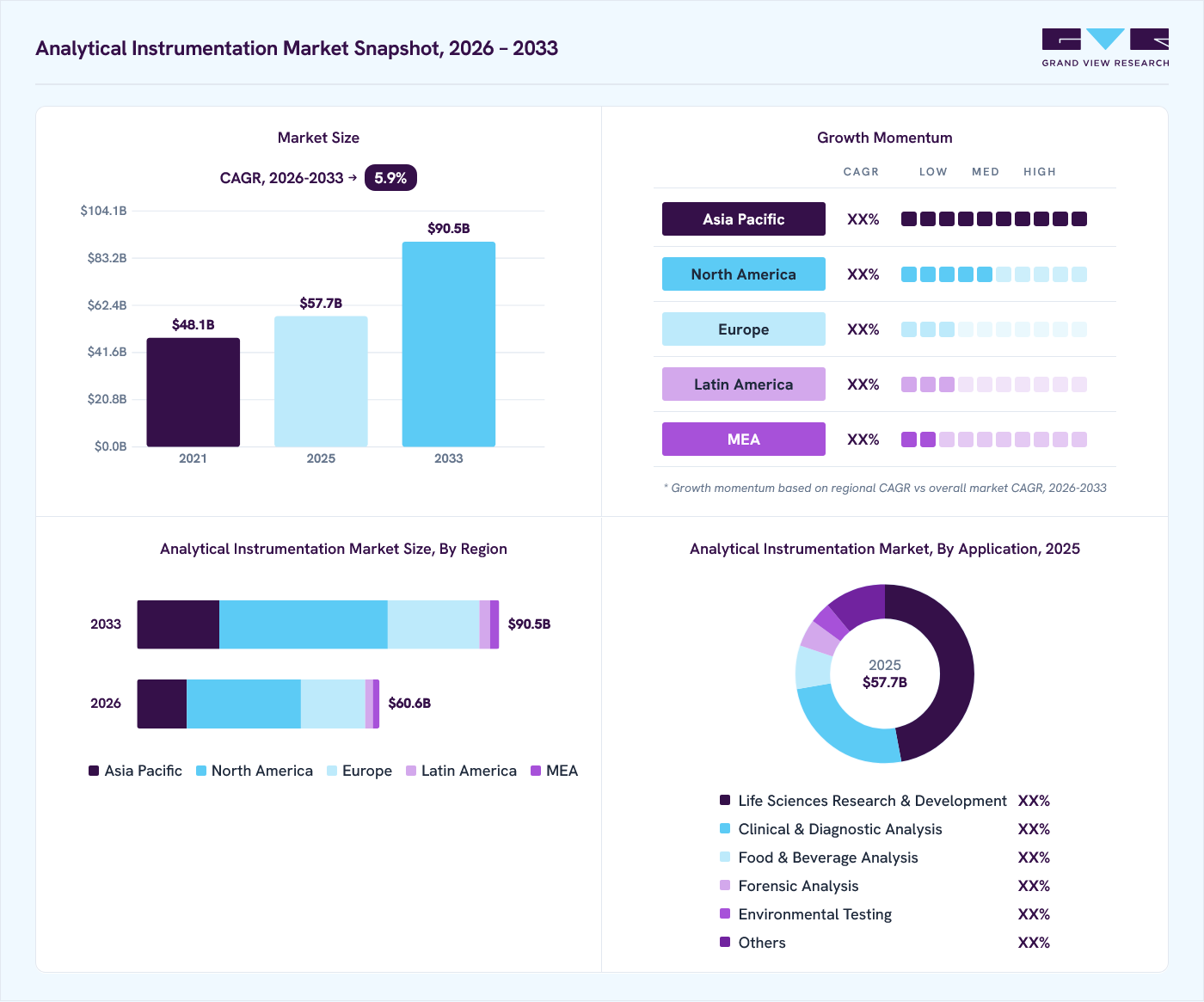
The analytical instrumentation market is expanding as industries place greater emphasis on precision, quality assurance, regulatory compliance, and advanced research. The market was valued at USD 57.7 billion in 2025 and is projected to reach USD 90.5 billion by 2033, growing from USD 60.6 billion in 2026 at a 5.9% CAGR from 2026 to 2033. Increasing adoption across pharmaceuticals, environmental monitoring, food safety, chemicals, and life sciences is supporting this expansion.
Core Market Segmentation
The market is segmented by product, technology, application, and region. By product, instruments represented the largest share, accounting for 63.5% of overall revenue in 2025. The category includes analytical technologies such as mass spectrometers, chromatographs, sequencers, and microscopes. At the same time, software is expected to register the fastest CAGR during the forecast period as laboratories increasingly depend on advanced data analysis and interpretation capabilities.
By technology, polymerase chain reaction (PCR) held the largest share at 25.2% in 2025. PCR supports rapid amplification, requires small samples, and is used across forensics, genetic identity testing, in vitro diagnostics, and industrial quality control. Sequencing is projected to grow at the fastest CAGR, supported by applications involving cancer, microbiology, complex diseases, and reproductive health research.
Application-wise, life sciences research & development accounted for the highest share at 47.0% in 2025. Analytical technologies including liquid chromatography, mass spectroscopy, UV-Vis spectroscopy, HPLC, capillary electrophoresis, and mass spectrometry are used to characterize antibodies and therapeutic proteins. Clinical & diagnostics analysis is anticipated to record the fastest CAGR, supported by demand for diagnostic testing and analytical technologies used in clinical applications.
Geographic Insights
North America accounted for the largest regional revenue share of 47.0% in 2025. Its established healthcare and pharmaceutical industries, research activity, and public-private investments in areas such as cancer research contribute to analytical instrumentation demand. The U.S. held the largest share within North America in 2025, supported by its pharmaceutical and biotechnology sectors, research institutions, R&D investment, and regulatory requirements.
Asia Pacific is anticipated to grow at the fastest CAGR of 7.4% from 2026 to 2033. Industrial expansion, increasing R&D investment, pharmaceutical manufacturing, and stronger regulatory compliance requirements are contributing to this momentum. China, India, Japan, and South Korea are identified as major contributors to regional development.
Europe is expected to grow steadily, supported by pharmaceutical, chemical, and environmental industries, regulatory frameworks, research initiatives, sustainability priorities, and precision medicine. Meanwhile, the Middle East & Africa market is emerging as healthcare infrastructure development, regulatory standards, industrialization, and sustainable-development initiatives encourage greater adoption of analytical technologies.
Key Trends & Technology Drivers
Technological innovation remains a central growth factor. Advances in chromatography, mass spectrometry, spectroscopy, and nuclear magnetic resonance are improving the accuracy, sensitivity, and efficiency of analytical systems. The integration of artificial intelligence, machine learning, IoT, automation, and digital capabilities is also enabling real-time data analysis, remote monitoring, predictive maintenance, and more efficient laboratory operations.
Miniaturization and portable analytical instruments are creating additional opportunities by enabling sophisticated testing in field environments, including healthcare facilities, environmental locations, and food safety inspections. The market is also moving toward integrated solutions that combine instruments, intelligent software, automation, informatics, and digital laboratory workflows.
Quality control and safety are another major demand factor. Pharmaceutical, biotechnology, food and beverage, chemical, and cosmetic companies require analytical systems to verify purity, identify contaminants, confirm chemical composition, and maintain batch consistency. Increasing product complexity, particularly in biologics and advanced pharmaceuticals, is further increasing the need for high-precision analysis.
Market Outlook
Despite strong technological opportunities, high capital investment and maintenance costs remain a restraint. Advanced instruments require substantial spending not only for acquisition but also for calibration, maintenance, software updates, consumables, installation, validation, infrastructure, and operator training. These costs can particularly affect smaller laboratories, academic institutions, contract research organizations, and healthcare facilities in emerging economies.
Overall, the analytical instrumentation market is progressing toward a more integrated, intelligent, and technology-intensive ecosystem. Continued innovation in AI-assisted, high-throughput, miniaturized, and software-enabled analytical technologies, combined with demand from life sciences, diagnostics, environmental monitoring, and industrial applications, is expected to support market expansion through 2033.
FAQ
Which segment leads the analytical instrumentation market?
The instruments product segment led the market with a 63.5% share in 2025, while PCR held the largest technology share at 25.2% and life sciences research & development held the largest application share at 47.0%.
What trends are shaping the analytical instrumentation market?
Key trends include technological advances in chromatography, spectroscopy, mass spectrometry, and NMR, alongside growing integration of AI, machine learning, IoT, automation, portable instruments, and digital laboratory workflows.
Key Analytical Instrumentation Companies:
· Thermo Fisher Scientific, Inc.
· Waters Corp.
· Shimadzu Corp.
· Danaher
About us:
Grand View Research, a market research and consulting company, provides syndicated research reports, customized research reports, and consulting services. Grand View Research database is used by the world's renowned academic institutions and Fortune 500 companies to understand the global and regional business environment. Our database features thousands of statistics and in-depth analysis on 46 industries in 25 major countries worldwide.

 English
 Arabic
 French
 Spanish
 Portuguese
 Deutsch
 Turkish
 Dutch
Dutch
 Italiano
 Russian
 Romaian
 Portuguese (Brazil)