


How Does the 665-7481 Heat Tracing Kit Perform?
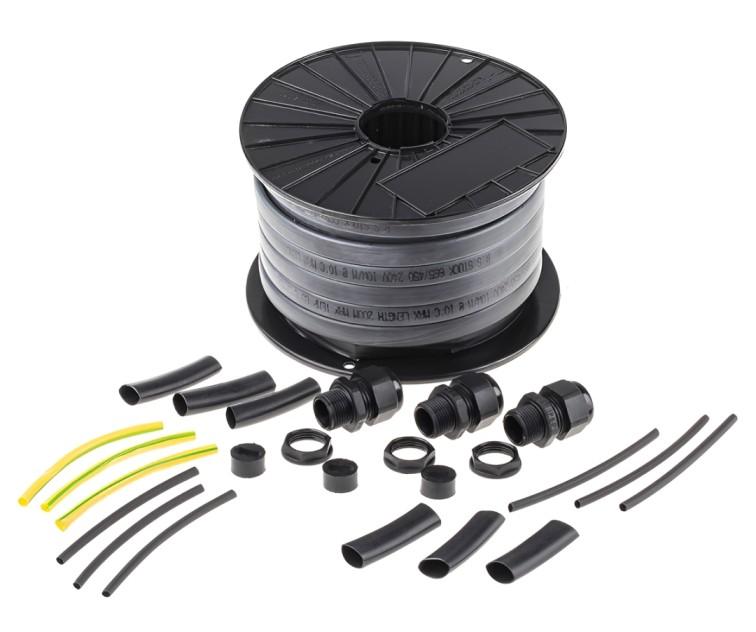
The 665-7481 Heat Tracing Kit is designed for controlled pipe heating where maintaining temperature and reducing freeze risk are important. With a 20 m self-regulating heating cable, 50 V AC operation, and a 12 W/m output, it provides a practical solution for selected HVAC, building services, and industrial temperature-maintenance applications.
How the 665-7481 Heat Tracing Kit Works
Self-regulating heat tracing changes its heat output according to local temperature conditions. Colder parts of the cable produce more heat, while warmer sections reduce their output.
This response helps the system adapt along a pipe run where one area may lose heat faster than another. Therefore, the cable can support more balanced thermal performance without producing the same level of heat at every point.
The kit is specified with a polyolefin sheath and a listed operating range from 0°C to 100°C. These characteristics make it suitable for non-hazardous installations where controlled surface heating is required.
Why Self-Regulating Heat Cable Is Useful
Traditional fixed-output heating cables deliver a constant wattage along their full length. By contrast, self-regulating cable responds to surrounding temperature changes.
That difference can improve energy use because the cable reduces output as sections warm up. It also gives designers more flexibility when heat loss varies across an installation.
However, correct insulation and system design still matter. Heat tracing should always be selected according to pipe material, ambient conditions, required maintenance temperature, and calculated heat loss.
Main Specifications of the 665-7481 Heating Kit
The 665-7481 model includes several important technical characteristics:
- 20 m trace heating cable length
- 50 V AC operating voltage
- 12 W heat output per metre
- Self-regulating heating technology
- Polyolefin outer sheath
- Maximum listed operating temperature of 100°C
- Minimum listed operating temperature of 0°C
- Intended for non-hazardous areas
These values provide a starting point for system planning. Nevertheless, installers should confirm whether the cable rating matches the thermal demand of the application.
Heat Tracing for Pipe Freeze Protection
Pipe freeze protection is one of the most common uses for trace heating. When water inside a pipe approaches the freezing point, flow can reduce, and pressure can rise.
The 665-7481 Heat Tracing Kit can help compensate for heat loss when it is correctly installed on suitable pipework and covered with appropriate thermal insulation.
Insulation remains essential because the cable should not be expected to overcome excessive heat loss on its own. A properly designed system combines heating, insulation, controls, and electrical protection.
HVAC and Building Services Applications
Heat tracing also plays an important role in HVAC and building services systems. It can help maintain temperatures in exposed pipe runs, plant rooms, service areas, or sections located near cold external surfaces.
In a broader HVAC installation, the trace heating circuit may operate alongside Fans, sensors, pumps, and Relays. These components perform different tasks, but together they support temperature management and system control.
Cables & Wires distribute power and control signals, while suitable Connectors, Circular Connectors, and Terminal Blocks may be used elsewhere in the electrical installation.
Electrical Components Supporting Heat Tracing
A heat tracing system relies on more than the heating cable itself. Control panels, monitoring circuits, and switching devices often contain Passive Components such as resistors, as well as other electrical parts.
Relays can provide circuit switching when a controller or thermostat calls for heat. Meanwhile, Terminal Blocks can help organise wiring inside suitable enclosures.
Every supporting component must be selected for the correct voltage, current, temperature, and environmental conditions. Using underrated accessories can reduce reliability and create safety risks.
Tools and Installation Considerations
Professional installation starts with planning. Installers may use Tools and Hand Tools for cable preparation, enclosure assembly, fixing systems, and insulation work.
Power Tools can assist with mounting brackets or control boxes where needed. Soldering equipment may also be used for associated control wiring, although heating cable connections should follow the manufacturer-approved termination method.
Before installation, check:
- Pipe diameter and construction
- Length of the heated section
- Lowest expected ambient temperature
- Desired maintain temperature
- Type and thickness of insulation
- Electrical supply characteristics
- Circuit protection requirements
- Moisture, chemical, or mechanical exposure
These checks help prevent underheating, excessive energy use, poor cable placement, and electrical faults.
Why Thermal Insulation Matters
Trace heating works most effectively when heat loss is controlled. Without suitable insulation, much of the generated heat can escape into the surrounding environment.
As a result, the cable may need to work harder and may still fail to maintain the desired temperature. Correct insulation improves thermal efficiency and helps stabilise pipe temperature.
The insulation material should also suit the operating environment. Moisture resistance, temperature capability, and mechanical durability are all important factors.
How to Select the Right Heat Tracing System
Choosing a trace heating solution requires more than matching cable length to pipe length. Engineers should calculate heat loss under the coldest expected conditions and compare it with the available heating output.
The 12 W/m rating of this kit provides a clear reference point. However, pipe diameter, insulation quality, wind exposure, installation location, and required maintenance temperature can significantly influence actual performance.
System designers should also consider electrical protection, control strategy, maintenance access, and cable routing before finalising the installation.
Final Thoughts on the 665-7481 Heat Tracing Kit
The 665-7481 Heat Tracing Kit offers a compact self-regulating heating solution for suitable pipe temperature-maintenance and freeze-protection applications. Its 20 m cable length, 50 V AC rating, 12 W/m output, and polyolefin construction provide useful parameters for system design.
For dependable performance, the kit should be matched to the actual heat-loss requirement and installed with suitable insulation, electrical protection, and approved accessories. When these factors are addressed correctly, self-regulating heat tracing can provide efficient and reliable temperature control in HVAC, commercial, and industrial environments.

 English
 Arabic
 French
 Spanish
 Portuguese
 Deutsch
 Dutch
 Italiano
 Russian
 Romaian
 Portuguese (Brazil)
 Greek