


Heat Meter Market Forecast 2034: Smart Metering and Energy Efficiency Trends
The transition toward energy-efficient heating systems, expanding district heating infrastructure, and growing demand for accurate thermal energy measurement are reshaping the adoption of heat metering technologies. Utilities, building owners, and industrial facilities are increasingly deploying advanced metering solutions to monitor consumption, improve billing accuracy, identify energy losses, and support more efficient heating operations. The integration of digital communication, remote monitoring, and data analytics is further strengthening the role of heat meters within modern energy management systems.
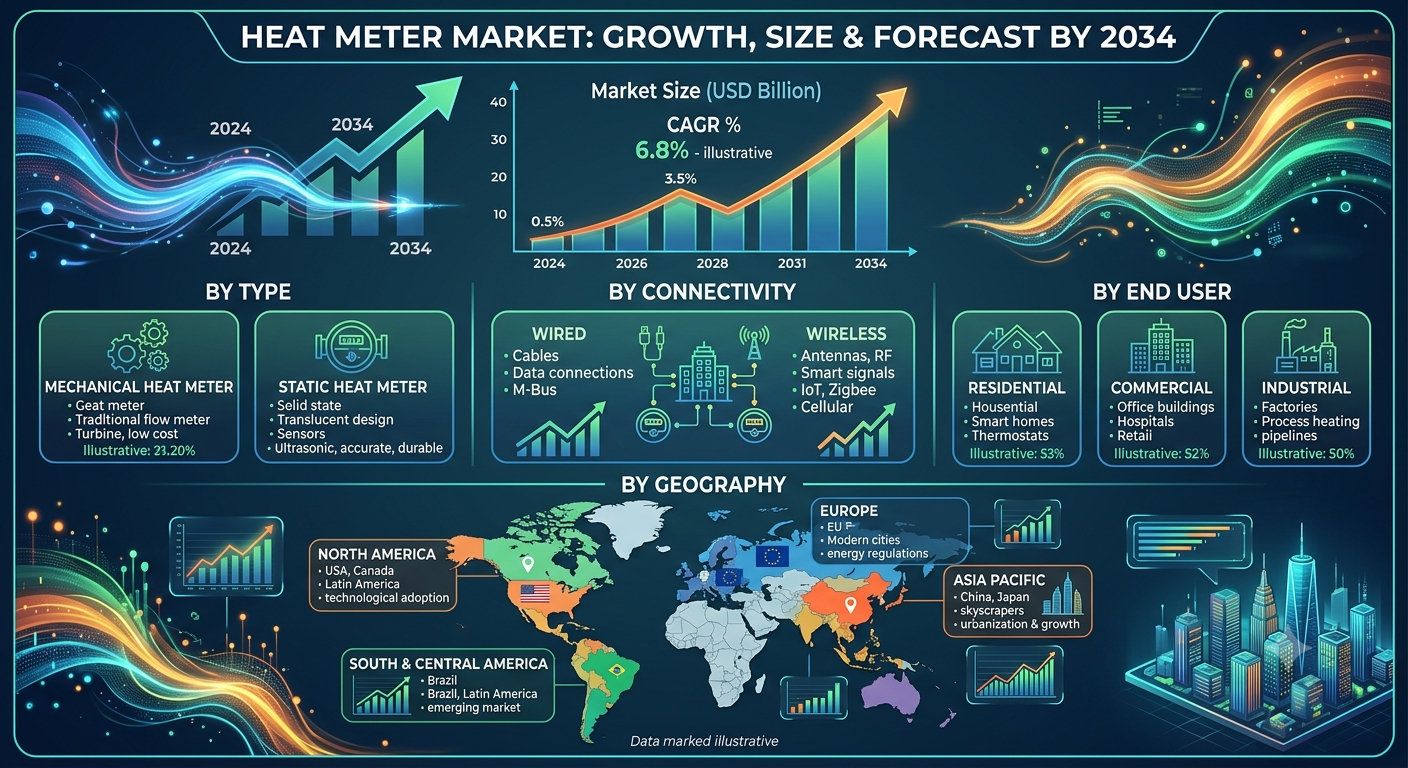
The Heat Meter Market Size was valued at US$1.28 billion in 2025 and is projected to reach US$2.86 billion by 2034, registering a CAGR of 9.36% from 2026 to 2034. The total addressable market is estimated at approximately US$18.50 billion during 2026–2034, indicating significant room for technology adoption across residential, commercial, and industrial applications. The industry is segmented by type into mechanical and static heat meters, by connectivity into wired and wireless systems, and by end user into residential, commercial, and industrial sectors.
Download Sample PDF Link:https://www.theinsightpartners.com/sample/TIPRE00009136
Key Market Report Drivers
Heat Meter Innovations Drive Energy Efficiency
Improving energy efficiency is one of the major factors supporting demand for heat meters. Heating systems can experience energy losses because of inefficient distribution, inaccurate measurement, poorly balanced networks, or changing operating conditions. Heat meters provide measurement of thermal energy consumption, allowing utilities and facility operators to understand where and how energy is being used. This information can support more effective energy management, consumption-based billing, and identification of operational inefficiencies.
The development of static and digitally enabled heat meters is also expanding the capabilities available to users. Static meters can provide accurate measurement without relying on conventional mechanical moving components, supporting applications where durability, measurement accuracy, and integration with digital systems are important.
Smart Heat Meters Enhance Monitoring and User Control
The shift from conventional metering toward connected systems is another important growth driver. Wireless connectivity enables heat consumption information to be collected remotely, reducing the need for manual meter readings and helping utilities streamline data management. Connected meters can also support more frequent consumption monitoring and integration with broader building or energy management platforms.
Smart metering is particularly relevant as buildings become increasingly digitized. Heat meters can provide data that supports consumption analysis, operational optimization, and more transparent energy usage. QUNDIS, for example, offers ultrasonic and impeller-based heat meters designed for measuring and recording heat consumption in systems with centralized heat generation.
District Heating and Sustainable Infrastructure Support Adoption
The expansion and modernization of district heating systems is another key factor influencing demand. Modern thermal networks increasingly combine district heating with technologies such as large-scale heat pumps and thermal energy storage. The European Union identifies smart thermal networks as an important component of heating-sector decarbonization, while modernization of existing infrastructure is creating demand for advanced monitoring and measurement technologies.
Heat meters support these systems by enabling thermal energy to be measured at the point of consumption. Accurate measurement is particularly important where multiple buildings, consumers, or network components are connected to centralized heating infrastructure. As utilities and municipalities pursue more efficient and lower-carbon heating systems, metering can play an increasingly important role in tracking energy performance.
Regional and Technology Trends
Europe remains an important environment for heat metering adoption because of established district heating networks, energy-efficiency initiatives, and modernization of building infrastructure. Industry research also points to increasing deployment of smart meters and energy management solutions across the region.
At the same time, opportunities are emerging across North America and Asia-Pacific as utilities, commercial buildings, industrial facilities, and residential developments increasingly prioritize digital energy monitoring. The US is identified by The Insight Partners as a key country within the global landscape.
From a technology perspective, wireless connectivity is gaining importance because it can simplify data collection and facilitate remote monitoring. Static heat meters are also positioned for continued adoption as users seek durable and digitally compatible measurement technologies. These developments are creating opportunities for manufacturers to combine accurate thermal measurement with communications, analytics, and smart-building capabilities.
Top Companies in the Heat Meter Market
The competitive landscape includes established metering, energy management, and industrial technology companies. According to The Insight Partners, key participants include Danfoss A/S, Diehl Stiftung and Co. KG, Engelmann Sensor GmbH, ista Deutschland GmbH, Itron Inc., Kamstrup, Landis+Gyr AG, Resideo Technologies, Inc., Siemens AG, and Wasion Group.
Companies are focusing on product development, connected metering, communication technologies, and integration with digital energy-management ecosystems. Competition is therefore extending beyond basic measurement capabilities toward solutions that provide remote data access, interoperability, analytics, and improved operational visibility.
Future Outlook
The outlook through 2034 is shaped by the convergence of energy efficiency, smart buildings, district heating modernization, and digital utility infrastructure. The projected increase from US$1.28 billion in 2025 to US$2.86 billion by 2034, at a 9.36% CAGR, reflects the growing importance of thermal energy measurement across multiple end-user environments.
Future development is expected to center on connected heat meters, wireless communication, smart-home integration, remote data collection, and solutions that help users optimize heating consumption. The growing emphasis on sustainable heating systems can further increase the requirement for accurate performance measurement. As district heating networks incorporate renewable energy, heat pumps, thermal storage, and other low-carbon technologies, heat metering can provide the data required to evaluate consumption and system performance.
The US$18.50 billion addressable market for 2026–2034 also highlights the broader opportunity available to technology providers, utilities, building operators, and metering companies.
About The Insight Partners
The Insight Partners is a global market research and consulting provider delivering actionable intelligence across technology, semiconductor, energy, healthcare, industrial, and other major industries. Its research combines market sizing, forecasting, competitive analysis, strategic insights, and regional assessment to support informed business planning.
Contact Us
The Insight Partners
Email: [email protected]
Phone: +1-646-491-9876
Website: https://www.theinsightpartners.com
Related Reports -
Submarine Fiber Cable Market Demand, Share & Growth by 2034
Aircraft Wiring Harness Market Dynamics and Trends by 2030
SCADA Oil and Gas Market Size, Trends & Growth by 2034

 English
 Arabic
 French
 Spanish
 Portuguese
 Deutsch
 Turkish
 Dutch
Dutch
 Russian
 Romaian
 Portuguese (Brazil)
 Greek
Greek