


Why Specialty Grades Are Becoming Important to Precipitated Silica Growth
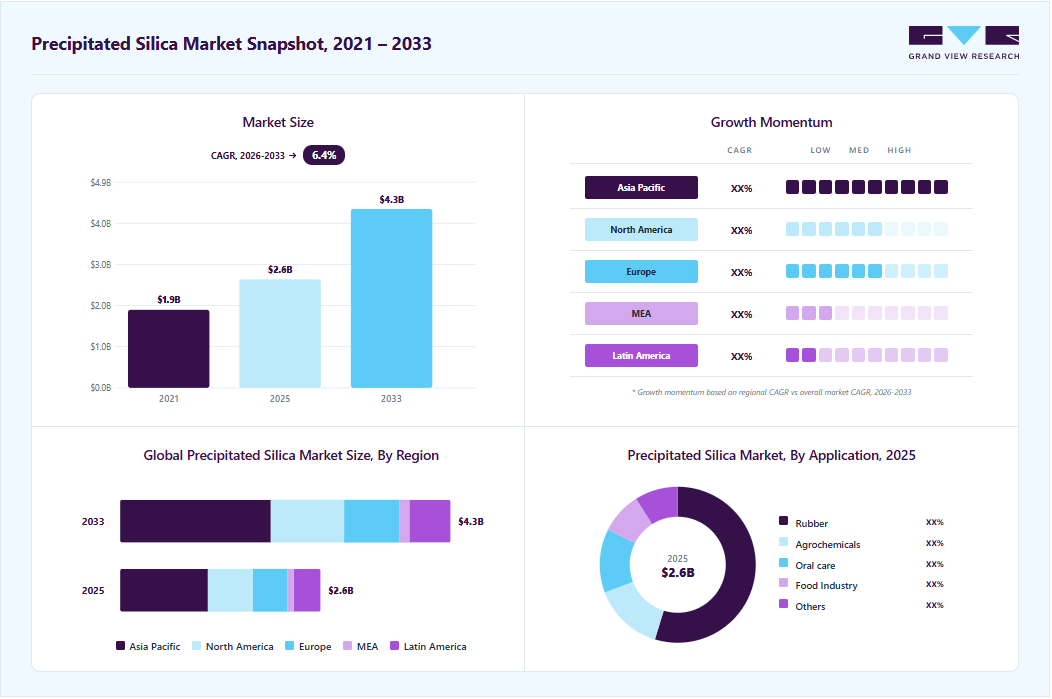
The precipitated silica market is expanding as demand increases from rubber, agrochemicals, oral care, food, and other industrial applications. The market was valued at USD 2.6 billion in 2025 and is projected to grow from USD 2.8 billion in 2026 to USD 4.3 billion by 2033, registering a CAGR of 6.4% from 2026 to 2033. Rising demand for reinforcing fillers, green tires, specialty silica, and sustainable production processes is creating new opportunities for manufacturers.
Key Market Dimensions
Application trends remain central to market development. The rubber segment accounted for over 54.0% of global revenue in 2025, making it the largest application category. Precipitated silica is extensively used as a reinforcing filler in tires, where it supports fuel efficiency, durability, and wet traction. Demand is also connected to green tire production as manufacturers work toward fuel-economy targets and reduced vehicle emissions.
Asia Pacific dominated the market with a 52.2% revenue share in 2025. Automotive production, tire manufacturing, industrial activity, personal care, cosmetics, and construction applications are supporting consumption across the region. Rising vehicle sales and expanding tire manufacturing capacity are additional sources of demand.
The market's application base extends beyond tires. Precipitated silica is used in silicone rubber, footwear soles, industrial rubber products, agrochemicals, oral care, paints and coatings, defoamers, plastics, and adhesives and sealants. This broad application range provides manufacturers with opportunities to serve different performance requirements.
Core Market Drivers & Trends
Growing demand from the automotive, rubber, and industrial sectors is a primary market driver. In tire manufacturing, precipitated silica acts as a reinforcing filler and contributes to low-rolling-resistance tires. Its role in improving fuel efficiency, durability, and wet traction is supporting continued adoption.
The shift toward greener mobility is also influencing demand. Low-rolling-resistance tires can improve fuel efficiency and reduce carbon emissions, while the increasing adoption of electric vehicles and lightweight materials is creating additional avenues for precipitated silica. Manufacturers are also developing specialty silicas with tailored particle sizes, surface areas, and dispersibility for high-performance tires, advanced coatings, and personal care products.
The agrochemicals segment is projected to grow at a CAGR of 5.7% during the forecast period. In liquid formulations, precipitated silica functions as a rheology modifier and anti-settling agent. In solid agrochemicals, it serves as a process aid, free-flowing agent, milling aid, and anti-cracking additive. These functions can improve manufacturing efficiency, formulation stability, and handling characteristics.
Oral care represents another important application. Precipitated silica is used in toothpaste as a polishing, whitening, and cleansing ingredient. Rising consumer awareness around hygiene and wellness is supporting demand for oral care products containing silica.
Supply Chain & Production Technology
Production economics remain an important consideration for the market. Raw materials such as sodium silicate and high-purity quartz can experience price fluctuations, while silica dust regulations and wastewater treatment standards can increase operating expenses. Regulatory compliance and production costs therefore influence manufacturing decisions and market expansion.
Technology and product innovation are helping manufacturers respond to changing requirements. Specialty grades can be engineered around particle size, surface area, and dispersibility, allowing precipitated silica to meet application-specific performance requirements. Such developments are particularly relevant to high-performance tires, coatings, and personal care products.
Sustainability is becoming increasingly important. Manufacturers are focusing on eco-friendly production processes, energy-efficient manufacturing, and reducing environmental emissions associated with silica production. Bio-derived precipitated silica produced from rice husk ash is gaining traction because of its lower carbon footprint and alignment with sustainability mandates.
In January 2026, Evonik announced plans to expand precipitated silica production capacity by 50% at its Charleston, South Carolina, facility to serve tire and specialty rubber industries. The development reflects increasing attention toward capacity expansion and specialty applications.
Application Expansion and Competitive Landscape
Rubber remains the central application area, but opportunities are expanding across agrochemicals, oral care, food, coatings, adhesives and sealants, plastics, and other uses. The combination of reinforcing performance, formulation support, and specialized material characteristics enables precipitated silica to address varied industrial requirements.
Recent developments include Evonik's January 2025 merger of its Silica and Silanes business lines into Smart Effects, Aksharchem India Ltd.'s June 2025 commissioning of an expanded precipitated silica facility at Dahej, Gujarat, and Tata Chemicals Ltd.'s November 2025 board approval for an expansion of precipitated silica manufacturing capacity by 50 Kilo Tonnes per annum.
Future Market Outlook
The market is expected to continue expanding through 2033 as automotive, tire, agrochemical, oral care, and industrial applications generate demand. Sustainability, specialty product development, green tire adoption, electric vehicles, and advanced manufacturing are creating additional pathways for market development.
FAQ
How big is the precipitated silica market?
The precipitated silica market was valued at USD 2.6 billion in 2025, is estimated at USD 2.8 billion in 2026, and is projected to reach USD 4.3 billion by 2033, growing at a CAGR of 6.4% from 2026 to 2033.
What trends are shaping the precipitated silica market?
Key trends include green tire adoption, demand for low-rolling-resistance tires, specialty silica development, electric vehicle growth, sustainable production, bio-derived silica, and expanding applications across agrochemicals, oral care, coatings, personal care, and industrial products.
Key Precipitated Silica Companies:
· Anten Chemical Co. Ltd.
· Evonik Industries
· Huber Engineered Materials
· IQE Group
About us:
Grand View Research, a market research and consulting company, provides syndicated research reports, customized research reports, and consulting services. Grand View Research database is used by the world's renowned academic institutions and Fortune 500 companies to understand the global and regional business environment. Our database features thousands of statistics and in-depth analysis on 46 industries in 25 major countries worldwide.

 Arabic
 French
 Spanish
 Portuguese
 Deutsch
 Turkish
 Dutch
Dutch
 Italiano
 Russian
 Romaian
 Portuguese (Brazil)
 Greek
Greek