


Agriculture Sensors Market Outlook: Trends and Opportunities to 2034
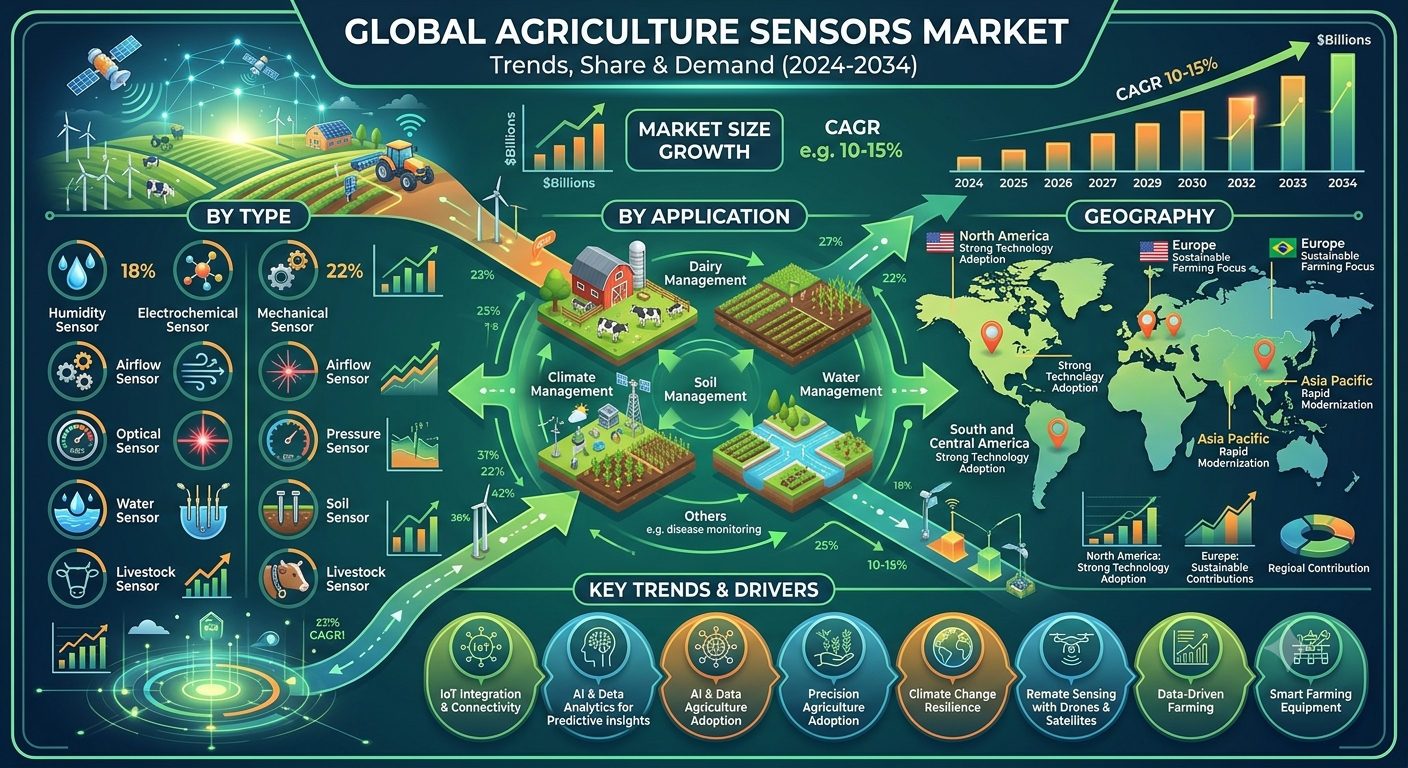
Increasing demand for efficient agricultural production, resource conservation, and data-driven farm management is accelerating the adoption of advanced sensing technologies across farming operations. Soil conditions, moisture levels, temperature, humidity, water quality, crop health, and livestock parameters can increasingly be monitored through connected sensing devices, enabling growers to make more timely operational decisions. The integration of sensors with digital agriculture platforms is also supporting automation across irrigation, fertilization, climate control, and crop monitoring.
The Agriculture Sensors Market Size is projected to expand from US$2.66 billion in 2025 to US$6.61 billion by 2034, registering a CAGR of 12.05% during 2026–2034. The addressable market is estimated at approximately US$44.13 billion during 2026–2034, highlighting substantial room for adoption across crop production, livestock management, soil management, climate management, and water management applications. The Insight Partners identifies smart agriculture, precision farming, and sustainable agricultural practices as major growth drivers.
Download Sample PDF: https://www.theinsightpartners.com/sample/TIPRE00026893
Rising Adoption of Smart Agriculture Technologies
One of the major drivers influencing the Agriculture Sensors Market is the transition from conventional farming toward smart and connected agriculture. IoT-enabled sensors allow farmers to collect continuous information from fields and livestock, while cloud platforms and analytics tools help convert this information into actionable insights. Sensors can measure parameters such as soil moisture, temperature, humidity, nutrient conditions, water levels, and crop characteristics.
The growing availability of wireless connectivity is further improving the practicality of deploying sensors over large agricultural areas. Technologies such as IoT networks, LoRaWAN, NB-IoT, and other wireless communication systems enable data transmission from remote locations to centralized farm management platforms. This supports real-time monitoring and helps reduce dependence on manual field inspections.
Precision Agriculture Drives Sensor Deployment
Precision agriculture represents another important growth driver. Farmers are increasingly seeking technologies that enable agricultural inputs to be applied according to the specific conditions of different areas within a field. Soil and environmental sensors provide localized information that can support irrigation scheduling, fertilizer management, crop monitoring, and yield optimization.
Soil sensors are particularly important because they provide information about moisture, temperature, and other soil characteristics. Connected soil-monitoring systems can help farmers identify variations across fields and make more targeted decisions. The growing emphasis on improving productivity while controlling input costs is therefore encouraging investment in sensor-based precision farming solutions.
Sustainability and Water Conservation Support Demand
Increasing pressure to use agricultural resources more efficiently is strengthening demand for sensor technologies. Water management is a significant application area, with moisture and water sensors helping growers determine when and where irrigation is required. This can support more precise water application and reduce unnecessary irrigation.
Sensors can also contribute to more efficient fertilizer use by providing information about soil and crop conditions. As sustainable farming practices become increasingly important, growers and agribusinesses are exploring technologies that can improve resource utilization while maintaining productivity. The Insight Partners specifically identifies sustainable farming and eco-friendly agricultural practices among the key factors supporting industry expansion.
Integration of AI, IoT, and Advanced Analytics
The combination of sensors with artificial intelligence, machine learning, remote sensing, and farm management software is creating additional opportunities. Sensor-generated datasets can be analyzed to identify patterns and support predictive decisions related to irrigation, crop stress, disease detection, and farm operations.
Advanced optical and multispectral sensors are also expanding the ability to monitor crop conditions remotely. Sentera, for example, develops agricultural sensing technologies including multispectral sensors and high-resolution cameras for vegetation analysis and precision agriculture applications.
This convergence of hardware, connectivity, and analytics is shifting agriculture sensors from standalone measurement devices toward integrated components of digital farming ecosystems.
Agriculture Sensors Market: Key Companies
The competitive landscape includes technology companies, sensor manufacturers, precision agriculture providers, and agricultural technology specialists. According to The Insight Partners, prominent companies profiled include Texas Instruments Inc., Auroras s.r.l., Robert Bosch GmbH, AG Leader, Avidor High Tech, Pycno Agriculture, Trimble Inc., Sentera, LLC., CropX Inc., and The Yield Pty.
Other companies identified across industry research include Deere & Company, Libelium, METER Group, Soil Scout, Yara, Acclima, and Topcon. Companies are focusing on sensor accuracy, connectivity, energy efficiency, data integration, and application-specific solutions to address the requirements of modern farming.
Future Outlook
The future outlook for agriculture sensors remains closely connected with the broader digital transformation of farming. Increasing adoption of precision agriculture, connected irrigation, automated farm machinery, smart greenhouse systems, and data-driven crop management is expected to create continued opportunities for sensor manufacturers.
The integration of AI and machine learning could further increase the value of sensor-generated data by enabling predictive insights and automated responses. At the same time, wireless technologies and lower-power sensor architectures can help expand deployments across remote and large-scale agricultural operations. The Insight Partners forecasts the Agriculture Sensors Market to reach US$6.61 billion by 2034, with a 12.05% CAGR from 2026 to 2034.
As agriculture increasingly moves toward connected and resource-efficient production models, sensors are positioned to serve as an important data-collection layer connecting physical farm conditions with digital decision-making systems.
About The Insight Partners
The Insight Partners is a globally recognized market research and consulting firm providing reliable and actionable insights across industries. The company delivers comprehensive research reports, industry analysis, strategic intelligence, and customized consulting solutions to help businesses understand emerging opportunities, competitive dynamics, technological developments, and growth trends.
Contact Us
The Insight Partners
Email: [email protected]
Phone: +1-646-491-9876
Website: https://www.theinsightpartners.com
Related Reports -
Submarine Fiber Cable Market Demand, Share & Growth by 2034
Aircraft Wiring Harness Market Dynamics and Trends by 2030
SCADA Oil and Gas Market Size, Trends & Growth by 2034

 English
 French
 Spanish
 Portuguese
 Deutsch
 Turkish
 Dutch
Dutch
 Italiano
 Russian
 Romaian
 Portuguese (Brazil)
 Greek
Greek