


From Testing to Immunotherapy, Allergy Care Is Entering a New Growth Phase
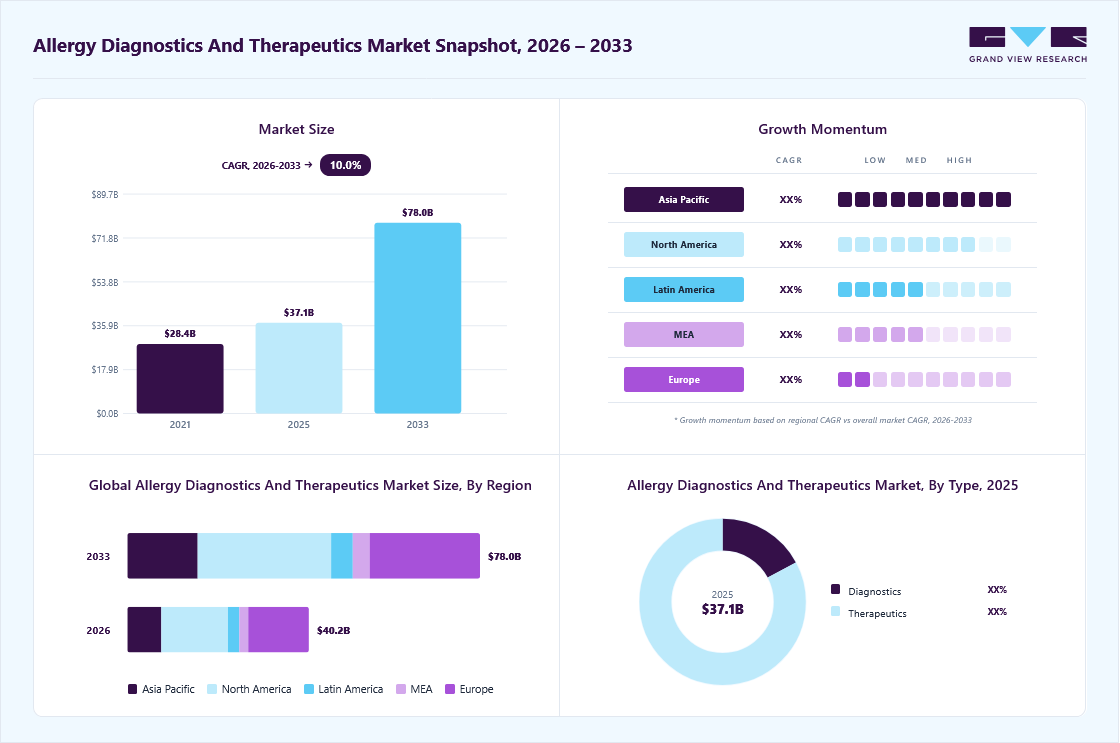
The allergy diagnostics and therapeutics market is expanding as the prevalence of allergic conditions rises and demand grows for earlier diagnosis, advanced testing, and effective treatment options. The market was valued at USD 37.1 billion in 2025 and is projected to reach USD 40.2 billion in 2026 and USD 78.0 billion by 2033, registering a CAGR of 10.0% from 2026 to 2033. Increasing adoption of immunotherapy drugs, technological advances, new product launches, and growing demand for precise allergy identification are contributing to market development.
Market Segmentation & Key Drivers
The market is segmented by type, allergen type, and test type. Therapeutics represented the largest type segment, accounting for 82.9% of market share in 2025. The segment benefits from continued demand for treatments that alleviate allergy symptoms and address allergic conditions. Epinephrine held a prominent position in allergy therapeutics because of its rapid response during severe allergic reactions such as anaphylaxis.
Diagnostics, meanwhile, are anticipated to experience the highest CAGR during the forecast period as healthcare providers seek more precise and earlier identification of allergic conditions. The increasing number of product launches and developments in testing technologies is supporting this segment.
By allergen type, inhaled allergies held the largest share at 49.9% in 2025. Increasing exposure to air pollution, environmental contaminants, indoor allergens, and longer pollen seasons is contributing to demand for inhaled allergy diagnosis and treatment. Molecular allergen profiling and component-resolved diagnostics are also improving the identification of specific allergen triggers.
The in vitro test segment accounted for the largest test-type share at 52.3% in 2025. In vitro testing is used to identify allergen-specific immunoglobulin E and can be applied to food, inhalation, skin, and medication allergies. Its minimally invasive characteristics, convenience, and cost-effectiveness are supporting adoption.
Competitive Landscape & Innovators
The allergy diagnostics and therapeutics industry is characterized by high innovation, with developments spanning AI-enabled diagnostics, digital health, molecular diagnostics, and multiplex assays. Artificial intelligence is being incorporated into allergy testing platforms to assist clinicians in interpreting results and supporting decisions related to treatment.
Innovations in diagnostic testing are also focused on making procedures faster, more precise, and more patient-friendly. Microfluidics, biosensor-based platforms, and lab-on-a-chip technologies are being developed to enable rapid testing with smaller sample volumes. Combining these technologies with AI and data analytics can support more personalized allergy assessment and treatment interventions.
The industry also features mergers and acquisitions, strategic collaborations, new product launches, technological developments, and investments in research and development. Regulatory requirements remain important because diagnostic and therapeutic products must meet standards related to efficacy, manufacturing quality, and patient safety.
Future Horizon & Regional Outlook
North America accounted for the largest regional revenue share at 36.6% in 2025. Strong healthcare infrastructure, established regulatory frameworks, high allergy prevalence, R&D investment, clinical trials, and adoption of advanced diagnostic and therapeutic technologies are supporting the market.
The U.S. market is supported by rising allergy prevalence, healthcare spending, early diagnosis, advanced healthcare infrastructure, and significant R&D investment. The adoption of molecular diagnostics and biologic drugs is also contributing to market development.
Europe is expected to grow rapidly as allergic disorders become more prevalent and public health awareness increases. The region benefits from established healthcare systems, investments in diagnostic technologies, and growing access to biologic therapies and sublingual immunotherapy.
Asia Pacific is expected to grow at a lucrative rate, supported by healthcare reforms, expanding healthcare infrastructure, population growth, rising allergy incidence, and the entry of local companies. Japan, China, and India are identified as notable markets within the region.
Latin America is experiencing steady development alongside improvements in healthcare facilities, public health infrastructure, and awareness of allergic diseases. However, reimbursement limitations, financial constraints, and unequal access to specialized care remain challenges.
The Middle East & Africa market is also expanding as allergy prevalence, urbanization, environmental exposure, healthcare awareness, and healthcare infrastructure development increase. Greater access to specialist services and innovative therapies is supporting continued market development.
Technology and Treatment Innovation
Technological development is expected to remain an important part of market expansion. Molecular diagnostics, multiplex testing systems, point-of-care devices, AI-driven diagnostic tools, and digital health platforms are improving the ability to identify and monitor allergic conditions.
On the therapeutics side, growth is being supported by immunotherapy, targeted desensitization protocols, and biologic treatments for severe allergies. Product development is largely focused on improving existing therapies while expanding treatment options for unmet patient needs.
Recent developments highlighted on the market page include the FDA approval of Xolair for certain food allergy applications in February 2024, the launch of a next-generation Basophil Activation Test by Beckman Coulter Life Sciences in April 2025, and the launch of Allegra-D by Sanofi in August 2025.
FAQ
Which segment leads the allergy diagnostics and therapeutics market?
Therapeutics was the leading type segment, holding 82.9% of market share in 2025. Inhaled allergies led by allergen type with 49.9%, while in vitro tests represented 52.3% of the market by test type in 2025.
What trends are shaping the allergy diagnostics and therapeutics market?
The market is being shaped by rising allergy prevalence, increasing demand for precise diagnosis, AI and digital health adoption, molecular diagnostics, multiplex assays, point-of-care testing, immunotherapy, biologic treatments, and growing development of faster and more patient-friendly allergy tests.
Key Allergy Diagnostics And Therapeutics Companies:
· R-Biopharm AG
· Thermo Fisher Scientific, Inc.
· DASIT Group SPA
· EUROIMMUN Medizinische Labordiagnostika AG (PerkinElmer, Inc.)
About us:
Grand View Research, a market research and consulting company, provides syndicated research reports, customized research reports, and consulting services. Grand View Research database is used by the world's renowned academic institutions and Fortune 500 companies to understand the global and regional business environment. Our database features thousands of statistics and in-depth analysis on 46 industries in 25 major countries worldwide.

 English
 Arabic
 French
 Portuguese
 Deutsch
 Turkish
 Dutch
Dutch
 Italiano
 Russian
 Romaian
 Portuguese (Brazil)
 Greek
Greek