


GPIO Expanders Market Development and Industry Outlook to 2034
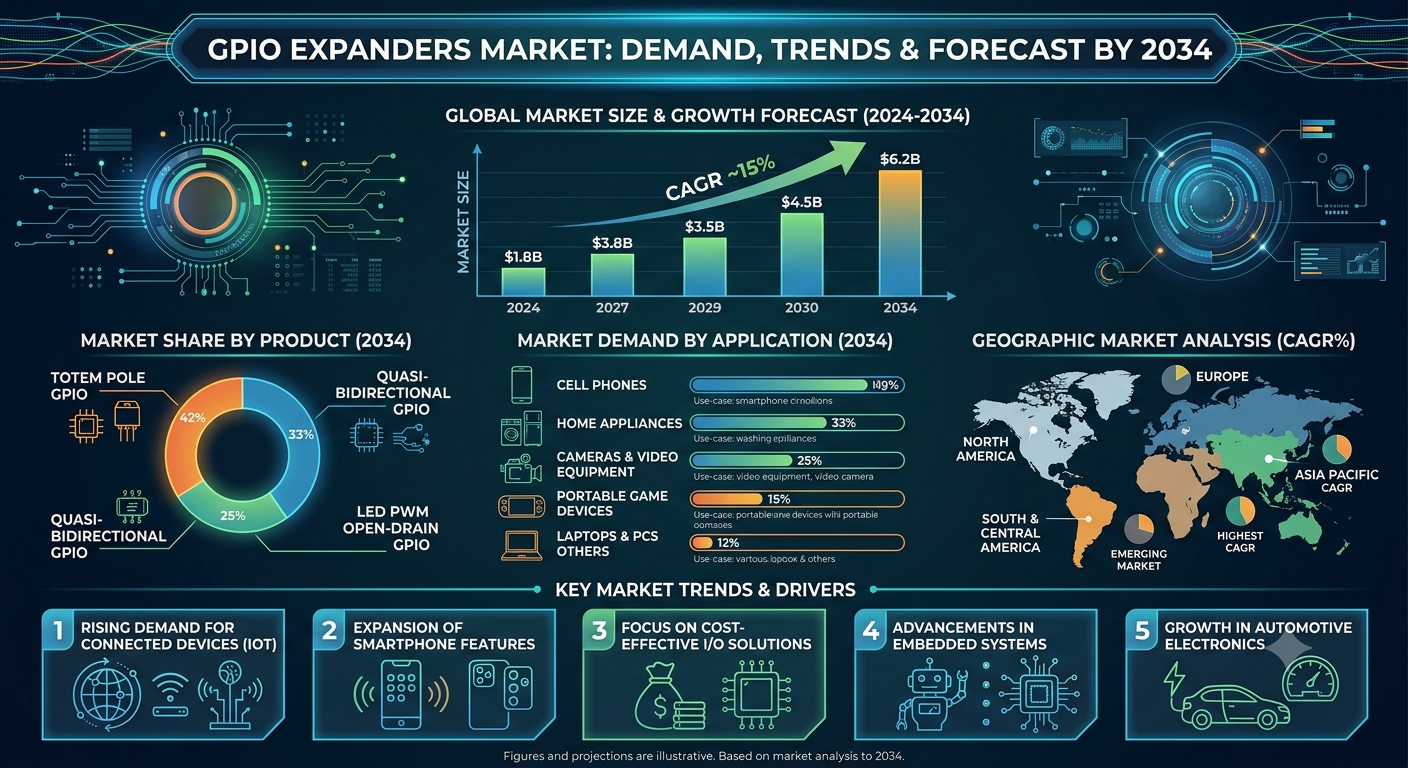
The growing complexity of electronic devices is increasing the need for flexible input/output management solutions. GPIO expanders enable microcontrollers, processors, and system-on-chip platforms to access additional digital I/O through interfaces such as I2C and SPI without requiring a larger controller package. Their ability to simplify board design, support compact architectures, and provide configurable connectivity makes them increasingly relevant across consumer electronics, automotive, industrial automation, telecommunications, and embedded computing applications.
The GPIO Expanders Market Size is valued at US$804.18 million in 2025 and is projected to reach US$1,828.54 million by 2034, expanding at a 9.56% CAGR from 2026 to 2034. The addressable opportunity is estimated at US$11,745.07 million during 2026–2034, reflecting the broad application potential of these components across increasingly connected electronic systems. As manufacturers seek to add functionality while maintaining compact form factors and efficient controller architectures, GPIO expanders are becoming an important component of modern embedded designs.
Download Sample PDF Link:https://www.theinsightpartners.com/sample/TIPRE00008268
GPIO Expanders Market Drivers
One of the primary drivers is the increasing adoption of embedded systems across multiple industries. Modern electronic products often require more control and monitoring signals than a microcontroller can provide directly. GPIO expanders address this limitation by adding configurable digital I/O through a small number of communication lines. This approach allows designers to increase functionality without replacing the primary controller with a device offering a significantly higher pin count.
The expansion of connected consumer electronics is another important growth factor. Smart home appliances, wearables, networking equipment, smart displays, and other connected products incorporate numerous sensors, switches, indicators, and peripheral devices. GPIO expanders can provide the additional digital interfaces required to manage these functions while helping manufacturers control board complexity and component costs.
Growing Demand for Compact and Flexible Electronics
Miniaturization is creating strong demand for semiconductor components that deliver greater functionality within limited board space. GPIO expanders allow engineers to manage multiple digital signals using relatively simple serial interfaces. This can reduce the number of traces required between the processor and peripheral components and support more efficient PCB layouts.
In industrial applications, programmable controllers, monitoring equipment, instrumentation, and automation systems increasingly require distributed control and status monitoring. GPIO expanders can support functions such as controlling relays, reading switches, monitoring alarms, and managing LEDs. Their flexibility makes them suitable for systems where the number of digital signals can vary according to application requirements.
Automotive Electronics Supporting Adoption
The rapid integration of electronics into vehicles is also contributing to demand. Advanced automotive systems incorporate numerous electronic control modules, sensors, lighting functions, infotainment features, and body-control applications. GPIO expanders can help manage additional digital signals in applications where processor I/O resources are constrained.
The development of electric vehicles and increasingly sophisticated vehicle architectures further increases the number of electronic functions that need to be monitored and controlled. As automotive manufacturers focus on centralized computing, connectivity, and sophisticated electronic control systems, efficient I/O expansion can become an important design consideration.
Technological Developments and Industry Trends
Technological advancements in semiconductor design are encouraging manufacturers to develop GPIO expanders with improved power efficiency, faster communication, greater configuration flexibility, and enhanced reliability. Compatibility with widely adopted interfaces such as I2C and SPI enables designers to integrate these components into existing architectures with limited changes.
Another significant trend is the increasing emphasis on low-power electronics. Battery-operated and energy-efficient devices require components that can perform required functions while minimizing power consumption. Manufacturers are therefore focusing on GPIO expander architectures that support low-power operating modes and efficient signal management.
The growth of industrial IoT is also creating opportunities. Connected industrial equipment increasingly relies on sensors, actuators, and monitoring devices that generate numerous digital signals. GPIO expansion can help embedded platforms accommodate these requirements while maintaining scalable system architectures.
Top Companies in the GPIO Expanders Market
Key companies operating in this space include Texas Instruments Incorporated, NXP Semiconductors N.V., Microchip Technology Inc., STMicroelectronics, Infineon Technologies AG, Renesas Electronics Corporation, Analog Devices, Inc., Diodes Incorporated, onsemi, and ROHM Co., Ltd.
These companies are focusing on product development, semiconductor integration, interface compatibility, power efficiency, and application-specific solutions. Competitive strategies include new product launches, technological improvements, portfolio expansion, and investments aimed at addressing evolving embedded-system requirements.
Future Outlook
The outlook for GPIO expanders remains closely connected to the continued expansion of embedded electronics, connected devices, automotive electronics, industrial automation, and smart infrastructure. The transition toward more sophisticated electronic architectures is increasing the number of digital signals that processors and controllers must manage.
From US$804.18 million in 2025, the industry is expected to reach US$1,828.54 million by 2034, representing a 9.56% CAGR during 2026–2034. The sizable addressable opportunity of US$11,745.07 million further highlights the potential applications across different electronic systems.
Future product development is likely to emphasize lower power consumption, smaller package sizes, faster interfaces, greater configurability, and enhanced reliability. As system designers continue balancing performance, functionality, cost, and physical space, GPIO expansion solutions are expected to remain relevant across a broad range of electronic platforms.
About The Insight Partners
The Insight Partners is a global market research and consulting provider delivering actionable intelligence across technology, semiconductor and electronics, healthcare, chemicals and materials, industrial, and other major industries. Its research combines industry analysis, competitive intelligence, market assessments, and strategic insights to help businesses understand evolving opportunities and make informed decisions.
Contact Us
The Insight Partners
Email: [email protected]
Phone: +1-646-491-9876
Website: https://www.theinsightpartners.com
Related Reports -
Submarine Fiber Cable Market Demand, Share & Growth by 2034
Aircraft Wiring Harness Market Dynamics and Trends by 2030
SCADA Oil and Gas Market Size, Trends & Growth by 2034

 Arabic
 French
 Spanish
 Portuguese
 Deutsch
 Turkish
 Dutch
Dutch
 Italiano
 Russian
 Romaian
 Portuguese (Brazil)
 Greek
Greek