


Displacement Measurement Sensors Market Expansion Across Key Industries
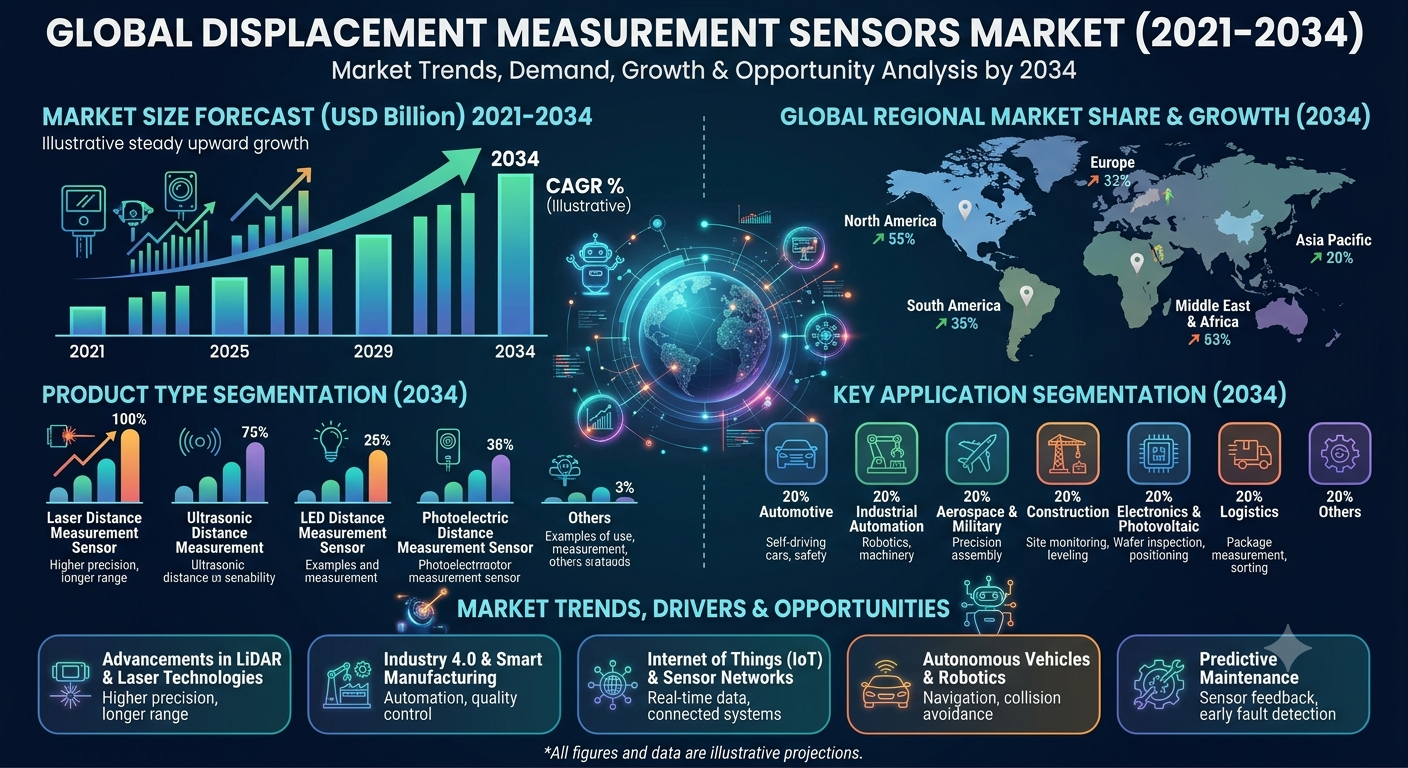
Precision measurement has become increasingly important across modern manufacturing, automation, infrastructure, electronics, and transportation applications. Displacement measurement sensors enable accurate detection of an object's position, distance, movement, or dimensional variation, supporting quality control, process optimization, equipment monitoring, and safety. Advancements in sensing technologies, rising automation levels, and growing demand for real-time measurement are encouraging industries to deploy sophisticated sensing solutions across production and inspection environments. Laser, ultrasonic, LED, and photoelectric technologies are being adopted for applications requiring reliable and highly precise displacement detection.
The Displacement Measurement Sensors Market Size was valued at US$1.3 billion in 2025 and is projected to reach US$2.26 billion by 2034, registering a CAGR of 7.16% from 2026 to 2034. The total addressable market is estimated at US$16.80 billion during 2026–2034, highlighting the substantial opportunity available across industrial and emerging applications. The report covers laser distance measurement sensors, ultrasonic distance measurement, LED distance measurement sensors, and photoelectric distance measurement sensors across automotive, aerospace and military, industrial automation, construction, electronics and photovoltaic, logistics, and other applications.
Download Sample PDF Link:https://www.theinsightpartners.com/sample/TIPRE00023686
Market Report Drivers
Innovative Sensor Technologies Transforming Displacement Measurement
Technological innovation is one of the primary factors supporting the expansion of displacement measurement solutions. Modern sensors are increasingly designed to deliver improved accuracy, repeatability, response time, and reliability while operating in demanding industrial environments. Laser-based sensing, optical technologies, ultrasonic measurement, and photoelectric detection are expanding the range of applications where non-contact measurement can replace conventional techniques.
The integration of advanced electronics and intelligent processing is also helping manufacturers obtain more actionable measurement data. Improved sensing capabilities can support automated inspection, dimensional verification, position monitoring, and process control. As manufacturers seek greater precision and reduced production variability, advanced displacement measurement technologies are becoming increasingly relevant to automated production environments.
Rising Demand for Automation Boosts Adoption
The rapid adoption of industrial automation represents another significant growth driver. Manufacturing facilities increasingly depend on sensors to monitor machine movements, component positioning, product dimensions, and production quality in real time. Displacement sensors can be incorporated into automated machinery and inspection systems, helping manufacturers maintain consistent production standards while reducing manual intervention.
The industrial automation segment is particularly important because displacement measurement can be applied throughout production workflows, from component positioning to final quality inspection. Increasing automation across automotive, electronics, logistics, and other industries is therefore creating additional demand for accurate and dependable sensing technologies.
Accuracy and Reliability Strengthen Industrial Adoption
Enhanced accuracy and reliability are critical requirements in industries where even small dimensional deviations can affect product quality, equipment performance, or operational safety. Displacement measurement sensors provide precise information about the movement and position of objects, making them valuable for applications involving automated inspection and process monitoring.
In automotive manufacturing, for example, sensors can support dimensional inspection and automated production processes. Aerospace and military applications require dependable measurement capabilities for sophisticated equipment and components, while construction applications can use displacement monitoring to support infrastructure and structural observation. These diverse requirements create opportunities for sensor suppliers across multiple industries.
Opportunities Across Emerging Applications
Smart infrastructure and construction monitoring represent an important opportunity for displacement sensing technologies. The development of smart sensors capable of supporting real-time infrastructure monitoring can improve the collection of information related to structural movement and changes. The Insight Partners identifies smart sensors for accurate displacement measurement and real-time infrastructure monitoring among the opportunities influencing industry dynamics.
Another opportunity is the integration of intelligent analytics with sensing systems. AI-driven analytics can help transform raw measurement information into useful operational insights, potentially supporting predictive maintenance, quality assurance, and process optimization. Sustainable and eco-friendly sensing solutions are also emerging as manufacturers and infrastructure operators place greater emphasis on efficient technologies and environmental monitoring.
Product and Application Landscape
The industry is segmented by product type into laser distance measurement sensors, ultrasonic distance measurement sensors, LED distance measurement sensors, and photoelectric distance measurement sensors. By application, the major areas include automotive, aerospace and military, industrial automation, construction, electronics and photovoltaic, logistics, and others. Geographically, the analysis covers North America, Europe, Asia-Pacific, South and Central America, and the Middle East and Africa, with country-level analysis including the United States, Canada, Mexico, China, India, Japan, Australia, the UK, Germany, France, and other markets.
Top Players
The competitive landscape includes established sensor and automation companies such as OMRON Corporation, Lion Precision, Panasonic Corp, Micro-Epsilon, RIFTEK LLC, KEYENCE CORPORATION, Autonics Corporation, Ixthus Instrumentation, HBK, and SICK AG. Other industry sources also identify companies including Baumer, Pepperl+Fuchs, Balluff, ifm Electronic, Turck, Schneider Electric, Rockwell Automation, OPTEX, SensoPart, Leuze electronic, Datalogic, and Sunny Optical as participants in the broader displacement measurement sensor ecosystem.
Competition is increasingly influenced by sensor precision, product miniaturization, integration capabilities, application-specific solutions, and the ability to provide measurement technologies suitable for automated production systems. Product development and technological differentiation are consequently important considerations for participants seeking to expand their presence across industrial applications.
Future Outlook
The future of displacement measurement sensors is expected to be shaped by greater automation, intelligent sensing, AI-supported analytics, and demand for highly accurate real-time measurement. As manufacturers modernize production lines and integrate connected technologies into industrial processes, sensors will increasingly serve as essential data-generation components within automated systems.
The global Displacement Measurement Sensors Market is projected to grow from US$1.3 billion in 2025 to US$2.26 billion by 2034, representing a 7.16% CAGR during 2026–2034. With an estimated US$16.80 billion addressable market, opportunities are expected to extend across established industrial applications as well as smart infrastructure, electronics, logistics, and advanced manufacturing.
About The Insight Partners
The Insight Partners is a global market research and consulting firm providing actionable intelligence across technology, semiconductor and electronics, healthcare, industrial, energy, telecommunications, and other sectors. Its research combines market analysis, industry expertise, and primary and secondary research to help businesses understand evolving industry dynamics and identify growth opportunities.
Contact Us
The Insight Partners
Email: [email protected]
Phone: +1-646-491-9876
Website: https://www.theinsightpartners.com
Related Reports -
Submarine Fiber Cable Market Demand, Share & Growth by 2034
Aircraft Wiring Harness Market Dynamics and Trends by 2030
SCADA Oil and Gas Market Size, Trends & Growth by 2034

 English
 French
 Spanish
 Portuguese
 Deutsch
 Turkish
 Dutch
Dutch
 Italiano
 Russian
 Romaian
 Portuguese (Brazil)
 Greek
Greek