


Webcam Eye Tracking Market Forecast, Drivers and Competitive Landscape
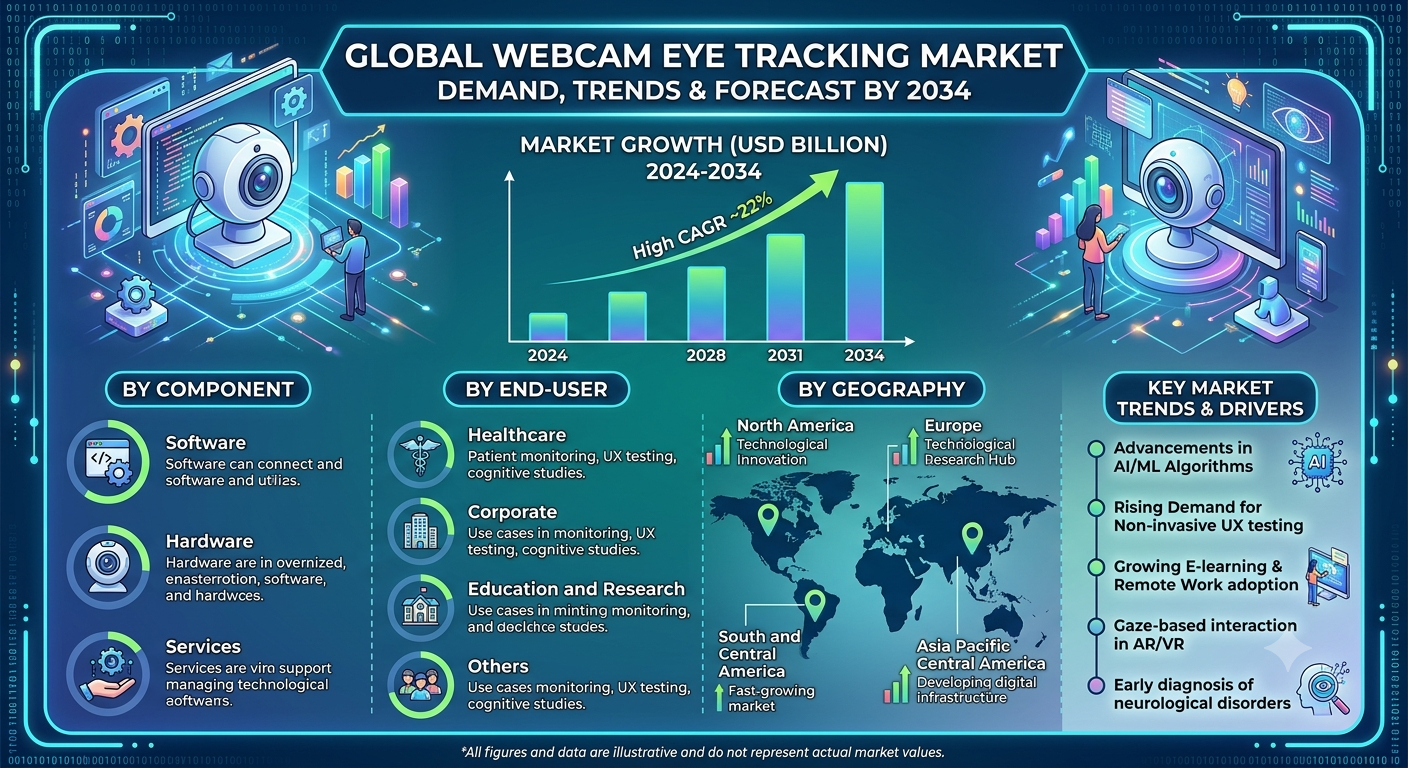
Webcam-based eye tracking is emerging as an accessible technology for understanding visual attention, user behavior, and human-computer interaction. By using standard webcams, advanced computer vision, artificial intelligence, and gaze-estimation algorithms, organizations can capture eye movements without requiring specialized infrared tracking hardware. This accessibility is expanding applications across education, healthcare, research, corporate environments, usability testing, digital experiences, and assistive technologies. The increasing availability of high-resolution cameras and AI-powered software is also helping organizations integrate eye-tracking capabilities into existing devices and platforms.
The Webcam Eye Tracking Market Size is projected to increase from US$2.69 billion in 2025 to US$6.62 billion by 2034, registering a CAGR of 11.91% during 2026–2034. The addressable market is estimated at US$44.31 billion during 2026–2034, indicating substantial commercial potential beyond current deployments. The report by The Insight Partners evaluates the industry by component, including hardware, software, and services, and by end user, including education and research, healthcare, and corporate applications.
Download Sample PDF Link:
https://www.theinsightpartners.com/sample/TIPRE00019381
Market Report Drivers
Growing Demand for Cost-Effective Eye Tracking
One of the primary factors supporting adoption is the ability of webcam-based solutions to provide eye-tracking functionality without dedicated tracking equipment. Traditional systems can require specialized cameras, infrared illumination, sensors, and controlled installation environments. Webcam-based solutions can instead leverage cameras already integrated into laptops, desktops, tablets, and other connected devices. This reduces hardware requirements and makes eye tracking more accessible to educational institutions, researchers, enterprises, and developers.
The software-driven approach is particularly important for organizations seeking scalable deployments. AI and computer vision can analyze facial landmarks, pupil position, head movement, and gaze direction to estimate where an individual is looking. Advances in AI-enabled gaze estimation are consequently helping broaden the use of eye tracking across consumer and professional environments.
Expansion of Remote Learning and Digital Education
Education and research represent important application areas for webcam eye tracking. Online learning platforms can use gaze-related information to investigate attention, engagement, reading behavior, and interaction patterns. Researchers can conduct studies remotely without requiring participants to visit specialized laboratories, potentially increasing the scalability of experiments.
As digital learning environments continue to incorporate interactive content, gaze information can provide another layer of behavioral data. Researchers can analyze fixation duration, gaze direction, scan paths, and other visual-attention indicators to understand how users interact with educational materials. This creates opportunities for personalized learning interfaces and more data-driven instructional design.
Increasing Healthcare and Assistive Technology Applications
Healthcare is another significant growth driver. Eye-movement analysis can support research into visual processing, cognitive behavior, neurological conditions, and assistive communication. Eye tracking has historically been used as an interface for individuals with mobility limitations, while advances in computer vision are creating opportunities for more accessible implementations.
Webcam-based systems can potentially lower the entry barrier for organizations exploring gaze-controlled interfaces and remote assessment applications. The combination of non-contact interaction and software-based tracking is particularly relevant to telehealth, rehabilitation research, accessibility solutions, and human-computer interaction studies.
Rising Adoption of AI and Computer Vision
AI is fundamentally changing the capabilities of webcam eye tracking. Modern algorithms can process camera feeds to estimate gaze direction and recognize patterns in eye and facial movement. Improvements in machine learning, camera resolution, processing power, and real-time analytics are helping increase the practical usability of these solutions.
The convergence of AI with eye tracking is also opening opportunities in user-experience research, digital advertising, interface optimization, gaming, and virtual environments. Companies can use gaze information to better understand how users interact with digital content, while developers can explore more natural interfaces based on visual attention.
Corporate and Research Applications
Corporate organizations are increasingly focused on understanding digital user behavior and improving employee and customer experiences. Webcam eye tracking can support usability testing, website evaluation, training, remote research, and attention analysis. Its compatibility with standard computing devices makes it suitable for distributed research involving participants in different locations.
The technology can also complement other forms of behavioral analytics. Combining gaze data with interaction patterns, questionnaires, facial analysis, or other contextual information can provide a broader understanding of user engagement. This creates opportunities for software providers offering integrated analytics platforms rather than standalone tracking tools.
Key Players
The competitive landscape includes technology providers and eye-tracking specialists developing hardware, software, analytics platforms, and integrated solutions. Key companies associated with the broader eye-tracking ecosystem include Tobii AB, Smart Eye AB, SR Research Ltd., EyeTech Digital Systems, Inc., Pupil Labs GmbH, Lumen Research Ltd., Ergoneers GmbH, ISCAN, Eyegaze Inc., and Sensomotoric Instruments GmbH (Apple Inc.).
Competition is increasingly centered on improving gaze-estimation accuracy, software compatibility, ease of integration, real-time analytics, and scalability. The shift toward software-based webcam tracking may also encourage technology companies to develop solutions that can operate across existing devices rather than relying exclusively on dedicated tracking hardware.
Future Outlook
The future outlook for webcam eye tracking is closely linked to advances in artificial intelligence, computer vision, cloud analytics, and human-computer interaction. As gaze estimation becomes more accurate and easier to integrate, applications are expected to expand beyond research laboratories into education, healthcare, corporate training, accessibility, digital experience optimization, and interactive computing.
Privacy and data governance will remain important considerations because eye-tracking systems process behavioral and potentially sensitive user information. Providers will therefore need to emphasize transparent consent mechanisms, secure data handling, responsible analytics, and appropriate controls for data collection.
With the industry projected to reach US$6.62 billion by 2034 and an 11.91% CAGR from 2026 to 2034, the combination of accessible webcams and increasingly sophisticated AI software is expected to remain a central factor shaping the industry's development.
About The Insight Partners
The Insight Partners is a global market research and consulting firm providing syndicated and customized research reports across technology, telecommunications, healthcare, semiconductors, energy, industrial, and other industries. Its research combines market sizing, competitive analysis, industry trends, strategic insights, and forecasts to support business and investment decisions.
Contact Us
The Insight Partners
Email: [email protected]
Phone: +1-646-491-9876
Website: https://www.theinsightpartners.com
Related Reports -
Submarine Fiber Cable Market Demand, Share & Growth by 2034
Aircraft Wiring Harness Market Dynamics and Trends by 2030
SCADA Oil and Gas Market Size, Trends & Growth by 2034

 English
 Arabic
 French
 Spanish
 Deutsch
 Turkish
 Dutch
Dutch
 Italiano
 Russian
 Romaian
 Portuguese (Brazil)
 Greek
Greek