


Fiber Bragg Grating Sensor Market Expansion Across Key Industries
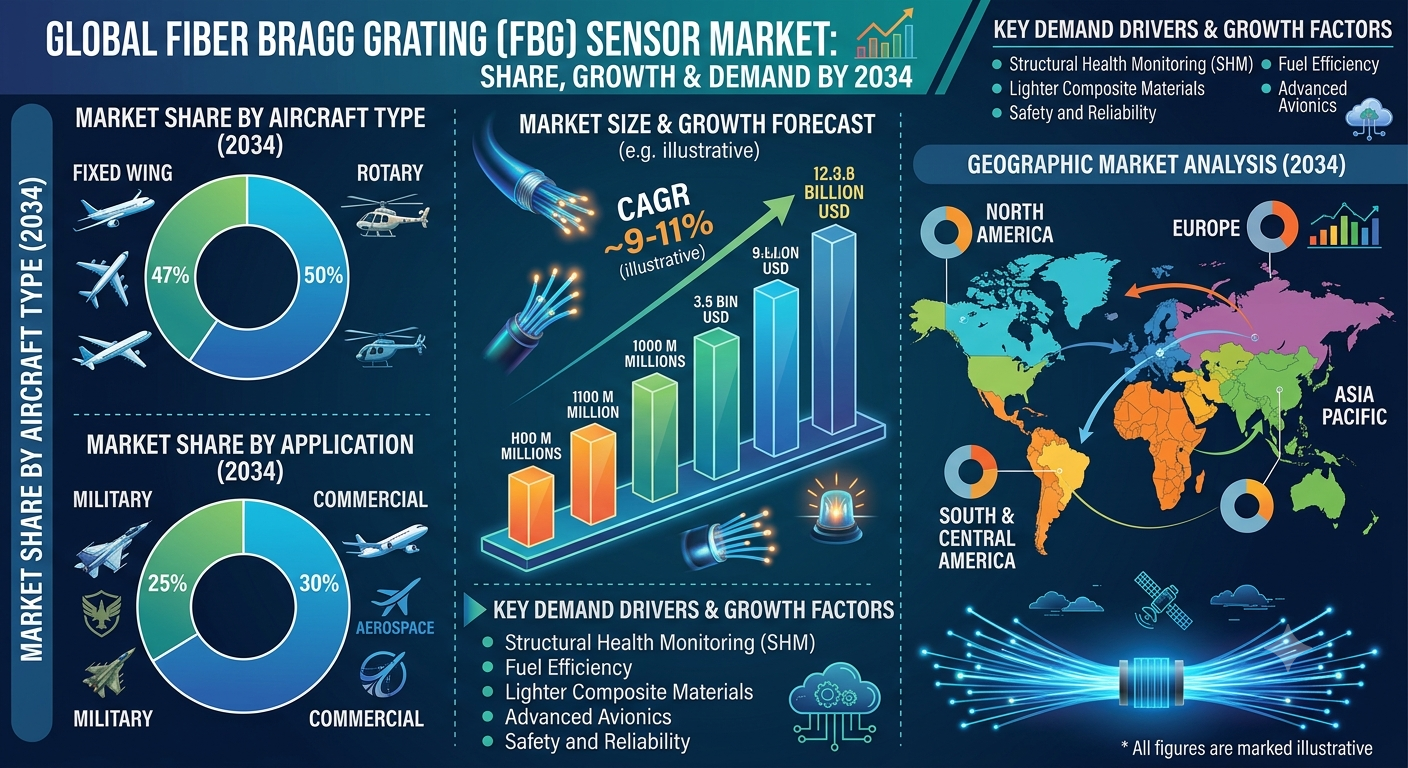
Fiber Bragg Grating (FBG) sensors are becoming increasingly important for precise, real-time monitoring across infrastructure, aerospace, energy, industrial, and other demanding applications. Their ability to measure parameters such as strain, temperature, vibration, and pressure with high accuracy makes them suitable for environments where conventional electrical sensors may face limitations. The growing emphasis on predictive maintenance, structural safety, remote monitoring, and intelligent sensing is creating new opportunities for FBG technology across multiple industries.
According to The Insight Partners, the Fiber Bragg Grating Sensor Market Size was valued at US$1.69 billion in 2025 and is projected to reach US$3.9 billion by 2034. The market is expected to register a CAGR of 11.02% from 2026 to 2034, while the total addressable market is estimated at US$26.60 billion during 2026–2034. Increasing demand for real-time monitoring, technological improvements in sensing accuracy, and innovative applications are among the major factors supporting this growth.
Download Sample PDF Link:https://www.theinsightpartners.com/sample/TIPRE00024659
Rising Demand for Real-Time Monitoring
One of the primary drivers is the increasing need for continuous and real-time monitoring of critical assets. Infrastructure such as bridges, tunnels, buildings, railways, pipelines, and power facilities requires reliable information about structural conditions to identify potential problems before they result in failures or costly downtime. FBG sensors can provide accurate measurements over long distances and can be integrated into monitoring systems for continuous data collection.
The technology is particularly valuable in structural health monitoring because optical fibers are lightweight, immune to electromagnetic interference, and capable of operating in challenging environments. As governments and infrastructure operators increasingly prioritize asset safety and lifecycle management, demand for advanced sensing technologies is expected to increase.
Advancements in Sensor Technology
Advancements in optical sensing technology are another significant growth driver. Improvements in sensor design, interrogation systems, multiplexing capabilities, measurement accuracy, and data-processing technologies are expanding the range of applications for FBG sensors. These developments allow multiple sensing points to be integrated along a single optical fiber, supporting efficient monitoring of large structures and geographically distributed assets.
The integration of FBG sensing with advanced analytics, automation, and digital monitoring platforms can further improve the value of collected data. Instead of relying solely on periodic inspections, organizations can increasingly use continuous measurements to support predictive maintenance and condition-based decision-making.
Expanding Applications Across Aerospace and Industrial Sectors
Aerospace represents an important application area for FBG sensors because aircraft structures require lightweight, reliable, and highly accurate monitoring technologies. FBG sensors can be embedded into or attached to composite structures to monitor strain, temperature, and structural changes. Their compact form factor and resistance to electromagnetic interference make them suitable for demanding aerospace environments.
Industrial applications are also expanding as manufacturers seek improved equipment reliability and operational efficiency. FBG-based monitoring can support machinery diagnostics, pressure measurement, temperature monitoring, and structural assessment. The ability to collect measurements from multiple locations can help industrial operators identify abnormal conditions and optimize maintenance schedules.
Opportunities in Smart Infrastructure, Energy, and Agriculture
The development of smart infrastructure is creating additional opportunities for FBG technology. Connected monitoring systems can combine sensor data with digital platforms to provide near-real-time information about infrastructure performance. This supports more informed maintenance planning and can help extend asset lifecycles.
Energy infrastructure also presents significant opportunities. FBG sensors can be applied to monitor components in power systems, renewable energy installations, and other critical assets where reliable measurements are essential. The technology can contribute to monitoring structural conditions and operating parameters in demanding environments.
Smart agriculture represents another emerging opportunity. FBG technology can support monitoring of environmental and physical parameters, helping improve crop-management practices and resource utilization. Such applications demonstrate how optical sensing can move beyond traditional industrial environments into increasingly connected and data-driven sectors.
Top Companies in the Fiber Bragg Grating Sensor Industry
Key companies profiled in The Insight Partners report include OPTROMIX, Micron Optics, Inc., Proximion AB, IDIL FIBRES OPTIQUES, Technica, Smart Fibres Ltd, Fiber Bragg Grating Technology, Ridgetop Group, Inc., Intelligent Optical Systems, Inc., and ITF Technologies. These companies contribute to the competitive landscape through sensor technologies, optical measurement solutions, interrogation systems, and application-specific sensing capabilities.
Competition is expected to remain focused on improving measurement accuracy, sensor reliability, scalability, integration capabilities, and application-specific performance. Innovation in optical sensing and monitoring platforms will remain important as end users seek solutions that can deliver actionable information from increasingly complex assets.
Future Outlook
The outlook for FBG sensing remains closely connected to the broader adoption of intelligent monitoring and predictive maintenance. Structural health monitoring, smart cities, renewable energy, aerospace, industrial automation, and advanced medical applications can provide new avenues for technology adoption.
As sensing systems become increasingly connected with analytics and digital platforms, FBG technology can play a greater role in transforming raw measurement data into useful operational insights. The combination of high-precision sensing, remote monitoring, and advanced data analysis is expected to support continued expansion through 2034. With the Fiber Bragg Grating Sensor Market projected to reach US$3.9 billion by 2034 at an 11.02% CAGR, technology development and diversification of applications are expected to remain important growth factors.
About The Insight Partners
The Insight Partners is a global market research and consulting firm providing industry intelligence, syndicated research, and customized research services across technology, electronics, semiconductors, healthcare, energy, industrial, and other sectors. Its research combines market analysis, industry trends, competitive intelligence, and strategic insights to support business and investment decisions.
Contact Us
The Insight Partners
Email: [email protected]
Phone: +1-646-491-9876
Website: https://www.theinsightpartners.com
Related Reports -
Submarine Fiber Cable Market Demand, Share & Growth by 2034
Aircraft Wiring Harness Market Dynamics and Trends by 2030
SCADA Oil and Gas Market Size, Trends & Growth by 2034

 English
 Arabic
 French
 Spanish
 Portuguese
 Turkish
 Dutch
Dutch
 Italiano
 Russian
 Romaian
 Portuguese (Brazil)
 Greek
Greek