Managing resident or patient information across paper forms, spreadsheets, separate schedules, and handwritten notes can create unnecessary work for care teams. Important details may be difficult to find, staff may spend too much time updating records, and communication between shifts can become inconsistent.
Healthcare documentation software provides a more organized way to record, access, and manage care information. Instead of keeping important details in different places, teams can use a centralized digital system to maintain resident records, care notes, medication information, assessments, and other documentation.
The Office of the National Coordinator for Health Information Technology notes that electronic records can make health information more accessible to authorized staff while supporting better coordination, workflow efficiency, and information accuracy.
What Is Healthcare Documentation Software?
Healthcare documentation software is a digital platform designed to help care organizations create, organize, store, and retrieve health-related documentation.
Depending on the system and care setting, it may support:
Resident or patient profiles
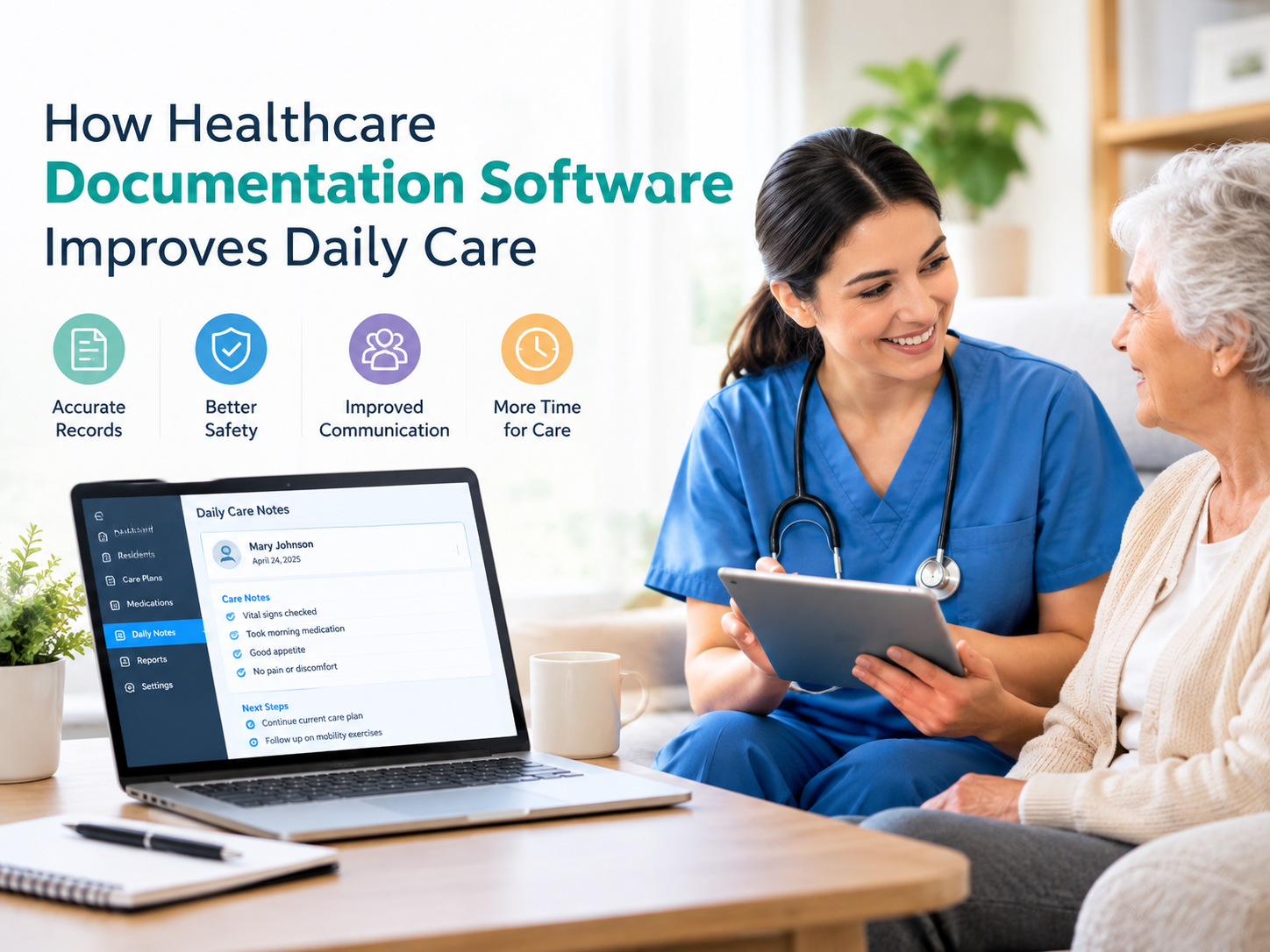
Daily care notes
Progress notes
Care plan documentation
Medication records
Assessments
Incident reports
Vital signs
Activity tracking
Staff communication
Document management
Reporting and compliance records
For assisted living communities and senior care organizations, documentation tools can bring daily observations and care information into one searchable location. This makes it easier for authorized staff to review what has happened and understand what needs attention.
Why Paper-Based Documentation Creates Problems
Paper documentation can work for small amounts of information, but it becomes harder to manage as the number of residents, caregivers, and daily tasks increases.
A paper-based process may require staff to search through folders, binders, forms, or separate records to find information. Handwritten notes can also be difficult to read, while missing or misplaced paperwork can create documentation gaps.
Another problem is delayed communication. A caregiver may document an important observation, but the next shift might not see that information quickly enough.
Digital documentation can reduce these problems by making records easier to organize, search, and share with authorized members of the care team.
How Digital Documentation Supports Better Care
Good documentation is more than an administrative requirement. It helps create a clearer picture of a person's daily needs and changes.
For example, daily caregiver notes can record observations about meals, mobility, behavior, personal care, activities, or other relevant events. Over time, these records can help care teams identify changes that may need further attention.
Electronic records can also improve access to information during care. According to ONC, having complete health information available when needed can support decision-making and care coordination.
This is particularly useful when multiple staff members are involved in providing services across different shifts.
Key Features to Look For
Not every healthcare documentation platform provides the same capabilities. Organizations should consider features that match their actual workflows.
Centralized Resident Records
A centralized profile gives authorized staff one place to review important information. This can include personal details, care requirements, notes, medications, assessments, and other relevant records.
Having information together can reduce the need to search across multiple systems.
Daily Care Documentation
Caregivers should be able to record completed tasks and observations without unnecessary steps.
Simple documentation workflows can make it easier for staff to keep records current during busy shifts rather than trying to remember everything later.
Searchable Notes
Search functionality can save time when managers or caregivers need to find a specific observation or previous entry.
Instead of searching through physical files, authorized users can locate relevant digital information using keywords, dates, categories, or resident profiles, depending on the platform.
Care Plan Documentation
Care plans need to reflect the current needs of the person receiving care. Digital systems can help staff access care instructions alongside daily documentation.
Some assisted living platforms also connect care plans with tasks and documentation workflows, helping staff see what needs to be completed during a shift.
Secure Access and Permissions
Healthcare information requires appropriate protection. A documentation platform should provide suitable access controls so employees can access the information necessary for their responsibilities.
Organizations should evaluate security practices, user permissions, audit capabilities, backups, and applicable regulatory requirements before selecting a system.
Connecting Documentation With Caregiver Scheduling
Documentation becomes even more useful when it works alongside staff coordination.
Caregiver scheduling software can help organizations organize shifts, assignments, staff coverage, and other scheduling responsibilities. When scheduling and documentation workflows are connected, managers can have a clearer view of which caregivers are assigned during particular periods.
For example, a facility might use scheduling tools to assign a caregiver to a resident during a specific shift. The caregiver can then access the appropriate care information and document completed services or observations.
This reduces the need to rely on separate calendars, messages, and paper schedules.
Modern care-management platforms increasingly combine resident documentation with staff coordination, allowing organizations to manage care tasks and staffing information in connected workflows.
Reducing Administrative Work for Care Teams
Care professionals already spend significant time providing direct support. Excessive paperwork can take time away from those responsibilities.
Digital documentation can reduce repetitive administrative tasks by providing templates, centralized records, automated workflows, and searchable information.
The goal should not simply be to replace paper with a computer screen. The system should make documentation easier and help staff complete necessary records accurately and consistently.
ONC reports that health IT can streamline workflows and reduce administrative burdens, while electronic records can support more efficient practice management.
Improving Communication Between Shifts
Shift changes are a common point where information can be lost.
One caregiver may notice a change during the morning shift, while another caregiver takes over later in the day. If the observation is only written on a piece of paper or communicated verbally, the information may not be available when needed.
A centralized documentation system gives authorized staff a consistent place to review recent notes and updates.
This can support better continuity between shifts and help teams maintain a more complete record of daily care.
Supporting Compliance and Recordkeeping
Healthcare and senior care organizations often need to maintain accurate documentation for internal processes, audits, inspections, billing, or other requirements.
Digital records can make documentation easier to organize and retrieve. Some systems also provide reporting, activity histories, or audit features.
However, software alone does not guarantee compliance. Organizations should configure their systems appropriately and follow the laws, regulations, policies, and documentation requirements that apply to their specific care setting.
How to Choose the Right Documentation System
Before selecting a platform, care organizations should consider the problems they want to solve.
Ask questions such as:
Can staff document care quickly?
Is information easy to search?
Can managers review documentation efficiently?
Does the system support care plans?
Can it handle daily caregiver notes?
Does it support mobile or tablet workflows if needed?
Can staff schedules and care assignments be managed?
What security and access controls are available?
Can the system produce useful reports?
Can it integrate with other tools already being used?
A system should fit the organization's workflow rather than forcing staff to create complicated workarounds.
The Future of Digital Care Documentation
Healthcare documentation continues to move toward connected digital workflows. The value of these systems is not simply storing information electronically. Their greater purpose is helping care teams access useful information, coordinate responsibilities, and maintain accurate records.
A well-designed platform can connect resident information, care plans, daily observations, scheduling, and reporting in a way that reduces unnecessary administrative work.
For organizations looking to improve consistency and efficiency, healthcare documentation software can provide a practical foundation for better record management. When combined with effective staff coordination and caregiver scheduling software, it can help create a more connected workflow where the right information is available to the right people at the right time.
The result is a documentation process that is easier for staff to maintain, easier for managers to monitor, and more useful for supporting consistent resident care.




 English
 Arabic
 French
 Spanish
 Portuguese
 Deutsch
 Turkish
 Dutch
Dutch
 Italiano
 Russian
 Romaian
 Portuguese (Brazil)