


PCR Detection Systems Market: Technological Advancements and Growth Outlook
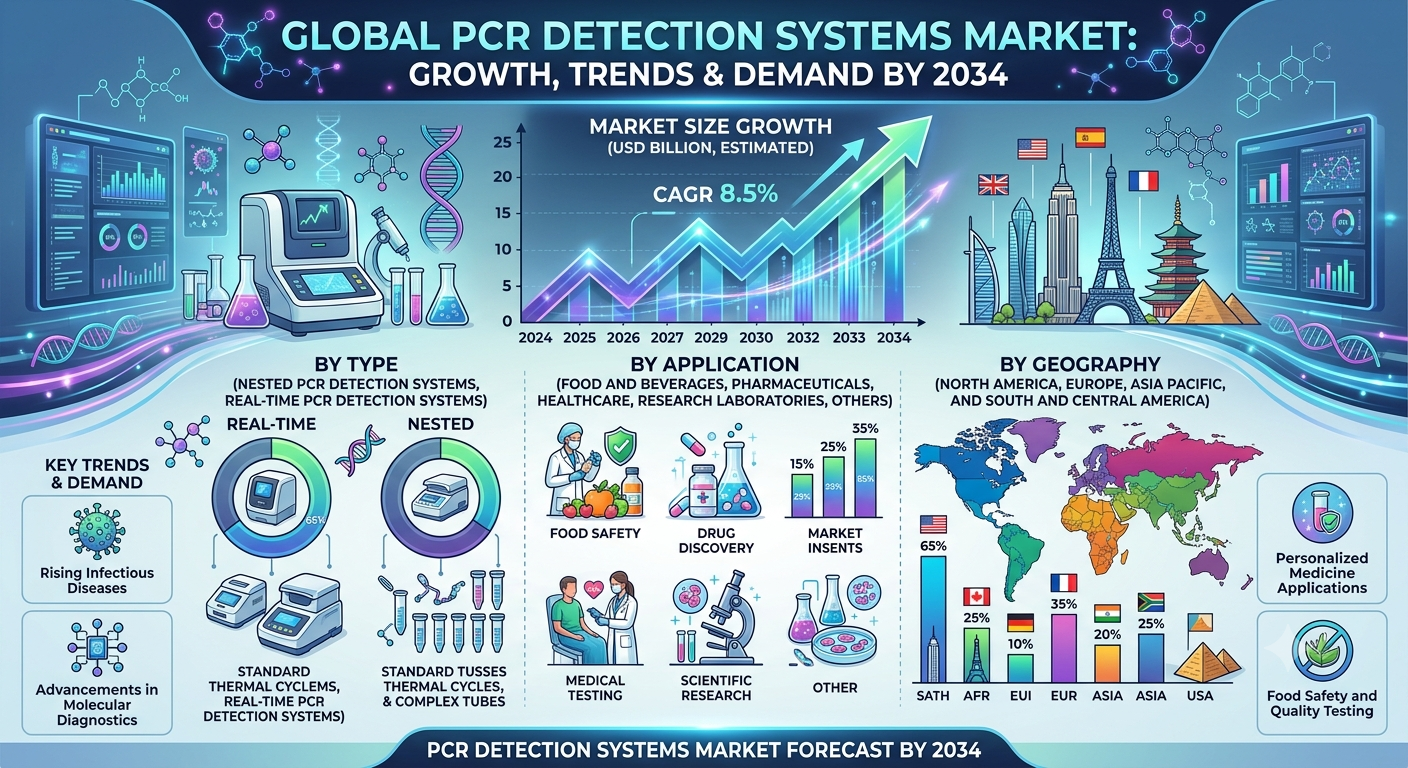
The growing need for accurate molecular testing, faster disease identification, and advanced laboratory workflows is strengthening demand for PCR-based detection technologies worldwide. Increasing investments in healthcare infrastructure, biotechnology research, pharmaceutical development, and infectious disease diagnostics are encouraging laboratories and healthcare organizations to adopt reliable molecular detection systems. Technological improvements in real-time PCR, multiplex testing, automation, and high-throughput workflows are also supporting broader adoption across clinical and research applications.
The global PCR Detection Systems Market Size is projected to increase from US$5.06 billion in 2025 to US$7.76 billion by 2034, registering a CAGR of 5.49% during 2026–2034. The addressable market is estimated at US$60.06 billion during the forecast period. The PCR Detection Systems Market covers systems used for detecting and analyzing nucleic acids across healthcare, pharmaceutical, food and beverage, and research applications. The report evaluates the industry by type, including nested PCR detection systems and real-time PCR detection systems, and by application, including food and beverage, pharmaceutical, healthcare, research laboratories, and others.
Download Sample PDF -https://www.theinsightpartners.com/sample/TIPRE00006354
Rising Demand for Accurate Molecular Diagnostics
One of the primary drivers supporting the PCR Detection Systems Market is the increasing demand for rapid, sensitive, and accurate diagnostic technologies. PCR can identify genetic material from pathogens and other biological targets, making it valuable for infectious disease diagnosis, genetic testing, research, and pharmaceutical applications. The continuing burden of infectious diseases and genetic disorders is encouraging healthcare providers and laboratories to strengthen molecular testing capabilities.
The expansion of molecular diagnostics is also increasing the need for systems that can deliver reproducible results with improved workflow efficiency. Real-time PCR platforms, in particular, support quantitative analysis while enabling laboratories to monitor amplification during the testing process. Growing utilization of PCR-based approaches in clinical laboratories, hospitals, pharmaceutical organizations, and research institutions is therefore contributing to sustained demand.
Technological Advancements in PCR Detection Systems
Continuous innovation in PCR technology is another important growth driver. Manufacturers are developing systems with improved sensitivity, higher throughput, multiplexing capabilities, automation, and integrated data-analysis functions. These developments can help laboratories process larger numbers of samples while reducing manual intervention and improving workflow consistency.
Digital PCR and advanced real-time PCR technologies are also expanding the range of molecular applications. Digital PCR provides highly sensitive nucleic-acid quantification and is increasingly relevant to applications involving rare genetic targets, mutation analysis, and precision medicine. Meanwhile, multiplex PCR enables simultaneous detection of multiple targets, making it useful when laboratories need to obtain broader diagnostic information from a single sample. Industry research also identifies technological advancements and expanding PCR applications as important factors supporting growth across the broader PCR technology ecosystem.
Growing Applications Across Healthcare and Pharmaceuticals
Healthcare remains an important application area because PCR detection systems support infectious disease testing, molecular diagnostics, genetic analysis, and disease monitoring. The growing emphasis on early diagnosis and personalized treatment is encouraging healthcare organizations to invest in advanced molecular testing capabilities.
Pharmaceutical and biotechnology companies are also increasing the use of PCR technologies throughout research and development activities. PCR-based detection can support biomarker analysis, genetic research, quality control, and validation processes. Increasing R&D spending and the expansion of biotechnology pipelines can consequently create additional demand for sophisticated PCR detection platforms.
Research laboratories and academic institutions represent another important user group. The growing focus on genomics, molecular biology, gene expression, and genetic research is encouraging laboratories to adopt systems capable of delivering accurate and repeatable results.
Expanding Food and Beverage Testing Applications
Beyond healthcare, PCR detection systems are increasingly relevant to food and beverage testing. Food manufacturers and testing laboratories use molecular methods for pathogen identification, quality assessment, authenticity testing, and contamination monitoring. The need for effective food safety practices is encouraging greater adoption of sensitive analytical technologies.
As food production and supply chains become increasingly complex, manufacturers and regulators require dependable testing approaches that can identify biological targets efficiently. PCR-based methods can provide a molecular approach to testing, supporting their use across different stages of food quality and safety management.
Key Players
The competitive landscape includes established life sciences, molecular diagnostics, and laboratory technology companies. Prominent players associated with PCR technologies and related detection systems include Thermo Fisher Scientific Inc., F. Hoffmann-La Roche Ltd., QIAGEN N.V., Bio-Rad Laboratories, Inc., Agilent Technologies, Inc., Takara Bio Inc., bioMérieux SA, Abbott Laboratories, Promega Corporation, and Becton, Dickinson and Company. These companies are focusing on product innovation, automation, assay development, partnerships, and expansion of molecular testing capabilities.
Future Outlook
The future outlook for PCR detection systems remains linked to the continued expansion of molecular diagnostics, life sciences research, pharmaceutical R&D, and food safety testing. The transition toward faster and more automated workflows is expected to encourage demand for next-generation systems. Multiplexing, digital PCR, improved real-time detection, software integration, and laboratory automation are likely to remain important areas of technological development.
With the global PCR Detection Systems Market projected to reach US$7.76 billion by 2034, manufacturers have opportunities to address demand for higher-throughput, reliable, and application-specific detection platforms. Emerging healthcare infrastructure and increasing molecular testing capabilities in developing regions may further broaden adoption during the forecast period.
About The Insight Partners
The Insight Partners is a global market research and consulting firm providing actionable intelligence across technology, healthcare, life sciences, semiconductors, chemicals, energy, and other industries. Its research combines industry analysis, market intelligence, company assessments, and strategic insights to help organizations understand evolving business environments and identify growth opportunities.
Contact Us
The Insight Partners
Email: [email protected]
Phone: +1-646-491-9876
Website: https://www.theinsightpartners.com
Related Reports -
Submarine Fiber Cable Market Demand, Share & Growth by 2034
Aircraft Wiring Harness Market Dynamics and Trends by 2030
SCADA Oil and Gas Market Size, Trends & Growth by 2034

 English
 Arabic
 French
 Portuguese
 Deutsch
 Turkish
 Dutch
Dutch
 Italiano
 Russian
 Romaian
 Portuguese (Brazil)
 Greek
Greek