


Airborne ISR Market 2026-2034: Size, Key Trends, Growth Rate, Top Companies & Industry Report
Market Overview
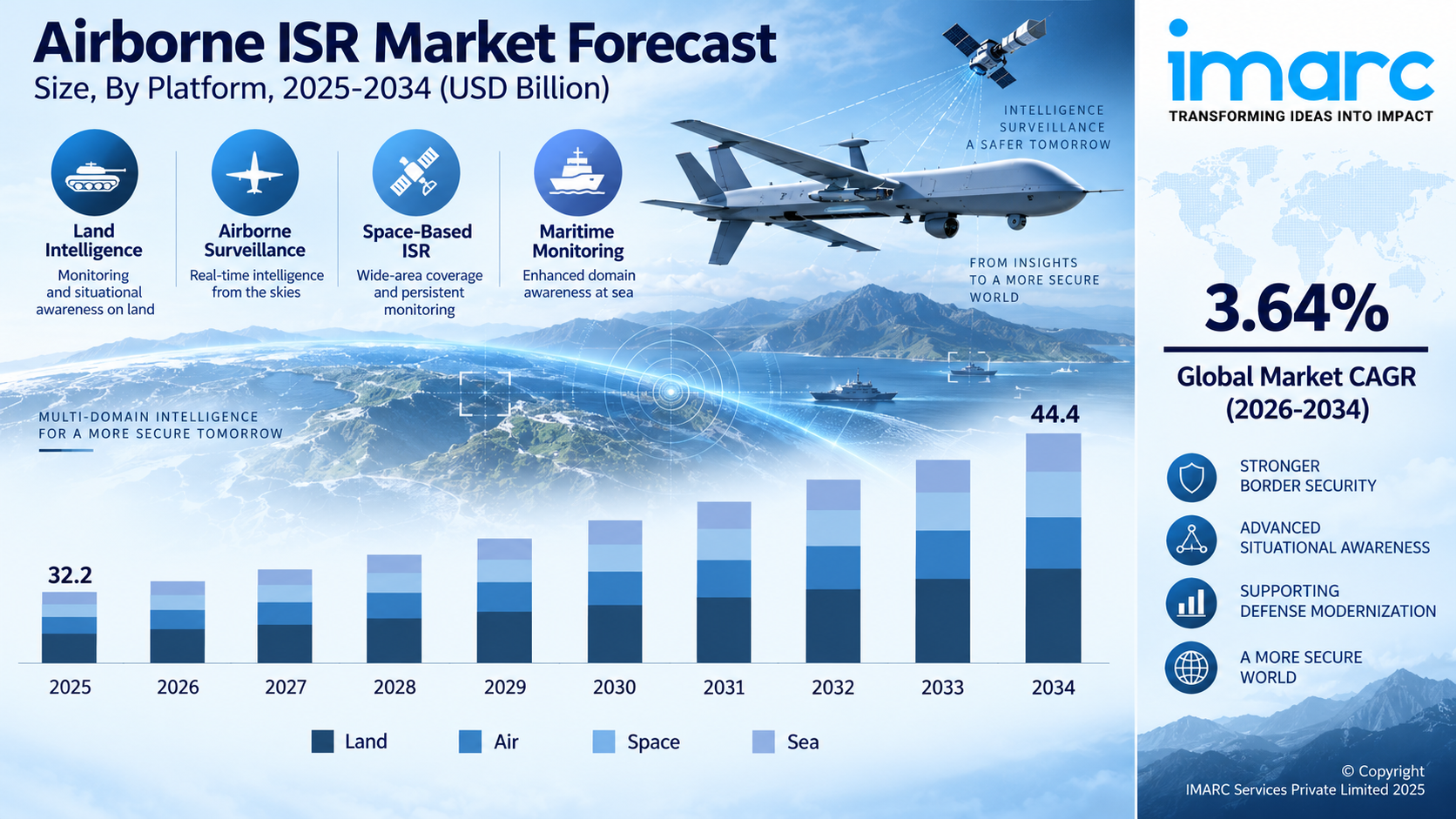
According to a research report by IMARC Group, the global airborne ISR market size was valued at USD 32.2 Billion in 2025. Looking forward, IMARC Group expects the market to reach USD 44.4 Billion by 2034, exhibiting a growth rate (CAGR) of 3.64% during 2026-2034. North America currently dominates the market, holding a significant market share of over 38.2% in 2025. The market is experiencing steady growth driven by the rising focus on strengthening border security, the growing prevalence of organized crime and illegal activities, increasing geopolitical tensions, and the integration of advanced electro-optical and infrared (EO/IR) cameras and other sensor technologies.
Airborne ISR Market Report: Key Highlights
-
Market Size & Growth: The global airborne ISR market was valued at USD 32.2 Billion in 2025 and is projected to reach USD 44.4 Billion by 2034, registering a CAGR of 3.64% during 2026–2034, according to IMARC Group.
-
Regional Leadership: North America represents the largest regional market, accounting for over 38.2% of the market share in 2025, supported primarily by substantial investments in defense technology and national security.
-
By Platform: The market is segmented into air, space, land, and sea, with land leading the market with around 35.3% of the share in 2025.
-
By System: The market covers maritime patrol, electronic warfare, airborne early warning and control (AEWC), airborne ground surveillance (AGS), and signals intelligence (SIGNIT), with AEWC accounting for around 42.7% of the market share in 2025.
-
By Type: The market is divided into surveillance, reconnaissance, and intelligence, with surveillance leading with around 41.1% of the market share in 2025.
-
By Fuel Type: The market includes hydrogen fuel-cells, solar powered, alternate fuel, battery operated, and gas-electric hybrids, with battery operated accounting for around 43.5% of the market share in 2025.
-
By Application: The market covers manned and unmanned intelligence, surveillance and reconnaissance, with manned ISR leading with around 69.1% of the market share in 2025.
-
Key Market Drivers: Rising defense expenditure, growing demand for real-time situational awareness, increasing security concerns, geopolitical tensions, and rapid integration of UAVs.
-
Key Market Trends: Advancements in sensors, synthetic aperture radar (SAR), EO/IR cameras, artificial intelligence (AI), machine learning (ML), and real-time data processing.
-
Key Market Opportunities: Increasing adoption of unmanned platforms, miniaturization of electronics, AI-enabled analytics, advanced sensor technologies, and growing requirements for border security and counter-terrorism applications.
Request for a Sample Report for Detailed Evaluation: https://www.imarcgroup.com/airborne-isr-market/requestsample
What Is Driving Airborne ISR Market Growth in 2026?
Growing Security Concerns
The global security landscape is experiencing significant changes, marked by increasing asymmetric threats, terrorism, cyber-attacks, and other unconventional security challenges. In response, nations and defense organizations are increasingly adopting airborne ISR capabilities to strengthen surveillance and intelligence-gathering operations.
One of the key advantages of airborne ISR is its ability to provide persistent surveillance across areas of interest. This capability is particularly important for monitoring unconventional threats, including terrorism and insurgency, as well as activities associated with illicit operations. Continuous monitoring can support early threat detection and facilitate faster responses.
Airborne ISR platforms also contribute to the broader intelligence cycle by supporting mission planning, target identification, and threat assessment. The timely information generated through these systems can support decision-making across complex operational environments, increasing demand for advanced ISR capabilities.
Geopolitical Tensions
Geopolitical tensions, regional conflicts, and territorial disputes are catalyzing demand for airborne ISR solutions. Nations with strategic interests or security concerns are investing in ISR capabilities to monitor borders, maritime territories, and other sensitive areas.
Airborne ISR assets provide persistent surveillance capabilities that can support early warning and situational awareness. They can also provide information for assessing activities in contested or strategically important regions.
In addition, ISR platforms can support diplomatic and security efforts by providing data related to activities in areas affected by territorial or maritime disputes. As geopolitical complexities continue to evolve, demand for advanced surveillance and intelligence capabilities is supporting the expansion of the airborne ISR market.
Advancements in Technology
Technological advancements are significantly improving the functionality and effectiveness of airborne ISR systems. Innovations in sensors, data analytics, communication systems, and processing technologies are enabling more efficient reconnaissance and surveillance missions.
Synthetic aperture radar (SAR) systems are enhancing the ability to collect high-resolution imagery across different environmental conditions and at various times of the day. EO/IR cameras are also benefiting from improvements in resolution, enabling detailed imagery capture and the detection of subtle changes on the ground.
The miniaturization of electronics is further facilitating the development of more agile and versatile airborne platforms. In addition, the integration of AI and ML into data processing is improving the speed and accuracy of information analysis, supporting faster and more informed decision-making.
Rising Defense Expenditure
Increasing defense expenditure by countries seeking to strengthen their military capabilities is another factor supporting market growth. Governments are allocating resources toward advanced surveillance, intelligence, and reconnaissance systems to improve their operational capabilities.
The growing requirement for real-time situational awareness in complex operational environments is encouraging investment in sophisticated sensors, communication systems, UAVs, and other ISR technologies. These investments are consequently creating sustained demand for airborne ISR solutions.
Rapid Adoption of Unmanned Aerial Vehicles
The rapid incorporation of unmanned aerial vehicles (UAVs) into ISR operations is fostering market expansion. UAV-based ISR platforms offer operational flexibility and can be deployed across a wide range of environments and mission profiles.
Their ability to integrate advanced sensors and data-processing technologies enables operators to collect and analyze information while reducing certain operational and logistical requirements. As defense and security organizations increasingly seek flexible ISR capabilities, the adoption of UAVs is creating new opportunities for market participants.
Airborne ISR Market Segmentation Analysis
By Platform
-
Air
-
Space
-
Land
-
Sea
Land leads the market by platform, accounting for around 35.3% of the market share in 2025. Land-based ISR systems offer versatility and operational effectiveness across diverse environments, including urban and rural settings. Equipped with advanced sensors and communication technologies, these platforms can monitor troop movements, assess operational conditions, and collect critical information for decision-making.
Their ability to integrate with other military assets further enhances their effectiveness and enables coordinated operations. Moreover, growing demand for border security and counter-terrorism initiatives is supporting the adoption of land-based ISR solutions.
By System
-
Maritime Patrol
-
Electronic Warfare
-
Airborne Early Warning and Control (AEWC)
-
Airborne Ground Surveillance (AGS)
-
Signals Intelligence (SIGNIT)
Airborne Early Warning and Control (AEWC) leads the market by system, accounting for around 42.7% of the market share in 2025. AEWC platforms play a critical role in enhancing situational awareness and threat detection through advanced radar and sensor technologies.
These systems can monitor extensive areas and identify potential threats in real time. Their ability to work alongside other military resources, including aircraft and ground forces, further improves overall mission effectiveness. Rising geopolitical tensions and the increasing need for comprehensive situational awareness are supporting demand for AEWC capabilities.
By Type
-
Surveillance
-
Reconnaissance
-
Intelligence
Surveillance leads the market by type, accounting for around 41.1% of the market share in 2025. Surveillance platforms incorporate high-resolution cameras, sensors, and data-processing technologies to collect detailed imagery and information from the air.
These capabilities are used across several applications, including border protection, emergency management, and defense operations. The ability to provide real-time information enhances situational awareness and supports informed decision-making. As operational environments become increasingly complex, demand for advanced surveillance capabilities continues to grow.
By Fuel Type
-
Hydrogen Fuel-Cells
-
Solar Powered
-
Alternate Fuel
-
Battery Operated
-
Gas-Electric Hybrids
Battery operated leads the market by fuel type, accounting for around 43.5% of the market share in 2025. Battery-operated ISR systems are gaining momentum due to their operational flexibility and reduced logistical requirements.
These platforms, particularly in the form of small UAVs, can offer silent operation and ease of deployment across different environments. Their battery-powered configuration can also support missions in areas where traditional fuel-based systems may be less practical.
The growing emphasis on efficient and flexible surveillance solutions is further supporting the adoption of battery-operated ISR technologies across military and civilian applications.
By Application
-
Manned Intelligence Surveillance and Reconnaissance
-
Unmanned Intelligence Surveillance and Reconnaissance
Manned ISR leads the market by application, accounting for around 69.1% of the market share in 2025. Manned ISR aircraft are equipped with advanced sensors and communication systems that enable comprehensive intelligence gathering and real-time data analysis.
These platforms are particularly valuable in complex operational environments where human operators can make decisions based on real-time situational awareness. Their ability to conduct extended missions and adapt to changing operational requirements supports their continued importance across military operations, border security, and disaster-response applications.
By Region
-
North America
-
Europe
-
Asia Pacific
-
Latin America
-
Middle East and Africa
North America accounted for the largest share of the global airborne ISR market, representing over 38.2% of the market in 2025. The region's dominance is principally driven by the United States, which remains a major investor in defense technologies and ISR capabilities.
Strong national security priorities, established military infrastructure, technological innovation, and continued investments in unmanned systems, sensors, and data analytics are supporting regional growth. Increasing emphasis on border security and counter-terrorism activities is further contributing to the implementation of airborne ISR solutions.
Europe is supported by increasing defense budgets, NATO modernization initiatives, and growing focus on advanced surveillance systems. Asia Pacific is experiencing increasing demand driven by defense expenditure, geopolitical uncertainties, and modernization programs. Latin America is witnessing steady growth associated with security concerns, defense investments, and the adoption of UAV-based surveillance solutions. Meanwhile, the Middle East and Africa are supported by increasing defense spending and growing requirements for border security and counter-terrorism capabilities.
Key Regional Insight: North America's Strategic Position
North America's leading position in the global airborne ISR market is primarily supported by the United States and its substantial investments in defense technologies. The region benefits from a robust focus on national security, established military infrastructure, and continued development of advanced ISR capabilities.
The United States is also investing in UAVs, high-resolution sensors, AI-based analytics, and other technologies to enhance intelligence and surveillance capabilities. In August 2024, the U.S. Army announced a collaboration with Sierra Nevada Corp to develop a future fleet of high-altitude ISR aircraft. Sierra Nevada Corp is integrating sensors and other equipment into HADES aircraft and Bombardier Global 6500s.
In November 2024, Chaos Industries, a U.S.-based defense technology startup, announced that it had secured USD 145 Million in funding, reflecting continued investment in defense technology.
Airborne ISR Market Regional Takeaways
United States Airborne ISR Market
The United States accounted for 83.40% of the North American airborne ISR market in 2025. Substantial defense spending and advancements in surveillance technologies are supporting the growth of the U.S. airborne ISR market.
The country is witnessing increasing demand for UAVs equipped with high-resolution sensors and AI-based analytics. These systems contribute to battlefield intelligence, real-time situational awareness, and counter-terrorism operations. Major industry participants include Northrop Grumman and Lockheed Martin, which provide advanced ISR platforms such as the RQ-4 Global Hawk and U-2 Dragon Lady.
Government initiatives supporting machine learning, big data analytics, and other advanced technologies are further contributing to the development of ISR capabilities in the country.
Europe Airborne ISR Market
The European airborne ISR market is growing due to increasing defense budgets, NATO modernization initiatives, and a focus on advanced surveillance systems. France and Poland are emphasizing ISR platforms for border security and military preparedness amid changing geopolitical conditions.
AI-powered analytics and multi-domain ISR systems are supporting technological development across the region. Major companies such as Airbus and Leonardo are contributing to the development of advanced ISR solutions, while European defense research and collaborative initiatives are supporting precision, interoperability, and technological innovation.
Asia Pacific Airborne ISR Market
The airborne ISR market in Asia Pacific is experiencing growth driven by rising defense expenditures and geopolitical uncertainties. China, India, Japan, and South Korea are investing in surveillance, intelligence, UAVs, and related technologies.
India is focusing on indigenous ISR development under initiatives such as "Make in India," while regional governments are increasingly adopting UAVs and satellite-based systems equipped with advanced sensors. AI-driven analytics and real-time data processing are further improving operational capabilities.
Modernization programs across Japan and South Korea are also contributing to demand for advanced ISR solutions, strengthening the region's role in the global airborne ISR market.
Latin America Airborne ISR Market
Latin America's airborne ISR market is steadily expanding amid growing security concerns, defense spending, and regional cooperation. Brazil, Mexico, and Colombia are investing in surveillance technologies to strengthen border security and address organized crime and other internal security challenges.
The adoption of UAVs for ISR missions is increasing, while regional companies and international manufacturers are participating in the development and deployment of advanced ISR solutions. AI integration into sensors and data-processing systems is also supporting improvements in operational efficiency.
Middle East and Africa Airborne ISR Market
The airborne ISR market in the Middle East and Africa is growing alongside increasing defense budgets and rising security requirements. Countries across the region are investing in UAVs, satellite-based systems, and other advanced ISR platforms for border security and counter-terrorism applications.
The UAE is increasingly adopting advanced ISR technologies, while South African companies such as Denel are involved in the development of ISR systems for domestic and international requirements. Government-backed research and development initiatives, international collaborations, and the integration of AI and machine learning are supporting the region's long-term market development.
Competitive Landscape in the Airborne ISR Industry
The competitive landscape of the global airborne intelligence, surveillance, and reconnaissance (ISR) market is characterized by continuous investments in research and development, technological innovation, and product portfolio expansion. Leading companies are focusing on miniaturization, enhanced sensor capabilities, data analytics, AI, and machine learning to improve ISR performance.
Companies are also expanding their portfolios to include diverse ISR platforms, including UAVs, while strengthening their global presence through partnerships, collaborations, and acquisitions. These initiatives are aimed at addressing evolving requirements from defense and security organizations worldwide.
For instance, in October 2024, MAG Aerospace announced a strategic partnership with Zapata AI to facilitate next-generation ISR by combining sensor technology, ground-based and airborne sources, and different sensor and signal types to automate target tracking, acquisition, and identification.
Key Airborne ISR Market Players Include:
-
BAE Systems PLC
-
L3Harris Technologies Inc.
-
Kratos Defense & Security Solutions Inc.
-
Thales Raytheon Systems
-
Elbit Systems Ltd.
-
UTC Aerospace Systems (United Technologies Corporation)
-
General Dynamics
-
CACI International Inc.
-
Northrop Grumman Corporation
-
Lockheed Martin Corporation
-
FLIR Systems Inc.
-
Airbus
-
General Atomics
-
and others
Recent Developments:
-
December 2024: Lockheed Martin announced that its ISR spacecraft demonstrator, TacSat, was scheduled for launch in 2025 aboard a Firefly Aerospace Alpha rocket. The satellite was expected to carry an infrared sensor and Lockheed Martin's first 5G.MIL payload to enhance military connectivity and support joint exercises and CJADC2.
-
October 2024: Northrop Grumman announced the demonstration of Phase Two of its Deep Sensing and Targeting system at Vanguard 24. The airborne system combines space-based sensor data with targeting intelligence to support long-range precision fires, using automation and intelligence services to improve accuracy and speed.
-
August 2024: The Air Force Research Laboratory announced that BAE Systems secured a USD 48 Million contract to further develop its Insight system. The system is designed to strengthen military ISR capabilities, including airborne applications such as Resolute Sentry, with machine learning and autonomy supporting real-time multi-domain battlespace awareness.
-
June 2024: L3Harris delivered three integrated King Air 350ER ISR aircraft to the Canadian Armed Forces under the MAISR project. The aircraft were modified at the company's Greenville, Texas center to enhance Canada's ISR capabilities and mission effectiveness.
-
October 2021: Kratos Defense & Security Solutions Inc. announced that it had secured a USD 17.7 Million contract to design and build an Off Board Sensing Station (OBSS) unmanned aerial system to support the Air Force Research Laboratory's Autonomous Collaborative Platforms technology maturation portfolio.
Market Drivers, Challenges & Opportunities
Major Market Drivers:
-
Growing Security Concerns: Increasing asymmetric threats, terrorism, cyber-attacks, organized crime, and other security challenges are strengthening demand for persistent surveillance and intelligence capabilities.
-
Geopolitical Tensions: Regional conflicts and territorial disputes are encouraging countries to invest in advanced ISR systems for situational awareness and security.
-
Technological Advancements: Innovations in sensors, SAR, EO/IR cameras, AI, ML, and data analytics are improving ISR effectiveness and operational responsiveness.
-
Rising Defense Expenditure: Increasing government investment in military modernization and national security is supporting demand for advanced ISR platforms.
-
UAV Adoption: The growing incorporation of unmanned aerial vehicles into ISR missions is creating demand for flexible and technologically advanced systems.
Key Challenges:
-
Technological Complexity: The integration of sophisticated sensors, communications, AI, and data-processing technologies can increase system complexity.
-
Operational Requirements: ISR platforms must support diverse and increasingly demanding mission environments while maintaining reliable data collection and processing capabilities.
-
High Technology Investment: The development and integration of advanced ISR capabilities require substantial investment in research, development, and deployment.
Emerging Opportunities:
-
AI and Machine Learning: Growing adoption of AI and ML for automated data analysis, target identification, and real-time decision-making is creating opportunities for technology providers.
-
Advanced Sensor Technologies: Continued improvements in EO/IR cameras, SAR, radar, and other sensors are opening opportunities for higher-performance ISR systems.
-
Unmanned ISR Platforms: Increasing demand for UAV-based intelligence and surveillance solutions is creating opportunities across military and security applications.
-
Miniaturized Electronics: Advances in electronics miniaturization are enabling more agile and versatile ISR platforms.
-
Real-Time Data Processing: Growing requirements for rapid intelligence analysis are creating opportunities for advanced communications and data-processing technologies.
Airborne ISR Market FAQs
1. What is the current size of the airborne ISR market?
The global airborne ISR market was valued at USD 32.2 Billion in 2025 and is expected to grow at a CAGR of 3.64% during 2026-2034, reaching USD 44.4 Billion by 2034.
2. What is driving the growth of the airborne ISR market?
The market is driven by growing security concerns, rising defense expenditure, geopolitical tensions, increasing demand for real-time situational awareness, technological advancements in sensors and data analytics, and the rapid adoption of UAVs for ISR operations.
3. Which region dominates the airborne ISR market?
North America leads the global airborne ISR market, accounting for over 38.2% of the market share in 2025, primarily supported by the United States' investments in defense technologies, national security, and advanced ISR systems.
4. Which segment holds the largest share in the airborne ISR market?
Land leads by platform with around 35.3%, AEWC leads by system with around 42.7%, surveillance leads by type with around 41.1%, battery operated leads by fuel type with around 43.5%, and manned ISR leads by application with around 69.1% of the respective market shares in 2025.
5. What are the key trends in the airborne ISR market?
Key trends include increasing demand for persistent surveillance, advancements in SAR and EO/IR technologies, greater integration of AI and ML, rapid adoption of UAVs, miniaturization of electronics, real-time data processing, and growing investment in advanced ISR capabilities amid evolving security requirements.
Conclusion: Airborne ISR Market Outlook to 2034
The global airborne ISR market is set for steady growth through 2034, underpinned by growing security concerns, increasing defense expenditure, geopolitical tensions, rising demand for real-time situational awareness, and continued advancements in sensor and data-processing technologies. The rapid integration of UAVs, AI, machine learning, SAR, and EO/IR systems is further transforming ISR capabilities across defense and security applications.
While North America maintains its position as the leading regional market, Europe, Asia Pacific, Latin America, and the Middle East and Africa are also developing their ISR capabilities through defense modernization and technology investments. Companies focusing on advanced sensors, AI-enabled analytics, unmanned platforms, miniaturized electronics, and real-time data processing are positioned to participate in the evolving ISR technology landscape.
About the Author:
IMARC Group is a leading global market research company providing data-driven insights and expert consulting services to businesses seeking to achieve their strategic objectives. With a multi-disciplinary team of industry experts, IMARC delivers thorough, reliable market intelligence across sectors including Energy and Mining, Construction and Manufacturing, Automotive, Chemicals and Materials, and more.
Media & Sales Contact:
IMARC Group
United States: +1-201-971-6302
India: +91-120-433-0800
United Kingdom: +44-753-714-6104

 English
 Arabic
 French
 Spanish
 Portuguese
 Deutsch
 Turkish
 Dutch
Dutch
 Italiano
 Russian
 Portuguese (Brazil)
 Greek
Greek