


Taxi Market Outlook 2026-2034: Size, Share, Trends, Demand and Forecast
Market Overview
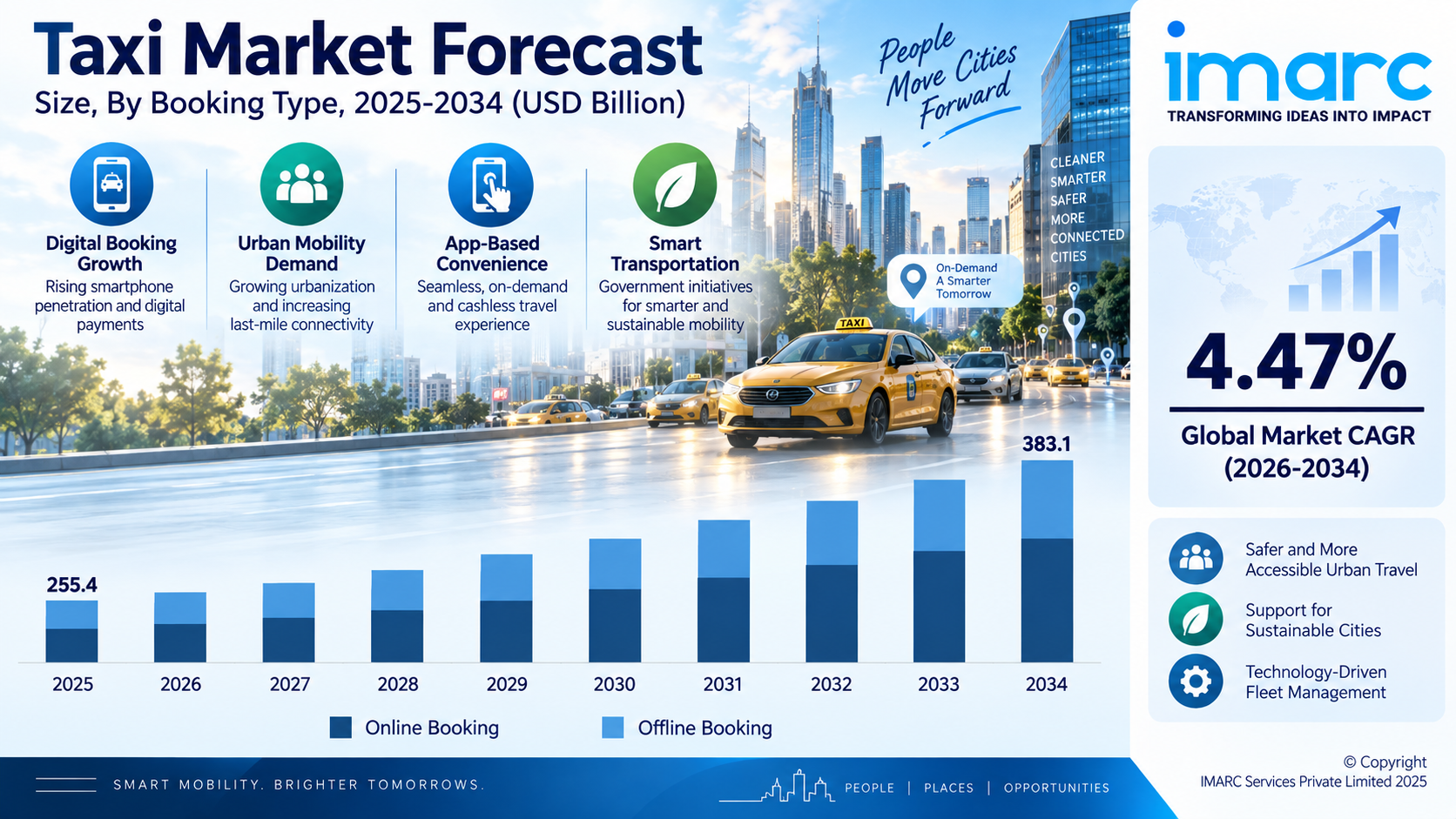
According to a research report by IMARC Group, the global taxi market size was valued at USD 255.4 Billion in 2025. Looking forward, IMARC Group expects the market to reach USD 383.1 Billion by 2034, exhibiting a growth rate (CAGR) of 4.47% during 2026-2034. Asia Pacific currently dominates the market, holding a market share of over 54.5% in 2025, supported by rapid urbanization, widespread adoption of ride-hailing apps, and increasing demand for convenient, flexible, and eco-friendly transportation options
Request for a Sample Report for Detailed Evaluation: https://www.imarcgroup.com/taxi-market/requestsample
Taxi Market Report: Key Highlights
-
Market Size & Growth: The global taxi market was valued at USD 255.4 Billion in 2025 and is projected to reach USD 383.1 Billion by 2034, registering a CAGR of 4.47% during 2026–2034, according to IMARC Group.
-
Regional Leadership: Asia Pacific represents the largest regional market, accounting for over 54.5% of the market in 2025, supported by rapid urbanization, technological adoption, and changing consumer preferences.
-
By Booking Type: The market is segmented into online booking and offline booking, with online booking representing the largest segment and accounting for around 67.6% of the market in 2025.
-
By Service Type: The market covers ride hailing and ride sharing, with ride-hailing platforms supporting demand through convenient, on-demand transportation services.
-
By Vehicle Type: The market comprises cars, motorcycles, and others, with cars accounting for the largest share of around 83.8% in 2025.
-
Key Market Drivers: Expanding cities, increasing population density, rising smartphone and Internet penetration, growing adoption of online taxi booking platforms, and escalating demand for ride-sharing services.
-
Key Market Trends: Increasing popularity of online taxi booking channels, rising Internet and smartphone penetration, growing adoption of ride-sharing services, and increasing integration of digital payments, GPS, and advanced routing technologies.
-
Key Regional Trends: Asia Pacific is benefiting from rapid urbanization and rising middle-class populations, while North America and Europe are witnessing increasing adoption of ride-hailing technologies and eco-friendly fleets.
-
Key Market Opportunities: Growing demand for electric and hybrid taxis, expansion of app-based services, smart-city initiatives, digital payment adoption, and increasing demand for convenient first-mile and last-mile connectivity.
What Is Driving Taxi Market Growth in 2026?
Expansion of Cities and Increasing Population Density
The expansion of cities and increasing population density represent some of the key factors positively influencing the global taxi market. Growing urban populations are amplifying the demand for comfortable and efficient transportation solutions. Taxis offer flexible point-to-point transportation customized according to commuter requirements, making them particularly relevant in busy metropolitan areas.
The growing population of working professionals and tourists in urban centers is further creating demand for convenient transportation. Traffic congestion also increases the appeal of taxis, which can provide practical alternatives to private vehicles and public transportation for certain journeys. Furthermore, limitations in urban infrastructure can make taxis an important mobility option where public transport struggles to meet dynamic transportation requirements.
Increasing Popularity of Online Taxi Booking Channels
The increasing popularity of online taxi booking channels is stimulating the growth of the taxi market. Mobile applications and web-based platforms have transformed the way passengers access and use taxi services. Users can book rides, track vehicle locations in real time, estimate arrival times, and make cashless payments through digital platforms.
Online booking also enhances transparency by allowing passengers to view fare estimates and monitor the location of their selected vehicle. This convenience and level of control can encourage repeat usage and broaden the customer base. As online taxi booking becomes increasingly established, service providers are focusing on improving digital interfaces and customer experiences while competing on service quality, convenience, and pricing.
For instance, in January 2024, YelowSoft introduced an in-app wallet for ride-hailing platforms, enabling one-click payments, enhanced security, reduced transaction times, and loyalty programs aimed at improving customer retention and streamlining operations.
Rising Penetration of the Internet and Smartphones
Growing Internet and smartphone penetration is further supporting the taxi market. The widespread availability of smartphones and Internet connectivity provides passengers with convenient access to taxi services through mobile applications. Users can book rides from virtually anywhere and receive real-time information about their transportation.
The integration of GPS technology into smartphones also enables accurate vehicle tracking and real-time updates on taxi locations, supporting convenience and safety. For drivers, smartphones provide navigation tools that can assist with route optimization and reduce travel times.
In 2024, 5.35 Billion people, or 66.2% of the global population, used the Internet, supporting the wider adoption of digital services, including app-based taxi booking. As digital connectivity continues to expand, taxi services are increasingly becoming technology-enabled and consumer-centric.
Escalating Demand for Ride-Sharing Services
The rising demand for ride-sharing services is also contributing to market growth. Ride-sharing platforms have transformed transportation by providing alternatives to traditional taxi services and enabling passengers to share rides and expenses.
The cost-sharing model can attract consumers seeking economical transportation options, while user-friendly mobile applications simplify the booking process. Ride-sharing can also reduce the number of individual vehicles on roads, supporting lower emissions and appealing to environmentally conscious consumers.
The expansion of ride-sharing is simultaneously increasing competition within the taxi industry, encouraging service providers to improve vehicle quality, reliability, technological capabilities, and customer service. As ride-sharing platforms continue to expand, their influence is contributing to the evolution of the broader taxi market.
Taxi Market Segmentation Analysis
By Booking Type
-
Online Booking
-
Offline Booking
Online booking represents the largest booking type, accounting for around 67.6% of the market in 2025. Online booking offers convenience and efficiency by enabling passengers to request rides through smartphones or computers within seconds.
Passengers can schedule rides, track vehicles, and make cashless payments, streamlining the overall transportation process. The convenience of digital booking attracts technology-oriented consumers as well as passengers seeking hassle-free mobility solutions.
Online platforms also provide greater transparency, allowing users to view fare estimates and track vehicles in real time. As adoption continues to increase, taxi companies are focusing on improving online booking interfaces and making their platforms more user-friendly and adaptable to changing consumer preferences.
By Service Type
-
Ride Hailing
-
Ride Sharing
Ride-hailing platforms have introduced greater convenience and flexibility into the taxi market. These services allow passengers to request transportation on demand through mobile applications, reducing waiting times and eliminating the need to physically flag down taxis.
The model caters to a wide range of transportation needs, including daily commuting, business travel, and leisure trips. Ride-hailing has also created flexible earning opportunities for drivers, contributing to a broader pool of available drivers.
Cashless transactions, transparent pricing, and passenger rating and review systems further contribute to the development of user-centric taxi services. As ride-hailing platforms continue to evolve across different markets, they remain an important contributor to the growth and transformation of the taxi industry.
By Vehicle Type
-
Cars
-
Motorcycle
-
Others
Cars lead the market by vehicle type, accounting for around 83.8% of the market share in 2025. Cars remain the cornerstone of taxi services, providing passengers with a comfortable and private mode of point-to-point transportation.
Their widespread availability and ability to accommodate different passenger requirements contribute to their dominant position. Modern taxi cars are also increasingly equipped with features such as air conditioning, entertainment systems, and comfortable seating, enhancing the passenger experience.
Taxi operators are focusing on maintaining clean and well-maintained fleets, while the flexibility of cars allows them to navigate different types of roads and reach locations that may be challenging for larger vehicles. Their suitability for urban and suburban journeys makes cars an important component of the global taxi industry.
By Region
-
North America
-
United States
-
Canada
-
-
Asia Pacific
-
China
-
Japan
-
India
-
South Korea
-
Australia
-
Indonesia
-
Others
-
-
Europe
-
Germany
-
France
-
United Kingdom
-
Italy
-
Spain
-
Russia
-
Others
-
-
Latin America
-
Brazil
-
Mexico
-
Others
-
-
Middle East and Africa
Asia Pacific holds the largest regional share of the global taxi market, accounting for over 54.5% in 2025. The region's leading position is supported by rapid urbanization, technological adoption, rising middle-class populations, and changing consumer preferences.
North America continues to benefit from increasing demand for on-demand transportation and advancements in ride-hailing technologies. Europe is witnessing growing adoption of electric and low-emission taxi fleets, supported by sustainability initiatives and regulatory measures. Latin America is benefiting from demand for cost-effective transportation and expanding tourism, while the Middle East and Africa are experiencing growing demand for efficient mobility solutions in densely populated and rapidly developing urban areas.
Key Regional Insight: Asia Pacific's Strategic Position
Asia Pacific's leading position in the global taxi market is anchored in rapid urbanization, technological adoption, and changing consumer preferences. Densely populated cities and expanding urban areas are creating strong demand for efficient and accessible transportation options.
The region's high smartphone penetration and tech-savvy population are accelerating the adoption of app-based taxi services. Mobile applications allow passengers to book rides, track vehicles in real time, and make cashless payments, improving convenience and accessibility.
At the same time, the expansion of the middle class across Asia Pacific is increasing disposable incomes and mobility requirements. Government initiatives focused on urban mobility, congestion reduction, and pollution control are also supporting the development of taxi services, including electric and shared mobility solutions.
Key Regional Takeaways
North America Taxi Market Analysis
The North American taxi market is evolving with rising demand for on-demand transportation and improvements in ride-hailing technologies. Urbanization is encouraging consumers to seek flexible mobility options, supporting both traditional and app-based taxi services.
Technological developments such as AI-driven route optimization and digital payment integration are improving operational efficiency and customer experiences. Increasing environmental awareness is also supporting the adoption of electric and hybrid taxi vehicles.
Regulatory mechanisms focused on safety, service quality, and operating standards continue to influence the industry. At the same time, competition from public transportation and other shared mobility models is encouraging taxi providers to improve their services and adopt new technologies.
United States Taxi Market Analysis
The United States taxi market is being influenced by technological advancements, urbanization, and increasing demand for convenient transportation. The U.S. urban population grew by 6.4% from 2010 to 2020 and accounted for 80% of the nation's population, supporting demand for transportation services in densely populated areas.
The adoption of ride-hailing platforms has streamlined access to taxi services through mobile applications. The integration of eco-friendly fleets is also supporting demand as consumers increasingly seek sustainable transportation options.
For instance, in April 2023, Lyft expanded its “Green” mode to 14 major U.S. cities, enabling riders to request electric and hybrid vehicles directly through its application while supporting its 2030 all-electric fleet goal.
Rising tourism and business travel are also contributing to demand. Infrastructure development around major transit hubs is supporting first-mile and last-mile connectivity, while accessibility improvements for differently abled individuals are expanding the scope of taxi services.
Asia Pacific Taxi Market Analysis
The growing urban middle-class population and improving affordability are supporting growth in the Asia Pacific taxi industry. India's middle-class population is projected to increase from 432 Million in 2020-21 to 1.02 Billion by 2047, representing 61% of the population, supporting demand for transportation services as affordability and urban mobility requirements increase.
Increasing smartphone penetration is facilitating the adoption of app-based taxi services, simplifying the booking process for users. Expanding cities and increasing traffic congestion are further creating demand for convenient and reliable transportation.
Taxi operators are also diversifying their fleets to include electric and hybrid vehicles in response to growing environmental awareness. Digital wallets and flexible payment options are enhancing convenience for technology-oriented consumers.
Micro-mobility solutions, including bikes integrated with taxi networks, are also gaining popularity. Shared transportation services in high-density areas can help accommodate large commuter volumes while supporting environmental and infrastructure objectives.
Europe Taxi Market Analysis
A strong emphasis on sustainability is supporting the adoption of electric and low-emission taxi fleets across Europe. Regulatory support and financial incentives for environmentally friendly vehicles are encouraging operators to upgrade their fleets.
According to a report by McKinsey, Germany's EV-charging demand is expected to reach 43 TWh annually by 2030 in an accelerated scenario, with passenger cars accounting for 55% of usage, supporting the broader development of electric mobility and eco-friendly transportation.
The expansion of intermodal transportation networks is also creating opportunities for taxis to complement buses, trains, and shared mobility platforms. Tourism is another important factor, with specialized taxi services offering multilingual drivers and customized travel options.
Operators are increasingly investing in real-time tracking and AI-based routing technologies to improve efficiency and reduce idle times. Demand for premium services and transportation options for elderly and differently abled passengers is also supporting market development.
Latin America Taxi Market Analysis
The Latin American taxi market is benefiting from rising demand for cost-effective transportation options and changing consumer preferences toward flexible and comfortable mobility solutions.
Ride-hailing platforms are improving access to taxi services and enhancing the customer experience. Tourism also plays an important role in market development, as visitors require convenient transportation to airports, hotels, attractions, and other destinations.
Brazil recorded 6.8 Million foreign tourists in 2024, surpassing its 2019 record by 500,000 visitors, supporting demand for taxi services through airport transfers and urban transportation.
Initiatives promoting cleaner vehicles are also contributing to changes within the sector. Local taxi systems are being modernized to address transportation gaps in areas where public transport remains limited or inconsistent.
Middle East and Africa Taxi Market Analysis
The taxi industry in the Middle East and Africa is being supported by rising demand for efficient and affordable transportation solutions in densely populated areas. Expansion in residential and commercial real estate projects is increasing movement between newly developed areas and established urban centers.
The emergence of app-based ride-hailing platforms is improving accessibility and convenience for technology-oriented consumers. In areas with limited public transportation infrastructure, taxis provide an important link for daily commuting.
The UAE real estate market was expected to reach approximately USD 707 Billion by 2024, while the number of high-net-worth individuals was projected to increase by 24.6% by 2025. These developments are supporting demand for luxury properties and contributing to opportunities for taxi services associated with expanding urban mobility requirements.
Efforts to modernize transportation systems and incorporate digital technologies are also influencing the trajectory of the regional taxi market.
Competitive Landscape in the Taxi Industry
The global taxi market is highly competitive, with providers focusing on technological advancements, service quality, operational efficiency, and sustainability. Companies are increasingly integrating digital technologies such as route optimization, dynamic pricing, digital payments, and AI-driven tools to improve customer experiences and reduce operational costs.
The adoption of electric and hybrid vehicles is also gaining importance as operators respond to environmental objectives and changing consumer preferences. Strategic partnerships, localized offerings, and expansion into new markets are being used to address regional mobility requirements and strengthen market presence.
The report provides a comprehensive analysis of the competitive landscape in the global taxi market, with detailed profiles of major companies.
Key Taxi Market Players Include:
-
BlaBlaCar
-
Bolt Technology
-
Curb Mobility, LLC
-
DiDi Global Inc.
-
Dubai Taxi Company PJSC
-
FREENOW
-
Gett
-
Gojek
-
Grab Holdings Inc.
-
Lyft, Inc.
-
Nihon Kotsu Co., Ltd.
-
Ola Electric Mobility Pvt Ltd. (ANI Technologies Pvt. Ltd.)
-
Uber Technologies Inc.
Recent Developments:
-
August 2024: The Pan Car App, a taxi booking service, was introduced in Kangra, Himachal Pradesh. Developed by local youth, the application enables users to book taxis from their homes, streamlining transportation services in the region. The service was launched by Tourism Corporation Chairman R S Bali and was positioned as a technology-driven initiative supporting convenience and self-employment.
-
March 2024: Xanh SM Laos launched its electric taxi service in Savannakhet following its operations in Vientiane and Vang Vieng. The expansion supports the company's focus on sustainable transportation and environmental preservation. Fares in Savannakhet started at approximately USD 0.90.
-
March 2024: Waymo, a Google spinoff, began rolling out its robotaxi service in Los Angeles, initially offering free rides to selected users. Approximately 50,000 people had signed up for the driverless ride-hailing experience. The service uses Jaguar I-PACE vehicles, with plans to introduce paid fares and expand to Austin.
-
January 2024: The Assam government launched 'Baayu,' described as India's first 100% electric app-based bike taxi service, developed with Bikozee Ecotech. The initiative was expected to create 5,000 jobs under Assam's Aggregator Rules 2022 and aimed to reduce carbon emissions and fuel costs.
-
January 2024: Dubai Taxi Corporation (DTC) introduced a service allowing people of determination with non-motor disabilities to book regular taxis through the DTC App. Eligible users can receive a 50% discount using the Sanad card, supporting improved accessibility and convenience.
Market Drivers, Challenges & Opportunities
Major Market Drivers:
-
Rapid Urbanization: Expanding cities and increasing population density are creating demand for convenient and flexible point-to-point transportation.
-
Online Taxi Booking: The growing adoption of mobile applications and digital platforms is making taxi services more accessible and convenient.
-
Smartphone and Internet Penetration: Increasing digital connectivity is facilitating app-based booking, GPS tracking, navigation, and cashless payments.
-
Growing Ride-Sharing Demand: Ride-sharing platforms are providing cost-efficient and convenient mobility options while increasing competition and innovation within the taxi industry.
-
Increasing Environmental Awareness: Rising interest in sustainable transportation is supporting the adoption of electric and hybrid taxi fleets.
Key Challenges:
-
Intense Competition: Taxi operators face competition from public transportation, ride-sharing platforms, and other shared mobility solutions.
-
Regulatory Requirements: Safety, service quality, vehicle standards, and local transportation regulations can influence taxi operators across different markets.
-
Infrastructure Limitations: Differences in transportation and digital infrastructure across regions can affect the accessibility and scalability of taxi services.
Emerging Opportunities:
-
Electric and Hybrid Taxis: Growing environmental awareness and government sustainability initiatives are creating opportunities for cleaner taxi fleets.
-
Digital Booking Platforms: Increasing smartphone and Internet penetration is expanding opportunities for app-based taxi booking and digital payment services.
-
Smart City Development: Investments in urban mobility and smart-city infrastructure can support the integration of taxis into broader transportation networks.
-
First-Mile and Last-Mile Connectivity: Taxi services can address mobility gaps around transit hubs and areas where public transportation does not adequately meet commuter requirements.
-
Advanced Technologies: AI-based routing, GPS tracking, dynamic pricing, digital payments, and other technologies are creating opportunities to improve operational efficiency and passenger experiences.
Taxi Market FAQs
1. What is the current size of the global taxi market?
The global taxi market was valued at USD 255.4 Billion in 2025 and is expected to grow at a CAGR of 4.47% during 2026-2034, reaching USD 383.1 Billion by 2034.
2. What is driving the growth of the taxi market?
The taxi market is being driven by rapid urbanization, increasing population density, growing adoption of online taxi booking platforms, rising smartphone and Internet penetration, increasing demand for ride-sharing services, and growing demand for convenient and flexible transportation.
3. Which region dominates the global taxi market?
Asia Pacific dominates the global taxi market, accounting for over 54.5% of the market in 2025. Rapid urbanization, technological adoption, rising middle-class populations, and increasing demand for convenient mobility are supporting the region's leading position.
4. Which segment holds the largest share in the taxi market?
Online booking represents the largest booking type, accounting for around 67.6% of the market in 2025. By vehicle type, cars represent the largest segment, with around 83.8% of the market share in 2025.
5. What are the key trends in the taxi market?
Key trends include the increasing popularity of online taxi booking channels, rising smartphone and Internet penetration, growing adoption of ride-sharing services, increasing use of digital payments and GPS technologies, and the growing adoption of electric and hybrid taxi fleets.
About the Author:
IMARC Group is a leading global market research company providing data-driven insights and expert consulting services to businesses seeking to achieve their strategic objectives. With a multi-disciplinary team of industry experts, IMARC delivers thorough, reliable market intelligence across sectors including Energy and Mining, Construction and Manufacturing, Automotive, Chemicals and Materials, and more.
Media & Sales Contact:
IMARC Group
United States: +1-201-971-6302
India: +91-120-433-0800
United Kingdom: +44-753-714-6104

 English
 Arabic
 Spanish
 Portuguese
 Deutsch
 Turkish
 Dutch
Dutch
 Italiano
 Russian
 Romaian
 Portuguese (Brazil)
 Greek
Greek