


Smart Camera System Market Growth Driven by Smart Surveillance
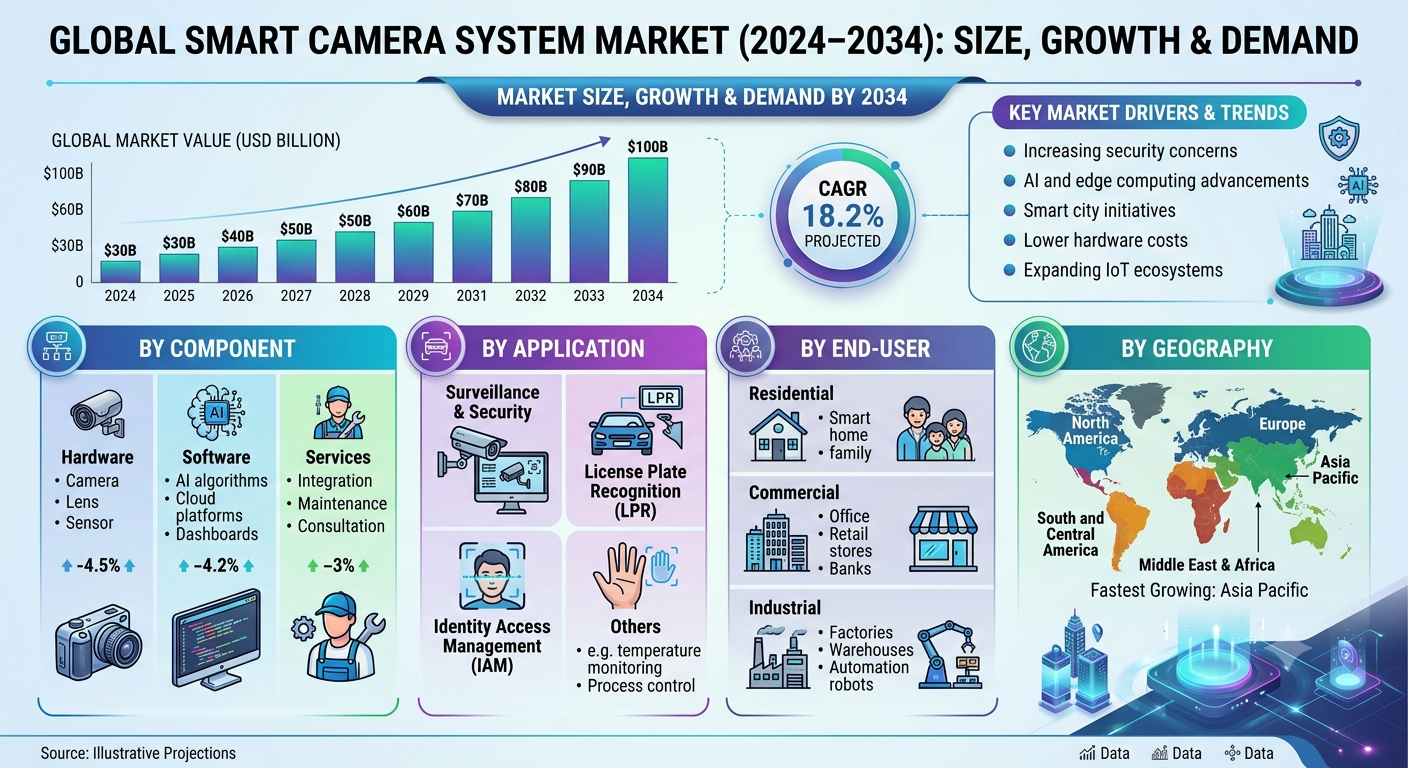
The rapid adoption of intelligent imaging technologies is transforming security, automation, monitoring, and operational decision-making across residential, commercial, and industrial environments. Smart cameras combine imaging capabilities with software, analytics, connectivity, and increasingly artificial intelligence to analyze visual information in real time. These capabilities are supporting applications ranging from surveillance and license plate recognition to identity access management, creating demand for more connected and intelligent camera infrastructure.
The global Smart Camera System Market Size is projected to reach US$24.09 billion by 2034, rising from US$11.9 billion in 2025, according to The Insight Partners. The industry is expected to register a CAGR of 9.21% from 2026 to 2034, while the total addressable opportunity is estimated at US$170.72 billion during the forecast period. The report covers hardware, software, and services across surveillance, license plate recognition, and identity access management applications for residential, commercial, and industrial users.
Download Sample PDF: https://www.theinsightpartners.com/sample/TIPRE00010844
Rising Demand for Advanced Security Solutions
One of the major Smart Camera System Market drivers is the increasing requirement for advanced security and monitoring solutions. Conventional cameras primarily capture and transmit video, whereas smart camera systems can incorporate analytics and automated interpretation of visual information. This enables organizations to identify events, monitor restricted areas, support access control, and improve situational awareness.
The growing need to protect commercial facilities, residential properties, transportation infrastructure, and public spaces is encouraging organizations to invest in intelligent surveillance technologies. The Insight Partners identifies enhanced security solutions as a key growth driver, with smart cameras increasingly supporting more responsive and technology-enabled security environments.
Smart Cameras Improve Operational Efficiency
Another important factor supporting the Smart Camera System Market Growth is the increasing focus on operational efficiency. Businesses are using intelligent cameras beyond conventional security applications to obtain actionable information from visual data. In industrial and commercial environments, camera-based systems can support monitoring, process observation, access management, and automated identification.
The broader transition toward Industry 4.0 is also creating favorable conditions for intelligent vision technologies. Machine vision systems increasingly integrate AI, IoT connectivity, and automation to support inspection, tracking, and process optimization. The integration of smart cameras with automation infrastructure can help organizations reduce manual monitoring requirements while improving the speed and consistency of visual analysis.
AI and Data-Driven Analytics Create New Demand
Artificial intelligence and machine learning are expanding the capabilities of smart camera systems. AI-enabled image processing allows cameras to move beyond recording toward real-time analysis, pattern recognition, and automated detection. This evolution is increasing the potential applications of smart cameras across security, retail, manufacturing, transportation, and other sectors.
The growing use of edge-based processing is particularly relevant because organizations increasingly require rapid analysis while minimizing latency. Embedded vision technologies are being used in applications involving robotics, IoT, autonomous systems, and real-time monitoring.
For retailers, AI-enabled cameras can support customer analytics and enhance store experiences, while industrial users can apply intelligent vision technologies to inspection and automation. The increasing availability of sophisticated analytics therefore represents an important opportunity for smart camera manufacturers and technology providers.
Smart Homes and IoT Adoption Support Expansion
The expansion of smart homes and connected devices is another factor contributing to demand. Consumers increasingly expect security systems to provide remote monitoring, intelligent alerts, and connectivity with broader home automation ecosystems. Smart cameras can integrate with connected devices and cloud platforms, allowing users to access information remotely.
According to The Insight Partners, growing demand in smart homes and IoT devices, along with enhanced remote monitoring and analytics capabilities, represents an important future trend for the industry.
Commercial facilities are similarly adopting connected cameras to improve security and facility management. As IoT ecosystems become more interconnected, smart cameras can serve as visual data sources within larger connected environments.
Segmentation and Competitive Landscape
The Smart Camera System Market is segmented by component, application, and end user. By component, the industry includes hardware, software, and services. By application, it covers surveillance, license plate recognition, and identity access management. By end user, the market is divided into residential, commercial, and industrial segments.
Key companies profiled in the report include Axis Communications AB, Hangzhou Hikvision Digital Technology Co., Ltd., Identiv, Inc., Kintronics, Milestone Systems A/S, Panasonic Corporation, Pelco Inc., Robert Bosch GmbH, Sony Corporation, and Tyco Security Products (Johnson Controls). These companies are participating in an evolving competitive environment characterized by technological innovation, intelligent analytics, connectivity, and application-specific solutions.
Future Outlook
The future outlook for the Smart Camera System Market remains closely linked to developments in AI, IoT, edge computing, automation, and connected security infrastructure. AI integration is expected to enable more personalized and responsive security solutions, while demand for remote monitoring and advanced analytics can expand the functionality of camera systems.
Privacy-focused technologies are also expected to become increasingly important as organizations deploy cameras across homes, workplaces, retail locations, and public environments. Vendors that combine intelligent analytics with secure data management and privacy-conscious architectures may address evolving customer requirements.
With the global industry projected to grow from US$11.9 billion in 2025 to US$24.09 billion by 2034, at a 9.21% CAGR from 2026 to 2034, investment in intelligent visual technologies is expected to continue across multiple end-user segments.
About The Insight Partners
The Insight Partners is a globally recognized market research and consulting firm providing reliable and actionable insights across industries. The company delivers comprehensive research reports, strategic analysis, competitive intelligence, and customized consulting solutions to help organizations understand changing industry dynamics and identify growth opportunities.
Contact Us
The Insight Partners
Email: [email protected]
Phone: +1-646-491-9876
Website: https://www.theinsightpartners.com
Related Reports -
Submarine Fiber Cable Market Demand, Share & Growth by 2034
Aircraft Wiring Harness Market Dynamics and Trends by 2030
SCADA Oil and Gas Market Size, Trends & Growth by 2034

 English
 Arabic
 Spanish
 Portuguese
 Deutsch
 Turkish
 Dutch
Dutch
 Italiano
 Russian
 Romaian
 Portuguese (Brazil)
 Greek
Greek