


What Makes Sequencing Technology Central to Genomics Market Growth Today?
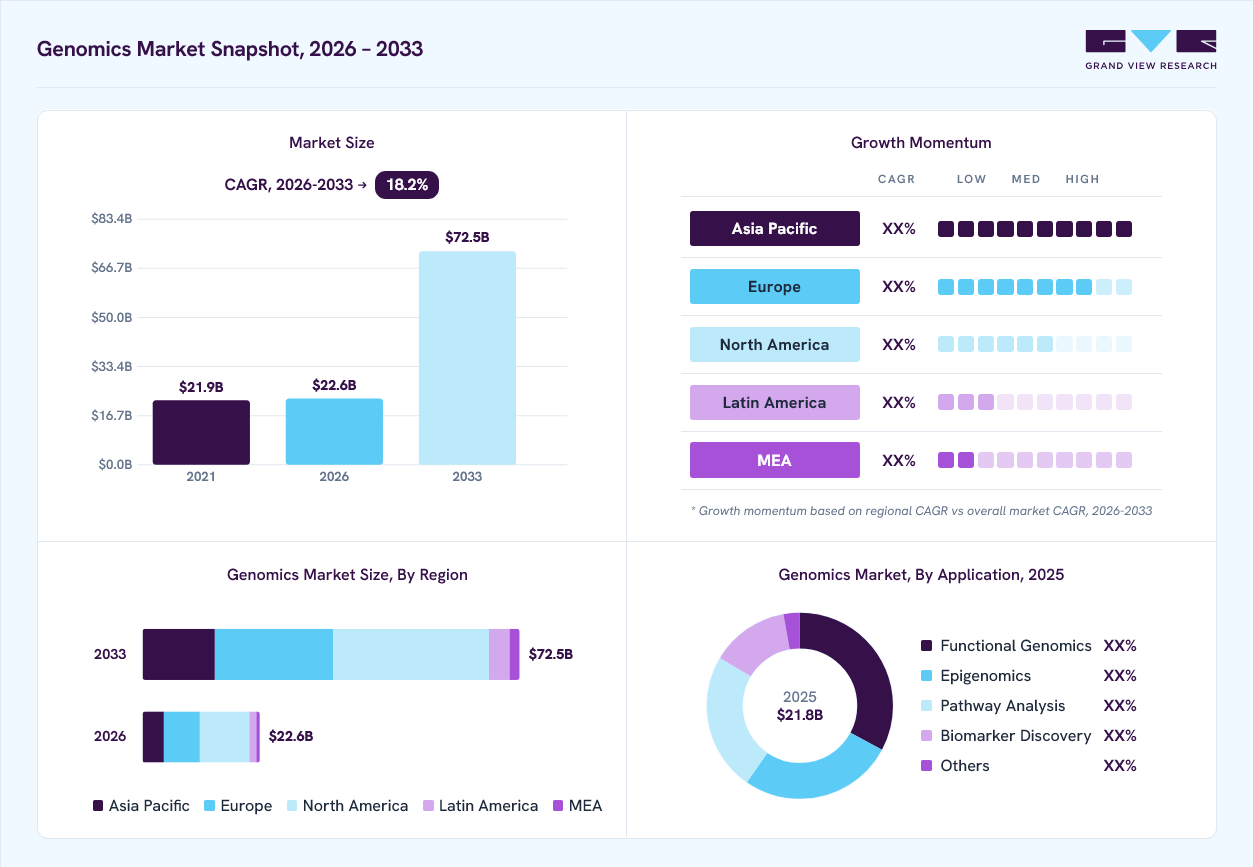
Genomics is becoming increasingly integrated into clinical diagnostics, biomedical research, drug development, and precision medicine. Advances in sequencing, genome editing, bioinformatics, and data analytics are making genetic analysis more efficient while expanding the use of genomic information across healthcare and research applications. The genomics market was valued at USD 21.8 billion in 2025 and is projected to reach USD 72.5 billion by 2033, growing from USD 22.6 billion in 2026 at a CAGR of 18.2% from 2026 to 2033.
Market Growth Supported by Expanding Clinical Applications
The growing adoption of genomics in clinical diagnostics, oncology, and rare disease management is strengthening demand for genomic technologies. Next-generation sequencing (NGS) and other molecular testing technologies support the detection of genetic disorders, inherited conditions, and disease-associated variants, helping improve disease risk assessment, prognosis, and treatment selection.
In oncology, genomic technologies are increasingly used for tumor profiling, biomarker identification, and targeted treatment selection. Genomic analysis can help characterize tumor heterogeneity, identify clinically relevant mutations, assess potential treatment response, and monitor disease progression. Whole-exome sequencing and whole-genome sequencing are also supporting rare disease diagnosis where conventional approaches may be inconclusive.
Precision Medicine Creates New Demand for Genomic Analysis
Precision medicine is another important factor supporting market expansion. Genomic information enables treatment strategies to be developed around an individual's genetic profile, while advances in sequencing, bioinformatics, and data analytics are helping integrate genomic information into clinical workflows.
Pharmaceutical and biotechnology companies are increasingly incorporating genomics into targeted drug development, companion diagnostics, and patient stratification for clinical trials. Genomic-based patient selection can help identify populations more likely to respond to specific therapies, supporting more efficient clinical development.
Technology Advances Improve Accessibility and Workflow Efficiency
Declining sequencing costs and technological advancements are making genomic testing more accessible, faster, and cost efficient. Improvements in NGS are supporting broader applications across precision medicine, cancer diagnostics, rare disease diagnosis, and drug discovery.
AI-based bioinformatics is also helping researchers and healthcare providers process increasingly complex genomic datasets and translate sequencing results into actionable insights. These developments are strengthening applications in personalized medicine, population health, and clinical research.
The integration of artificial intelligence, machine learning, and cloud-based bioinformatics platforms represents an important opportunity for the market. These technologies can support genetic variant identification, biomarker discovery, disease profiling, treatment-response analysis, and genomic data management.
Functional Genomics Leads Application Demand
Functional genomics accounted for the largest application revenue share of 32.8% in 2025. Its use in investigating gene function, biological mechanisms, and phenotypic changes associated with diseases is supporting its leading position. Functional genomic approaches are also contributing to cancer research and gene-based therapy development.
Meanwhile, pathway analysis is expected to register the fastest CAGR over the forecast period. Its growing relevance is linked to the need for a deeper understanding of molecular interactions, signaling pathways, and disease mechanisms in therapeutic research.
Products Remain the Largest Deliverables Segment
The product segment dominated the genomics market with a revenue share of 70.0% in 2025 and is expected to grow at the fastest CAGR over the forecast period. Genomics products include instruments and systems used for nucleic acid synthesis and sequencing, along with consumables and reagents used throughout genomic workflows.
The service segment is also expected to maintain steady growth through 2033. High instrument costs, specialized expertise requirements, and the preference for outsourcing complex activities are supporting demand for genomic services.
Pharmaceutical and Biotechnology Companies Drive End-use Demand
Pharmaceutical and biotechnology companies accounted for 54.8% of revenue in 2025, supported by the increasing use of genomic information in drug discovery, target identification, biomarker development, and precision medicine. Spatial genomics and transcriptomics are further supporting detailed disease characterization and therapeutic development.
Hospitals and clinics are expected to grow at a substantial pace as genomic sequencing becomes increasingly integrated into clinical decision-making, particularly for oncology and rare diseases.
Regional Expansion Broadens the Genomics Opportunity
North America dominated the genomics market with a revenue share of 42.3% in 2025, supported by established genomics technology providers, advanced sequencing adoption, genomic research investment, and a mature healthcare and life sciences ecosystem. Asia Pacific is identified as the fastest-growing regional market during 2026–2033.
Across developed and emerging economies, investments in healthcare infrastructure, genomics research, and advanced sequencing technologies are creating additional opportunities. Government initiatives supporting genomic research and precision medicine are also contributing to regional market development.
Data Privacy Remains an Important Market Consideration
Despite strong growth opportunities, data privacy, security, and ethical concerns remain important constraints. Genomic information can be sensitive and potentially identifiable, while the growing use of genomic databases, cloud-based platforms, and AI-driven analytics raises concerns surrounding informed consent, unauthorized access, data breaches, and potential misuse.
Differences in data protection requirements and regulatory frameworks can also increase compliance requirements and operational complexity. As genomic datasets expand, stronger governance and responsible data-sharing practices remain important for broader adoption.
FAQ
What trends are shaping the genomics market?
Advances in next-generation sequencing, AI-enabled bioinformatics, single-cell genomics, data analytics, and precision medicine are shaping the market. Declining sequencing costs and increasing genomic applications across diagnostics, drug discovery, and clinical research are also supporting expansion.
Which segment leads the genomics market?
Functional genomics led the application segment with a 32.8% revenue share in 2025, while products led deliverables with a 70.0% revenue share and pharmaceutical and biotechnology companies led end use with a 54.8% revenue share.
Key Genomics Companies:
· Illumina, Inc.
· Thermo Fisher Scientific, Inc.
· Danaher Corporation
· F. Hoffmann-La Roche Ltd.
About us:
Grand View Research, a market research and consulting company, provides syndicated research reports, customized research reports, and consulting services. Grand View Research database is used by the world's renowned academic institutions and Fortune 500 companies to understand the global and regional business environment. Our database features thousands of statistics and in-depth analysis on 46 industries in 25 major countries worldwide.

 English
 Arabic
 French
 Portuguese
 Deutsch
 Turkish
 Dutch
Dutch
 Italiano
 Russian
 Romaian
 Portuguese (Brazil)
 Greek
Greek