


Small Satellite Market 2026-2034: Size, Share, Key Trends, Growth Analysis & Industry Report
Market Overview
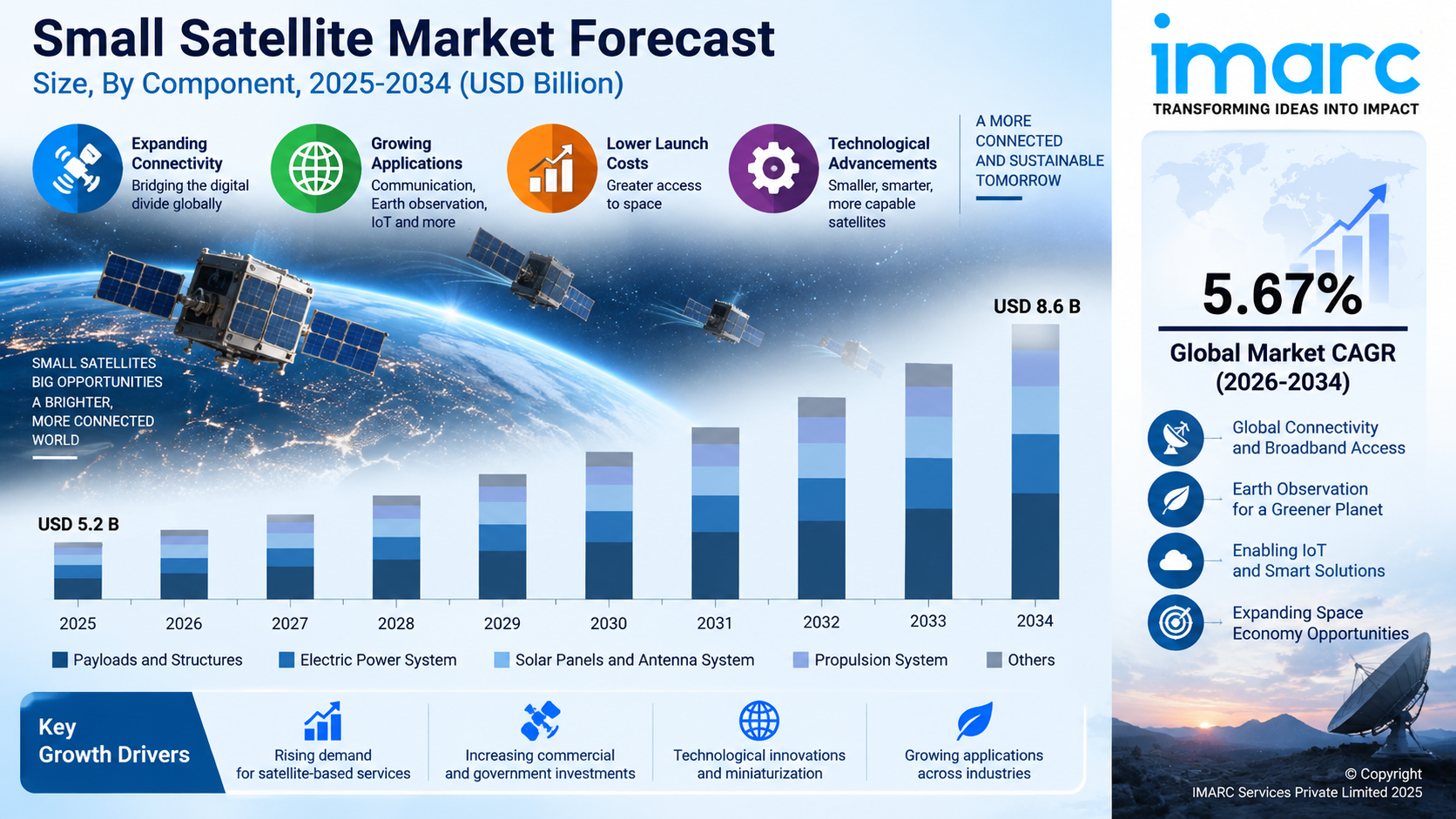
According to a research report by IMARC Group, the global small satellite market size reached USD 5.2 Billion in 2025. Looking forward, IMARC Group expects the market to reach USD 8.6 Billion by 2034, exhibiting a growth rate (CAGR) of 5.67% during 2026-2034. North America currently leads the regional landscape, accounting for over 43.3% of the market share in 2025, supported by technological advancements, cost efficiency, growing demand for communications and Earth observation, increasing private sector investment, and strong government support.
Small Satellite Market Key At a Glance
-
Base Year: 2025
-
Historical Period: 2020–2025
-
Forecast Period: 2026–2034
-
Market Size (2025): USD 5.2 Billion
-
Market Forecast (2034): USD 8.6 Billion
-
CAGR (2026–2034): 5.67%
-
Leading Region: North America
-
North America's Market Share (2025): Over 43.3%
-
Dominant Component: Payloads and Structures
-
Dominant Type: Micro Satellite
-
Leading Frequency: Ku-Band
-
Leading Application: Earth Observation and Remote Sensing
-
Dominant End User: Government and Military
Request for a Sample Report for Detailed Evaluation: https://www.imarcgroup.com/small-satellite-market/requestsample
Small Satellite Market Report: Key Highlights
-
Market Size & Growth: The global small satellite market reached USD 5.2 Billion in 2025 and is projected to reach USD 8.6 Billion by 2034, registering a CAGR of 5.67% during 2026–2034, according to IMARC Group.
-
Regional Leadership: North America represents the largest regional market, accounting for over 43.3% of the market share in 2025, supported by technological advancements, government initiatives, private sector investment, and increasing demand for satellite-based services.
-
By Component: The market is segmented into payloads and structures, electric power system, solar panels and antenna system, propulsion system, and others, with payloads and structures representing the largest segment.
-
By Type: The market covers mini satellites, micro satellites, nano satellites, and others, with micro satellites accounting for the largest share.
-
By Frequency: The market includes L-band, S-band, C-band, X-band, Ku-band, Ka-band, Q/V-band, HF/VHF/UHF-band, and others, with Ku-band holding the leading share.
-
By Application: The market spans communication, Earth observation and remote sensing, science and exploration, mapping and navigation, space observation, and others, with Earth observation and remote sensing representing the largest segment.
-
By End User: The market comprises commercial, academic, government and military, and others, with government and military accounting for the largest share.
-
Key Market Drivers: Cost efficiency, technological advancements, increasing demand for communications and real-time data services, rising private sector investment, and government support.
-
Key Market Trends: Advances in miniaturization, propulsion systems, onboard sensors, artificial intelligence and IoT integration, reusable launch systems, and growing deployment of small satellite constellations.
-
Key Market Opportunities: Expanding applications in Earth observation, communications, disaster management, agriculture, defense, scientific research, navigation, and connectivity services.
What Is Driving Small Satellite Market Growth in 2026?
Significant Technological Advancements
The small satellite market is being driven by significant technological advancements in miniaturization, propulsion systems, and onboard sensors, which are enhancing satellite capabilities while reducing size and weight. Innovations in manufacturing processes, including 3D printing, along with the use of advanced materials, are making satellites more affordable and reliable.
These advancements are enabling small satellites to support a broader range of applications, including high-resolution imaging, real-time communications, Earth observation, and scientific research. The integration of artificial intelligence (AI) and the Internet of Things (IoT) is further expanding satellite capabilities by enabling smarter data collection and analysis.
Moreover, the continuous evolution of launch systems, including reusable rockets, is supporting more frequent and cost-effective launches and encouraging the adoption of small satellites across various industries. For instance, ISRO successfully launched its Earth Observation Satellite, EOS-08, in August 2024 from the Satish Dhawan Space Centre using the Small Satellite Launch Vehicle (SSLV)-D3. The satellite weighs approximately 175.5 kg and is designed for a mission life of one year in a Circular Low Earth Orbit at an altitude of 475 km and an inclination of 37.4°.
Rising Cost Efficiency
Cost efficiency represents another major factor supporting the growth of the small satellite market. Smaller and lighter satellites generally require lower development, manufacturing, launch, and operational costs compared with traditional satellite systems. This affordability makes them increasingly accessible to commercial organizations, startups, academic institutions, and government agencies.
Innovations in shared and reusable launch systems have further contributed to reducing launch expenses. The lower cost of deployment also enables operators to establish larger satellite constellations, improving coverage, redundancy, and service quality.
For instance, in August 2024, ISRO received 15 orders for its SSLV, including requests from Singapore. The SSLV can launch satellites weighing between 5 kg and 500 kg into orbit. NewSpace India Ltd., the commercial division of the space organization, is expected to begin producing the launch vehicles to meet demand. According to an ISRO official, the SSLV is inexpensive, can carry several satellites, and has a shorter interval between consecutive launches. Its launch-on-demand capability also requires minimal launch infrastructure compared with larger launch vehicles.
Growing Private Sector and Government Support
The increasing participation of private space companies and continued government support are creating a favorable environment for small satellite market growth. Companies such as SpaceX, Rocket Lab, and OneWeb are contributing to the development of affordable and frequent access to space, while private sector investments are encouraging innovation in satellite design, manufacturing, and launch services.
Government agencies, including NASA and the U.S. Department of Defense, are also supporting small satellite deployment for scientific research, communications, defense, and other applications. Public-private partnerships and supportive regulatory frameworks are further facilitating innovation and collaboration throughout the space sector.
For instance, in September 2024, Space Machines Company, an Australian start-up, collaborated with Ananth Technologies and Digantara, two Indian companies, to improve its satellite services. Through the partnership, the Optimus spacecraft is planned to be assembled and tested at Ananth's Bengaluru facilities, with a launch planned on ISRO's SSLV in 2026.
Growing Demand for Real-Time Data Services
The growing requirement for real-time data across sectors is contributing to the increasing deployment of small satellites. Applications such as climate monitoring, disaster management, agriculture, environmental monitoring, mapping, and resource management rely on timely satellite imagery and data.
Small satellites offer a cost-effective means of collecting high-resolution information and can be deployed as constellations to provide broader and more continuous coverage. The increasing demand for data-driven decision-making across commercial and government applications is consequently supporting market expansion.
Small Satellite Market Segmentation Analysis
By Component
-
Payloads and Structures
-
Electric Power System
-
Solar Panels and Antenna System
-
Propulsion System
-
Others
Payloads and structures represent the largest component segment, accounting for around 38.2% of the market in 2025. Payloads and structures play a critical role in determining the functionality and performance of small satellites. Payloads include cameras, sensors, communication equipment, and other systems that enable applications such as Earth observation, telecommunications, and scientific research.
Structures provide the physical framework required to house and protect these payloads from the harsh space environment. Advances in miniaturization and lightweight materials are further enhancing payload capabilities while reducing satellite size and weight. Rising demand for precise, high-resolution data and reliable communication is consequently supporting continued development of sophisticated payloads and robust satellite structures.
By Type
-
Mini Satellite
-
Micro Satellite
-
Nano Satellite
-
Others
Micro satellites represent the largest type segment, accounting for around 40.4% of the market in 2025. Micro satellites generally weigh between 10 kg and 100 kg and are widely used for applications including scientific research, Earth observation, and military surveillance.
Their relatively small size supports affordable manufacturing and launch costs, with rideshare opportunities further improving cost efficiency. Micro satellites are also suitable for multi-mission constellations, enabling broader coverage and redundancy. Continued advancements in miniaturization and payload design are enhancing their capabilities and supporting adoption among commercial operators and government agencies.
By Frequency
-
L-Band
-
S-Band
-
C-Band
-
X-Band
-
Ku-Band
-
Ka-Band
-
Q/V-Band
-
HF/VHF/UHF-Band
-
Others
Ku-band leads the market by frequency, accounting for around 22.8% of the market share in 2025. The widespread use of Ku-band in satellite communications, including broadband internet, telecommunications networks, and broadcasting services, is supporting its leading position.
The frequency band offers a combination of wide coverage, high data transfer rates, and reliability, making it suitable for various small satellite applications. Ku-band is also increasingly utilized by low Earth orbit (LEO) satellites that require reliable communication links for real-time data transmission. Growing demand for global connectivity and satellite-based internet services is further supporting its adoption.
By Application
-
Communication
-
Earth Observation and Remote Sensing
-
Science and Exploration
-
Mapping and Navigation
-
Space Observation
-
Others
Earth observation and remote sensing represent the largest application segment, accounting for around 34.3% of the market share in 2025. Small satellites are increasingly used for disaster response, resource management, environmental monitoring, mapping, climate analysis, and agricultural evaluation.
These satellites provide high-resolution data and imagery that support precise monitoring and decision-making. Governments, academic institutions, and private enterprises are increasingly relying on small satellites for affordable and real-time data collection. Their relatively low launch costs and compact designs also make them suitable for establishing constellations capable of providing broad geographic coverage.
By End User
-
Commercial
-
Academic
-
Government and Military
-
Others
Government and military users represent the largest end-user segment, accounting for around 47.3% of the market share in 2025. These sectors rely on small satellites for communication, surveillance, intelligence, national security, disaster management, and environmental monitoring.
The affordability and relatively rapid deployment of small satellites make them suitable for defense applications such as border monitoring, threat detection, and tactical operations. Increasing demand for real-time data and scalable satellite constellations is further supporting their use across government and military activities.
By Region
-
North America
-
United States
-
Canada
-
-
Asia Pacific
-
China
-
Japan
-
India
-
South Korea
-
Australia
-
Indonesia
-
Others
-
-
Europe
-
Germany
-
France
-
United Kingdom
-
Italy
-
Spain
-
Russia
-
Others
-
-
Latin America
-
Brazil
-
Mexico
-
Others
-
-
Middle East and Africa
North America holds the largest regional share in the global small satellite market, accounting for over 43.3% in 2025. The region's leading position is supported by technological advancements, strong private sector participation, government support, and increasing demand for real-time data services.
The United States has a well-established space industry and continues to benefit from advances in miniaturization, propulsion technologies, and reusable launch systems. Small satellites are increasingly being used for Earth observation, climate monitoring, defense, communications, and broadband connectivity.
Asia Pacific is also witnessing growing demand, supported by expanding IoT applications, urbanization, satellite-based monitoring, academic research, and the development of dedicated launch capabilities. Europe is benefiting from advancements in mapping, navigation, environmental monitoring, and satellite communications, while Latin America and the Middle East and Africa are increasingly adopting small satellite technologies for connectivity, remote sensing, infrastructure monitoring, and urban development.
Key Regional Insight: North America's Strategic Position
North America's leading position in the global small satellite market is anchored by its established space ecosystem, technological capabilities, and strong government and private sector participation. The United States accounted for over 91.40% of the North American market in 2025, supported by the increasing use of small satellites for communication, Earth observation, disaster management, agriculture, defense, scientific research, mapping, navigation, and space observation.
Government agencies such as NASA and the Department of Defense actively support research and deployment initiatives, while private companies contribute to cost-effective launch and satellite services. The increasing demand for broadband connectivity and real-time data is further supporting deployment across commercial and government applications.
Key Regional Takeaways
United States Small Satellite Market Analysis
Small satellites are increasingly utilized for communication applications, supporting connectivity across large and remote areas. Their role in Earth observation is expanding applications such as disaster management, agricultural monitoring, and environmental studies. The United States has experienced more than USD 400 Billion in weather and climate disasters since 1980, with associated costs reaching USD 2.785 Trillion, highlighting the importance of effective disaster management systems and satellite-based observations.
Remote sensing technologies integrated into satellite systems provide real-time environmental information, while small satellites also support scientific missions through cost-efficient research-focused payloads. Mapping and navigation applications benefit from precise geospatial information, while space observation capabilities support orbital debris tracking and solar activity monitoring.
The country's favorable technological ecosystem and strong research and development infrastructure are further supporting innovation in compact and reliable satellite systems.
Asia Pacific Small Satellite Market Analysis
Growing demand for small satellites across Asia Pacific is being supported by expanding IoT applications, including real-time supply chain monitoring and remote asset tracking. Rapid urbanization is also increasing demand for smart city solutions, with small satellites supporting precision mapping and infrastructure monitoring.
A constellation of remote sensing small satellites equipped with synthetic aperture radar (SAR) payloads, featuring four orbital planes and 12 satellites at an altitude of 600 km, has been developed for infrastructure monitoring across India. Academic institutions are also contributing to satellite development for educational and experimental purposes.
Maritime monitoring remains another important application, with satellites providing data for shipping and fisheries. The development of cost-effective launch vehicles and dedicated launch infrastructure is helping reduce barriers to entry for emerging space ventures. Advancements in Earth observation technologies are further supporting applications related to natural disaster monitoring and resource management.
Europe Small Satellite Market Analysis
Small satellites are supporting advancements in mapping and navigation systems through compact designs and innovative functionalities. They enable detailed geographic data collection for urban planning, environmental conservation, and infrastructure development.
High-resolution imaging and real-time data transmission are also supporting smart transportation systems, mobility solutions, and route optimization. Their adaptability allows operators to deploy cost-effective constellations capable of providing continuous monitoring and coverage.
Small satellite technologies are increasingly being integrated into navigation and logistics frameworks, supporting applications ranging from autonomous vehicles to maritime route tracking.
Latin America Small Satellite Market Analysis
Small satellites are contributing to the expansion of communication networks by providing scalable solutions for underserved areas. Their role in 5G infrastructure deployment is supporting high-speed internet and IoT applications across the region.
By enabling data exchange across large geographic areas, small satellite networks can help address connectivity gaps while supporting smart home technologies, e-commerce, education, and other digital services. The ability to establish low-cost satellite constellations is further supporting the expansion of satellite-based connectivity and technological integration across Latin America.
Middle East and Africa Small Satellite Market Analysis
Small satellites are supporting advances in remote sensing, urban development, land management, and infrastructure monitoring across the Middle East and Africa. In the United Arab Emirates, 13,826 active construction projects worth USD 319.50 Billion are driving demand for technologies capable of improving project tracking and analytics.
High-resolution satellite imagery can provide insights into land use patterns and support real estate planning and investment decisions. The lightweight and cost-effective nature of small satellites also enables frequent launches and more regular updates for infrastructure monitoring.
Their flexibility is supporting integration into disaster management and sustainable urban development frameworks, while growing adoption of space technologies is contributing to modernization across industries.
Competitive Landscape in the Small Satellite Industry
The global small satellite market is highly competitive, with companies focusing on innovation, cost reduction, satellite capabilities, and specialized applications. Traditional aerospace companies are expanding their small satellite portfolios, while specialized space companies and startups are developing satellite platforms, payloads, launch services, and related technologies.
Competition is being further shaped by advancements in reusable launch vehicles, miniaturized components, propulsion systems, and artificial intelligence integration. Government programs and public-private partnerships are also supporting industry development and encouraging collaboration across the space ecosystem.
For instance, in October 2024, Lockheed Martin Corp announced the completion of its tactical acquisition of Terran Orbital, a manufacturer of small satellites, with a significant investment of USD 450 million.
Key Small Satellite Market Players Include:
-
AAC Clyde Space
-
Airbus U.S. Space & Defense, Inc.
-
Blue Canyon Technologies LLC (RTX Corporation)
-
GomSpace
-
L3Harris Technologies Inc.
-
Lockheed Martin Corporation
-
Millennium Space Systems, Inc. (The Boeing Company)
-
Northrop Grumman
-
Spire Global
-
Tyvak International (Terran Orbital Corporation)
Recent Developments:
-
In December 2024, Eutelsat partnered with Airbus to manufacture 100 small satellites for the OneWeb constellation extension, with deliveries scheduled to begin in late 2026. The expansion is intended to strengthen satellite-based connectivity capabilities through the OneWeb low Earth orbit constellation.
-
In December 2024, the European Union's USD 11 Billion IRIS² constellation deal was announced to deploy 290 small communication satellites in medium and low Earth orbit by 2030. The initiative is designed to provide secure connectivity for governments, businesses, and individuals while expanding high-speed internet access to areas with limited connectivity.
-
In December 2024, Taiwan engaged with Amazon's Project Kuiper to strengthen satellite-based communication infrastructure and improve internet and mobile reliability. The development highlights the growing importance of satellite networks for connectivity and communications resilience.
-
In December 2024, AST SpaceMobile signed a long-term agreement with Vodafone through 2034 to enable space-based cellular broadband across Europe and Africa through its Partner Markets program. Vodafone also ordered its first Block 1 BlueBird gateway, designed to connect everyday smartphones to AST SpaceMobile's low Earth orbit satellites through Vodafone's network infrastructure.
-
In January 2024, Airbus U.S. Space & Defense acquired full ownership of Airbus OneWeb Satellites (AOS), taking over Eutelsat OneWeb's 50% stake. The move strengthened Airbus's position in small satellite manufacturing at its Merritt Island, Florida facility and supported its activities across commercial, institutional, and national security space markets.
Small Satellite Market FAQs
1. What is the current size of the small satellite market?
The global small satellite market reached USD 5.2 Billion in 2025 and is expected to grow at a CAGR of 5.67% during 2026-2034, reaching USD 8.6 Billion by 2034.
2. What is driving the growth of the small satellite market?
The market is driven by cost efficiency, technological advancements, increasing demand for communications and real-time data services, growing applications in Earth observation and scientific research, rising private sector investment, and government support.
3. Which region dominates the small satellite market?
North America leads the global small satellite market, accounting for over 43.3% of the market share in 2025, supported by technological advancements, a well-established space industry, government initiatives, and strong private sector participation.
4. Which segment holds the largest share in the small satellite market?
Payloads and structures represent the largest component segment, accounting for around 38.2% of the market in 2025. Micro satellites lead by type with around 40.4%, Ku-band leads by frequency with around 22.8%, Earth observation and remote sensing leads by application with around 34.3%, and government and military users lead by end user with around 47.3%.
5. What are the key trends in the small satellite market?
Key trends include continued advancements in miniaturization, propulsion systems, onboard sensors, AI and IoT integration, increasing use of reusable launch systems, growing deployment of satellite constellations, and rising demand for real-time Earth observation, communication, navigation, and scientific data.
Conclusion: Small Satellite Market Outlook to 2034
The global small satellite market is set for steady growth through 2034, underpinned by cost efficiency, technological advancements, growing demand for communications and real-time data, increasing private sector investment, and government support. The development of miniaturized components, advanced propulsion systems, sophisticated payloads, and reusable launch technologies is further expanding the capabilities and accessibility of small satellites.
While government and military applications currently represent the largest end-user segment and Earth observation and remote sensing remains the leading application, commercial and academic uses are also contributing to the expansion of the industry. With North America maintaining its position as the leading regional market and Asia Pacific, Europe, Latin America, and the Middle East and Africa offering further growth avenues, the outlook through 2034 remains positive. Continued investment in satellite constellations, advanced payloads, cost-effective launch services, communications infrastructure, and data-driven applications is expected to support the evolution of the small satellite industry.
About the Author:
IMARC Group is a leading global market research company providing data-driven insights and expert consulting services to businesses seeking to achieve their strategic objectives. With a multi-disciplinary team of industry experts, IMARC delivers thorough, reliable market intelligence across sectors including Energy and Mining, Construction and Manufacturing, Automotive, Chemicals and Materials, and more.
Media & Sales Contact:
IMARC Group
United States: +1-201-971-6302
India: +91-120-433-0800
United Kingdom: +44-753-714-6104

 English
 Arabic
 French
 Portuguese
 Deutsch
 Turkish
 Dutch
Dutch
 Italiano
 Russian
 Romaian
 Portuguese (Brazil)
 Greek
Greek