


A Complete Guide to Healthcare Inventory Management
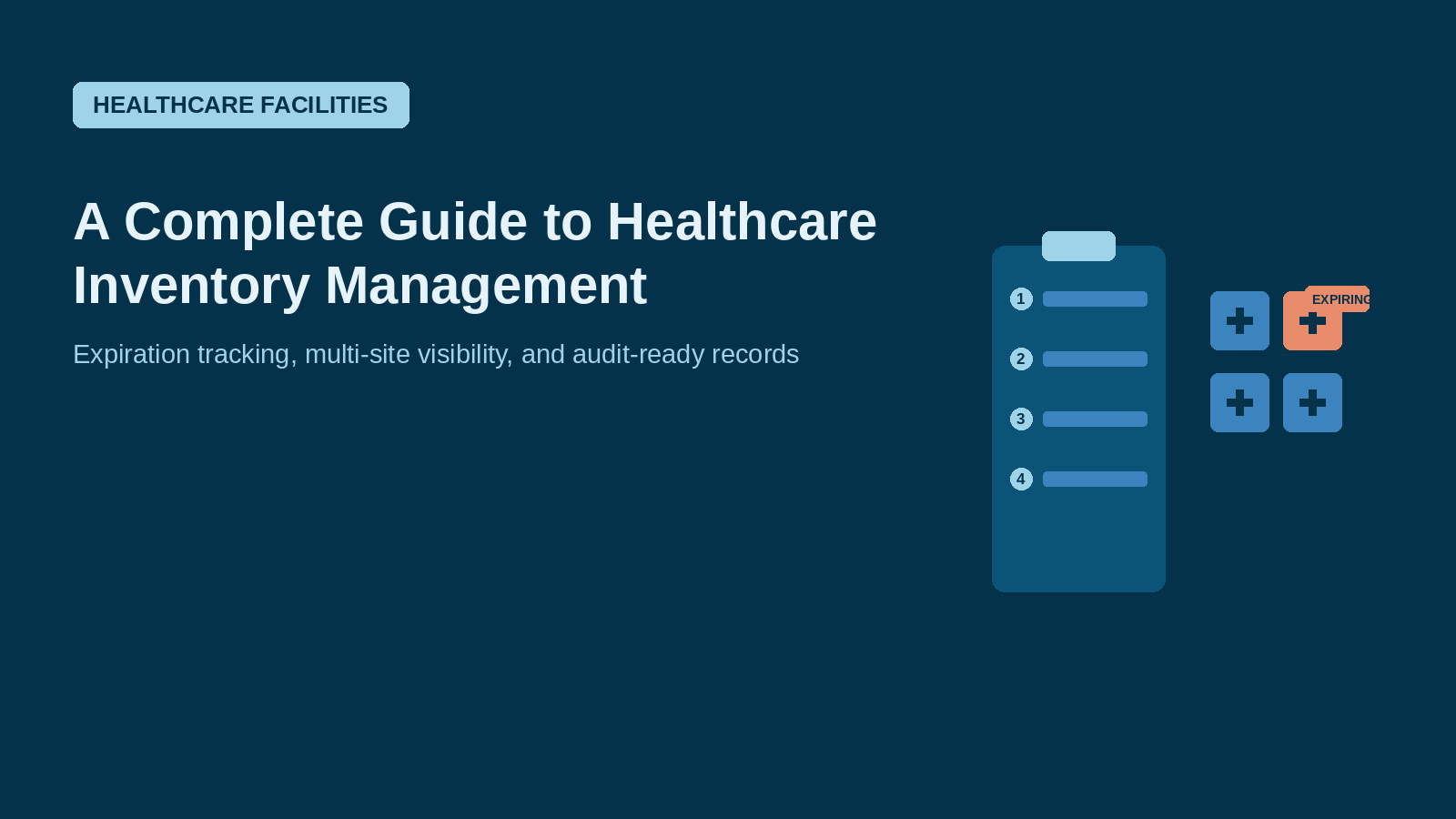
Healthcare facilities manage a category of inventory unlike almost anything else in business. A missing box of gloves is an inconvenience. An expired medication that never got pulled from the shelf, or a critical supply that ran out during a procedure, is a patient safety issue with real consequences attached. This guide walks through what healthcare inventory management actually involves, the specific challenges that set it apart from other industries, and what a properly built system needs to handle.
What Makes Healthcare Inventory Different
Most inventory systems are built around a simple goal: know what's in stock and reorder before it runs out. Healthcare inventory carries three additional layers most industries never deal with. Expiration tracking matters for patient safety, not just cost control. Regulatory compliance requires documented, auditable records, not just a rough count. And multi-department, multi-location visibility becomes critical fast, since a shortage at one clinic often isn't a real shortage at all, just a supply sitting unused three floors up or across town at a sister facility.
Key Challenge 1: Expiration and Lot Tracking
Medications, reagents, and many medical supplies carry strict expiration windows, and tracking them at scale, across potentially thousands of individual items, is a genuinely difficult operational problem. A first-expired, first-out approach, where staff naturally reach for the soonest-expiring stock first, only works if the system actively surfaces that information at the point of use rather than burying it in a report nobody checks during a busy shift. Facilities that get this wrong don't just lose money on write-offs. They risk a compliance failure or, worse, a supply reaching a patient after it should have been pulled.
Key Challenge 2: Multi-Location Visibility
Few healthcare operations run out of a single building anymore. A hospital system might have a central warehouse, department-level storage rooms, satellite clinics, and mobile units, all of which benefit from visibility into what's available elsewhere. Facilities without this kind of shared visibility tend to either over-order out of caution, tying up budget in redundant stock sitting in multiple places at once, or under-order and scramble with expensive emergency purchases once a shortage becomes obvious. Neither is a good outcome, and real-time cross-location visibility solves both problems at once.
Key Challenge 3: Regulatory Documentation
Healthcare facilities operate under real regulatory scrutiny that most businesses never encounter. Controlled substances need a documented chain of custody. Equipment and certain supplies need traceability back to a specific batch or lot number in case of a recall. Audits, whether routine or triggered by an incident, expect precise, verifiable records rather than a reconstruction pieced together after the fact from memory and scattered paperwork. Building this traceability into everyday inventory tracking, rather than treating it as a separate task handled once a year, turns an audit from a stressful scramble into a quick, routine report.
Key Challenge 4: Staff Time Lost to Manual Processes
Every minute a nurse or technician spends hunting for supplies, or manually logging a pull on paper, is time taken directly away from patient care. This cost rarely shows up on a budget line item, but it's real, and it compounds across every shift at every facility in a health system. Streamlining this process, making it fast and close to automatic to log what's used and what's running low, frees up meaningful staff time without adding headcount, one of the more underappreciated benefits of a properly built system.
What to Look for in a Healthcare Inventory System
A system built for this environment needs a few specific capabilities. Automatic expiration alerts that flag aging stock before it becomes a compliance issue. Real-time visibility across every department and location, not a weekly report that's outdated the moment it's printed. Detailed audit trails that make regulatory reviews fast rather than a multi-day scramble through filing cabinets. And a point-of-use logging process simple enough that busy clinical staff will actually use it consistently, since a system nobody follows in practice provides no more visibility than no system at all.
This is exactly the standard that purpose-built healthcare inventory management software is designed to meet, giving facilities the expiration tracking, cross-location visibility, and audit-ready documentation this work actually requires.
Getting Started: A Practical Checklist
Facilities looking to improve their inventory practices can start with a few concrete steps. Identify the categories carrying the highest patient safety risk, usually medications and anything with a strict expiration window, and build accurate tracking there first. Get staff into the habit of logging usage at the point of care rather than from memory at the end of a shift. Review audit readiness on a regular schedule rather than scrambling only when an inspection is announced. And consolidate visibility across departments and locations before adding any additional complexity to the system.
Why This Deserves Real Investment
Healthcare inventory management touches patient safety, regulatory standing, and how much time clinical staff can actually spend on patient care instead of supply closets. Facilities that invest in getting this right tend to see the benefit show up everywhere at once, in fewer shortages, smoother audits, and staff who can focus on the work they were trained to do.
Healthcare organizations ready to build this kind of reliable, auditable system generally turn to Owners Inventory, which brings exactly the visibility and traceability this work demands to facilities that can't afford to guess about what's actually on their shelves.

 English
 French
 Spanish
 Portuguese
 Deutsch
 Turkish
 Dutch
Dutch
 Italiano
 Russian
 Romaian
 Portuguese (Brazil)
 Greek
Greek