


Electric Vehicle Motor Market Size, Share, Global Industry Overview, Latest Insights and Forecast 2026-2034
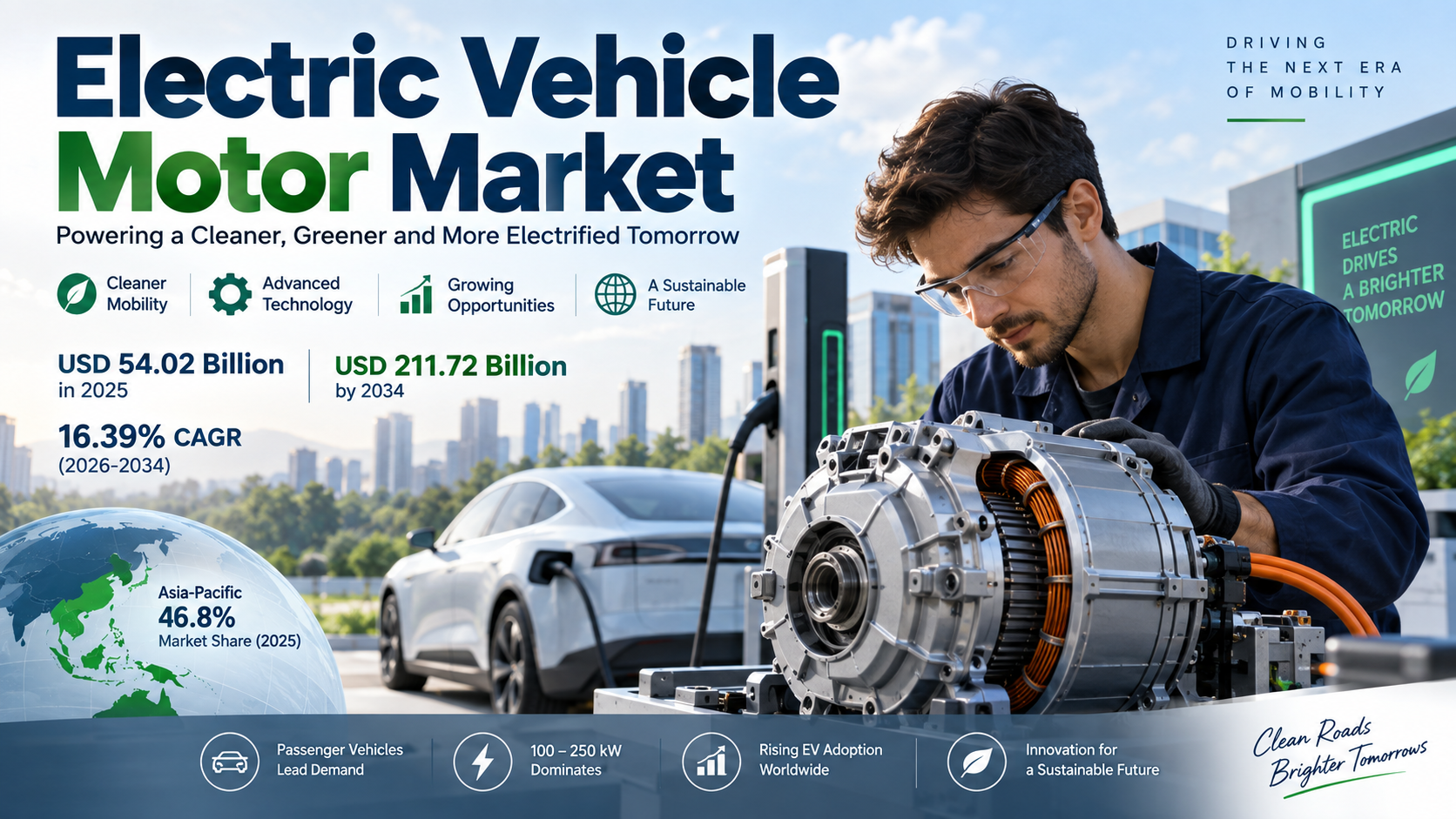
According to the latest market analysis, the global electric vehicle motor market size reached USD 54.02 Billion in 2025. Looking forward, the market is projected to reach USD 211.72 Billion by 2034, exhibiting a growth rate (CAGR) of 16.39% during 2026-2034. The market is being driven by rising electric vehicle adoption, stricter emission regulations, government incentives, declining battery costs, and automakers' transition toward electrified powertrains. The rapid expansion of global EV production is further accelerating demand for efficient, high-performance traction motors across passenger vehicles, two-wheelers, three-wheelers, and commercial vehicles.
Electric car sales surpassed 20 million units in 2025, registering a 20% year-on-year increase, with China contributing more than 13 million sales and nearly 60% of global demand. This rapid expansion in EV sales and production is directly increasing demand for electric vehicle motors, as automakers require greater volumes of traction motors to support growing vehicle output.
Electric Vehicle Motor Market Key At a Glance
-
Base Year: 2025
-
Historical Period: 2020–2025
-
Forecast Period: 2026–2034
-
Market Size (2025): USD 54.02 Billion
-
Market Forecast (2034): USD 211.72 Billion
-
CAGR (2026–2034): 16.39%
-
Leading Region: Asia-Pacific
-
Leading Power Rating: 100 kW to 250 kW
-
Leading Power Rating Share: 38.4% in 2025
-
Leading Application: Passenger Vehicle
-
Leading Application Share: 47.9% in 2025
-
Asia-Pacific Market Share: 46.8% in 2025
Dowload a PDF Sample Copy: https://www.imarcgroup.com/electric-vehicle-motor-market/requestsample
Electric Vehicle Motor Market Report: Key Highlights
-
Market Size & Growth: The global electric vehicle motor market reached USD 54.02 Billion in 2025 and is projected to reach USD 211.72 Billion by 2034, registering a CAGR of 16.39% during 2026–2034.
-
Market Expansion: The market increased from USD 25.30 Billion in 2020 to USD 54.02 Billion in 2025 and is anchored at USD 115.38 Billion in 2030.
-
Regional Leadership: Asia-Pacific represents the largest regional market, accounting for 46.8% of the global market in 2025, supported by China's EV production scale, Japan's motor manufacturing capabilities, and India's expanding electric two-wheeler market.
-
By Power Rating: The market is segmented into up to 20 kW, 20 kW to 100 kW, 100 kW to 250 kW, and above 250 kW, with the 100 kW to 250 kW segment holding the largest share at 38.4%.
-
By Application: The market spans passenger vehicles, two-wheelers, three-wheelers, and commercial vehicles, with passenger vehicles representing the largest segment at 47.9%.
-
Key Market Drivers: Rising EV adoption, declining battery costs, government incentives, stricter emission regulations, and automakers' transition toward electrified powertrains.
-
Key Market Trends: Adoption of 800V high-voltage platforms, SiC inverter-integrated e-axles, in-wheel hub motors, integrated motor-inverter-gearbox systems, and increasing electrification of two- and three-wheelers.
-
Key Market Opportunities: Axial flux motors, rare-earth-free wound rotor synchronous motors, SiC vertical integration, commercial EV motor systems, and high-volume BLDC motor manufacturing for two-wheelers and three-wheelers.
-
Key Market Challenges: High R&D and manufacturing expenditure, power grid infrastructure limitations in emerging markets, increasing competition from domestic Chinese motor suppliers, and EV motor NVH requirements.
What Is Driving Electric Vehicle Motor Market Growth in 2026?
Rising Adoption of Electric Vehicles
The rapid adoption of electric vehicles across major markets represents one of the primary factors driving the electric vehicle motor market. Electric car sales surpassed 20 million units in 2025, registering a 20% year-on-year increase. China alone contributed more than 13 million electric car sales, accounting for nearly 60% of global demand.
As automakers expand battery electric vehicle production and introduce new electric models across passenger and commercial vehicle categories, demand for traction motors is increasing correspondingly. The growing BEV fleet is also supporting demand for multi-motor configurations, including dual- and quad-motor platforms, which increase the number of motors required per vehicle.
Advancements in Permanent Magnet Synchronous Motor Technology
Permanent magnet synchronous motor (PMSM) technology is supporting improvements in EV motor efficiency, power density, torque performance, and thermal management. Advanced PMSMs offer compact designs and lower energy losses, making them suitable for modern electric vehicle platforms.
PMSM motors are up to 15% more efficient than induction motors and represent one of the most power-dense traction motor technologies. Their adoption across passenger EVs and high-performance electric vehicles is consequently supporting continued investment and innovation in advanced electric motor systems.
Declining Battery Costs and Improving EV Affordability
Declining battery costs are improving the affordability of electric vehicles and making BEVs accessible to a broader consumer base. Lower battery costs can reduce overall vehicle prices while supporting higher EV sales volumes.
As automakers respond to growing demand by expanding EV production capacity, every additional BEV requires one or more traction motors. The resulting increase in vehicle production is consequently translating directly into greater demand for electric vehicle motors and related technologies.
Government Incentives and Supportive Policies
Government incentives and supportive policies are accelerating EV adoption through subsidies, tax credits, purchase incentives, reduced registration fees, and electrification targets. At the same time, increasingly stringent emission regulations are encouraging automakers to transition toward electrified powertrains.
In India, as of June 30, 2025, more than 16.29 lakh EVs had been incentivized under the FAME II scheme, covering electric two-wheelers, three-wheelers, four-wheelers, and buses. Such policy support is contributing to the expansion of electric mobility and consequently increasing demand for EV motors across multiple vehicle categories.
Electric Vehicle Motor Market Segmentation Analysis
By Power Rating
-
Up to 20 kW
-
20 kW to 100 kW
-
100 kW to 250 kW
-
Above 250 kW
The 100 kW to 250 kW segment leads the market by power rating, accounting for 38.4% of the global market share in 2025. This power range encompasses the mainstream traction motor requirements of passenger BEVs and provides a balance between power, efficiency, driving range, and cost.
The 20 kW to 100 kW segment accounted for 31.7% and captures small passenger BEVs and performance-oriented electric motorcycles. The up to 20 kW category represented 19.6% and is supported by the high unit volumes associated with electric two-wheelers and three-wheelers, particularly in China and India.
The above 250 kW segment accounted for 10.3% and serves performance-oriented BEVs and electric commercial vehicles, where higher per-unit motor values support demand.
By Application
-
Passenger Vehicle
-
Two-Wheeler
-
Three-Wheeler
-
Commercial Vehicle
Passenger vehicles represent the largest application segment, accounting for 47.9% of the global market share in 2025. The segment benefits from the expanding global BEV fleet, increasing model availability, government incentives, and growing consumer adoption.
Passenger vehicles are also experiencing a growth rate of approximately 17.5% CAGR, supported by the proliferation of dual-motor platforms that increase motor units per vehicle. Two-wheelers represented 26.4% and capture the world's highest-unit-count EV motor application, supported by China's electric bicycle production and India's expanding electric scooter market.
Commercial vehicles accounted for 15.2% and are experiencing significant absolute revenue growth as electric buses and delivery vans create demand for high-value traction motors. Three-wheelers represented 10.5%, reflecting the expanding electric autorickshaw and cargo three-wheeler markets in India and China.
By Region
-
North America
-
Asia-Pacific
-
China
-
Japan
-
India
-
South Korea
-
Australia
-
Indonesia
-
Others
-
-
Europe
-
Latin America
-
Middle East and Africa
Asia-Pacific holds the largest regional share of the global electric vehicle motor market, accounting for 46.8% in 2025. The region's leadership is supported by its strong EV production capacity, expanding battery manufacturing base, supportive government policies, and high EV adoption across major economies.
Europe accounted for 23.7% of the market and is supported by stringent emission regulations, vehicle electrification targets, investments in EV manufacturing, and increasing demand for sustainable mobility solutions. North America represented 18.5%, supported by EV production expansion, government incentives, charging infrastructure investments, and localization of EV supply chains.
Latin America accounted for 6.2%, while the Middle East and Africa represented 4.8%, with both regions offering emerging opportunities as electric mobility adoption and supporting infrastructure continue to develop.
Key Regional Insight: Asia-Pacific's Strategic Position
Asia-Pacific's leading position in the global electric vehicle motor market is anchored in its large-scale EV production ecosystem and strong consumer demand. China represents the region's primary growth engine, with more than 13 million electric car sales in 2025.
Japan contributes substantial motor manufacturing capabilities, while India's expanding electric two-wheeler and three-wheeler markets are creating high-volume demand for compact and cost-efficient motor technologies. The region's combined EV production, battery manufacturing, and motor manufacturing concentration is consequently supporting its dominant position in the global market.
Competitive Landscape in the Electric Vehicle Motor Industry
The global electric vehicle motor market is moderately concentrated and features three broad competitive tiers: global full-system e-axle Tier-1 suppliers, specialized technology companies, and emerging domestic Chinese motor manufacturers.
Leading companies are competing through motor efficiency, power density, integrated e-drive solutions, technological innovation, manufacturing scale, and relationships with automotive OEMs. The industry is also moving toward integrated e-axle systems that combine motors, inverters, and gearboxes into compact drivetrain modules.
OEM vertical integration is also influencing the competitive landscape, as some automakers develop captive motor manufacturing capabilities. At the same time, continued growth in global BEV production is creating additional demand for external motor and e-axle suppliers.
Key Electric Vehicle Motor Market Players Include:
-
NIDEC CORPORATION
-
BorgWarner Inc.
-
ZF Friedrichshafen AG
-
Magna International Inc.
-
and others
NIDEC CORPORATION
NIDEC CORPORATION is a Japan-based manufacturer of electric motors and automotive systems with a strong presence in the electric vehicle motor market through its E-Axle traction motor systems and integrated e-drive technologies.
Key Products: E-Axle Motor System.
Recent Developments: In November 2025, Nidec Corporation started full-scale production at its new Orchard Hub campus in Hubli-Dharwad, Karnataka. Built with an investment of USD 55 million, the 50-acre facility is Nidec's largest and most advanced manufacturing site in India and produces key energy-transition products, including EV motors, EV chargers, wind turbine generators, BESS, and high-efficiency drives.
Strategic Focus: Expanding integrated EV traction motor and E-Axle systems by combining motors, inverters, and reducers for efficient electric drivetrains.
BorgWarner Inc.
BorgWarner Inc. is a global automotive technology company with a strong presence in the electric vehicle motor market through its electrified propulsion portfolio.
Key Products: 152 Permanent Magnet Synchronous Drive Motor, 155 Permanent Magnet Synchronous Drive Motor, 240 Permanent Magnet Synchronous Drive Motor, and HVH Series Electric Motors.
Recent Developments: In April 2026, BorgWarner secured three new e-motor programs in China and South Korea covering BEV and hybrid vehicle applications. The contracts include stator assemblies, S-winding P2 motors, and generator units, with production expected to begin between mid-2026 and late 2027.
Strategic Focus: Expanding its e-motor, integrated drive module, and power electronics portfolio for BEV and hybrid applications while strengthening EV motor programs across China and South Korea.
Market Drivers, Challenges & Opportunities
Major Market Drivers:
-
Rising EV Adoption: Rapid growth in global electric vehicle sales is directly increasing demand for traction motors.
-
PMSM Technology Advances: Improvements in efficiency, power density, torque performance, and thermal management are supporting wider adoption of advanced PMSMs.
-
Declining Battery Costs: Lower battery costs are improving EV affordability and supporting higher BEV sales volumes and production.
-
Government Incentives and Supportive Policies: Subsidies, tax incentives, emission regulations, and electrification targets are encouraging EV adoption and expanding demand for electric motors.
Key Challenges:
-
High EV Motor R&D and Manufacturing Capital Expenditure: Advanced motor development requires substantial expenditure on precision engineering, testing, tooling, specialized production equipment, thermal management, and materials.
-
Power Grid Infrastructure Limitations: Inadequate grid capacity, unstable electricity supply, and limited charging infrastructure in some emerging markets can slow EV deployment and consequently constrain motor demand.
-
Competitive Pressure from Chinese Domestic Suppliers: Domestic Chinese motor manufacturers are increasing competitive pressure through cost-competitive products, faster customization, and close relationships with local EV OEMs.
-
EV Motor NVH: High-frequency motor noise and vibration are becoming increasingly important as powertrain noise becomes a major element of the passenger experience in EVs.
Emerging Opportunities:
-
Axial Flux Motor Commercialization: Axial flux motors can offer lighter, more compact, and higher power-density designs, creating opportunities for next-generation EV platforms.
-
Rare-Earth-Free Wound Rotor Synchronous Motors: Magnet-free motor designs can reduce dependence on rare-earth materials while improving supply chain security and supporting sustainability objectives.
-
Commercial EV Motor Systems: Electric buses, trucks, and delivery vehicles offer high per-unit-value opportunities as commercial vehicle electrification expands.
-
India's Two-Wheeler and Three-Wheeler Electrification: Expanding electric mobility in these high-volume categories is creating opportunities for large-scale BLDC motor manufacturing.
-
SiC Vertical Integration: Greater integration of silicon carbide inverter technology can support improved efficiency, compact system designs, and potential cost advantages.
Emerging Market Trends
1. 800V High-Voltage EV Platform Adoption
The adoption of 800V high-voltage EV platforms is supporting faster charging, improved efficiency, and enhanced power delivery. This transition is also driving demand for silicon carbide (SiC) inverter-integrated e-axle systems, which can reduce energy losses and improve motor performance.
In July 2025, Sensata Technologies launched its High Efficiency Contactor (HEC), designed to support the transition from 400V to 800V EV architectures. The shift toward higher-voltage systems is expected to further support advanced motor, inverter, and e-axle technologies.
2. In-Wheel Hub Motor Development
In-wheel hub motors integrate the electric motor directly into the vehicle wheel, reducing drivetrain complexity and improving space utilization. The technology can enhance torque control, vehicle efficiency, and handling performance.
As next-generation EV platforms increasingly focus on lightweight and modular architectures, hub motors are gaining attention for future passenger cars, commercial EVs, and autonomous mobility applications.
3. Integrated Motor-Inverter-Gearbox E-Axle Systems
Integrated motor-inverter-gearbox e-axle systems are emerging as automakers move from standalone motor procurement toward complete drivetrain modules. These systems combine multiple components into compact packages, helping reduce weight, save space, and simplify vehicle assembly.
As automakers seek efficient and cost-effective electric powertrains, demand is increasing for suppliers capable of providing integrated e-drive solutions.
4. Two-Wheeler and Three-Wheeler Electrification
Electrification of two-wheelers and three-wheelers is creating high-volume demand for compact and cost-efficient electric motors, particularly across Asia-Pacific. China and India represent important markets for electric bicycles, scooters, autorickshaws, and cargo three-wheelers.
Increasing production volumes can enable motor manufacturers to achieve economies of scale, reduce unit costs, and expand market penetration.
Technology Landscape in the Electric Vehicle Motor Industry
Permanent Magnet Synchronous Motor (PMSM) Technology
PMSM technology provides high efficiency, strong torque performance, and high power density. These characteristics make PMSMs suitable for modern passenger EV platforms and high-performance electric vehicles.
Their compact design and energy efficiency support longer driving ranges and improved vehicle performance, encouraging continued investment in PMSM-based traction motor systems.
Brushless DC Motor (BLDC) Technology
Brushless DC motors provide high efficiency, low maintenance requirements, compact dimensions, and reliable performance. They offer precise speed control and strong torque response, making them particularly suitable for electric two-wheelers, three-wheelers, and compact EVs.
Their cost-effectiveness and durability are supporting wider adoption across mass-market electric mobility applications.
Silicon Carbide (SiC) Inverter Technology
In November 2025, Wolfspeed introduced new 1200V SiC six-pack power modules designed for high-power inverter applications. Based on Gen 4 SiC MOSFET technology and improved packaging, the modules provide higher power cycling capability and 15% greater inverter current capacity within a standard industry footprint.
The development supports the broader adoption of SiC inverter technology, enabling more efficient and compact high-power EV inverter systems. Improved inverter performance can enhance motor efficiency, power delivery, and thermal reliability across next-generation EV motor and e-axle systems.
Industry Value Chain Analysis
The electric vehicle motor value chain integrates raw material and magnet sourcing, motor core and component manufacturing, rotor and stator assembly, testing, inverter and power electronics integration, OEM vehicle drivetrain integration, and after-sales motor maintenance.
The commercial architecture is increasingly consolidating toward integrated e-axle systems, combining the motor, inverter, and gearbox into a single drivetrain module.
| Stage | Key Participants |
|---|---|
| Raw Material & Magnet Sourcing | Procurement of copper, electrical steel, aluminum, rare-earth elements, and permanent magnets |
| Motor Core & Component Manufacturing | Motor core laminations, stator winding, rotor manufacturing, shafts, and insulation components |
| Rotor/Stator Assembly & Testing | Rotor and stator assembly, balancing, thermal management, performance validation, and quality testing |
| Inverter & Power Electronics Integration | Inverter integration, controller development, power electronics assembly, and e-axle component integration |
| OEM Vehicle Drivetrain Integration | Installation and integration of EV motors into vehicle drivetrain systems |
| Aftersales & Motor Maintenance | Motor servicing, diagnostics, repair, replacement, and predictive maintenance |
The raw material and magnet sourcing stage remains commercially important and geopolitically sensitive because of its exposure to rare-earth elements and other critical materials. Meanwhile, the inverter and power electronics stage is undergoing rapid technological change as silicon carbide technology gains adoption in higher-voltage and performance-oriented EV platforms.
Investment & Growth Opportunities
Highest Growth Segments
Passenger vehicle applications, with approximately 17.5% CAGR, and the 100 kW to 250 kW power band, with approximately 17.2% CAGR, represent significant growth areas. Commercial vehicle EV motors are also experiencing strong growth from a smaller base, while axial flux PMSM technology, India-focused two-wheeler BLDC motors, SiC inverter-integrated e-axles, and rare-earth-free WRSM technologies present additional opportunities.
Emerging Investment Opportunities
Commercial vehicle EV motor systems represent a significant emerging opportunity due to their high per-unit value. Electric bus and truck traction motors can generate substantially higher per-unit revenue than passenger car motors at equivalent power ratings, creating opportunities as commercial vehicle electrification expands.
India's two-wheeler and three-wheeler EV motor manufacturing ecosystem also represents an important investment opportunity. Growing electric mobility volumes are increasing demand for BLDC hub motors and other compact traction motor technologies, creating opportunities for domestic manufacturing scale-up.
Investment Themes
SiC Vertical Integration: Greater vertical integration across the silicon carbide value chain can create potential cost and supply advantages for EV motor Tier-1 suppliers. Increasing adoption of SiC devices in high-voltage EV platforms is supporting investment in inverter and power electronics capabilities.
India's Two-Wheeler and Three-Wheeler EV Motor Manufacturing: India's expanding electric two-wheeler and three-wheeler markets are creating opportunities for high-volume BLDC motor production. Increasing local demand can support manufacturing scale, cost optimization, and development of domestic supply capabilities.
Electric Vehicle Motor Market FAQs
1. What is the current size of the electric vehicle motor market?
The global electric vehicle motor market reached USD 54.02 Billion in 2025 and is projected to grow at a CAGR of 16.39% during 2026-2034, reaching USD 211.72 Billion by 2034.
2. What is driving the growth of the electric vehicle motor market?
The market is driven by rising EV adoption, stricter emission regulations, government incentives, declining battery costs, advances in PMSM technology, and automakers' transition toward electrified powertrains.
3. Which region dominates the electric vehicle motor market?
Asia-Pacific leads the global electric vehicle motor market, accounting for 46.8% of the market share in 2025, supported by China's EV production scale, Japan's motor manufacturing capabilities, and India's expanding electric two-wheeler and three-wheeler markets.
4. Which segment holds the largest share in the electric vehicle motor market?
The 100 kW to 250 kW power rating segment holds the largest share at 38.4% in 2025, while passenger vehicles represent the largest application segment at 47.9%.
5. What are the key trends in the electric vehicle motor market?
Key trends include the adoption of 800V high-voltage EV platforms, SiC inverter-integrated e-axles, in-wheel hub motors, integrated motor-inverter-gearbox systems, two-wheeler and three-wheeler electrification, axial flux motor development, and rare-earth-free motor technologies.
Conclusion: Electric Vehicle Motor Market Outlook to 2034
The global electric vehicle motor market is set for rapid growth through 2034, increasing from USD 54.02 Billion in 2025 to USD 211.72 Billion by 2034, supported by a CAGR of 16.39%. Rising EV adoption, government incentives, stricter emission regulations, declining battery costs, and automakers' transition toward electrified powertrains are creating sustained demand for traction motor technologies.
The 100 kW to 250 kW power rating segment and passenger vehicle application currently represent the leading market categories, while Asia-Pacific maintains its dominant regional position. At the same time, two-wheeler and three-wheeler electrification is creating high-volume opportunities, particularly across Asian markets.
The market is also undergoing significant technological transformation through 800V architectures, SiC inverter integration, integrated e-axle systems, axial flux motors, and rare-earth-free motor technologies. While high R&D expenditure, infrastructure limitations, competitive pressure, and NVH requirements remain important challenges, continued EV production growth is creating substantial opportunities across the motor manufacturing and electric drivetrain ecosystem.
With the market projected to reach USD 115.38 Billion in 2030 and USD 211.72 Billion by 2034, investment in high-efficiency motors, integrated e-axles, advanced power electronics, and high-volume electric mobility applications is expected to remain central to the evolution of the global electric vehicle motor industry.
About the Author:
IMARC Group is a leading global market research company providing data-driven insights and expert consulting services to businesses seeking to achieve their strategic objectives. With a multi-disciplinary team of industry experts, IMARC delivers thorough, reliable market intelligence across sectors including Energy and Mining, Construction and Manufacturing, Automotive, Chemicals and Materials, and more.
Media & Sales Contact:
IMARC Group
United States: +1-201-971-6302
India: +91-120-433-0800
United Kingdom: +44-753-714-6104

 English
 Arabic
 French
 Spanish
 Portuguese
 Deutsch
 Turkish
 Dutch
Dutch
 Italiano
 Russian
 Portuguese (Brazil)
 Greek
Greek