


Microbial Enzymes Strengthen the Next Phase of Industrial Enzyme Market Growth
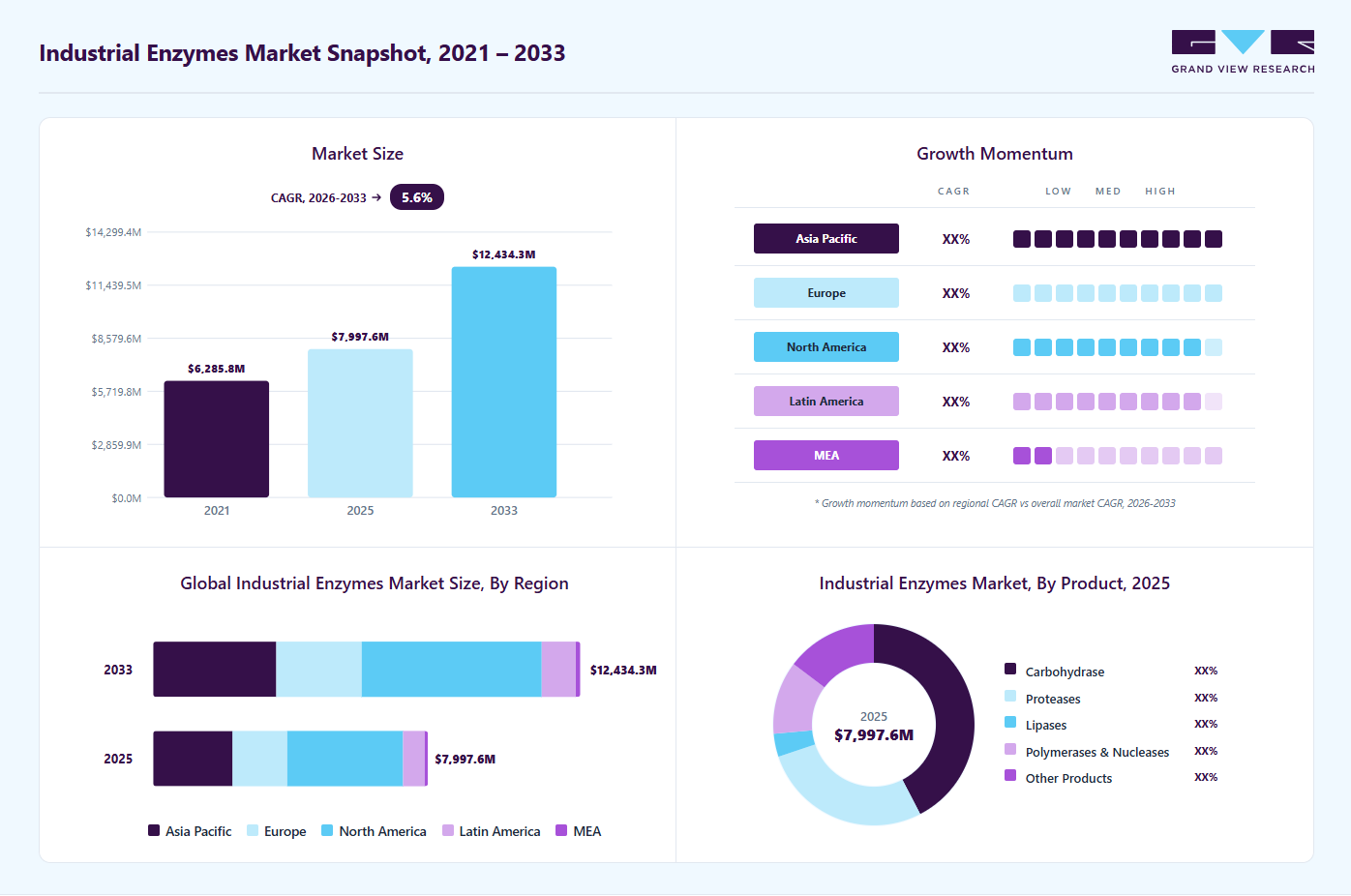
The industrial enzymes market was valued at USD 7.9 billion in 2025 and is projected to grow from USD 8.5 billion in 2026 to USD 12.4 billion by 2033, expanding at a CAGR of 5.6% from 2026 to 2033. North America accounted for the largest revenue share of 42.5% in 2025, while Asia Pacific is expected to record the fastest CAGR during the forecast period.
Sustainable Processing Creates New Enzyme Demand
The shift toward sustainable and bio-based industrial processing is a major factor supporting market expansion. Enzymes can help manufacturers reduce energy consumption, chemical use, and industrial waste while improving process efficiency. This is encouraging their use as alternatives to conventional chemical-intensive processes.
Demand is also being supported by expanding food production, renewable fuels, high-efficiency feed solutions, and cleaner manufacturing practices. Improvements in fermentation and production technologies are enabling manufacturers to produce enzymes at larger scales with more consistent quality, encouraging adoption across applications.
Carbohydrase Maintains a Leading Product Position
The carbohydrate product segment accounted for the largest revenue share of 42.4% in 2025. Carbohydrases have extensive applications across food and beverage, animal feed, and bioethanol production, where they support the breakdown of starches and complex carbohydrates.
Their broad applicability and stable performance under industrial conditions continue to support demand. Meanwhile, proteases are expected to grow at a CAGR of 6.1% from 2026 to 2033. Their expanding use in detergents, pharmaceuticals, and protein processing is supported by their ability to enable effective protein breakdown at lower temperatures.
Food and Beverages Remains a Core Application
Food and beverages dominated in terms of market share across all product categories. Enzymes such as carbohydrases, proteases, and lipases are used to support processing, preservation, texture, flavor, shelf life, and production efficiency.
Large-scale consumption, continuous production cycles, and stringent quality requirements contribute to consistent enzyme utilization in food and beverage manufacturing. Nutraceuticals are expected to grow fastest over the forecast period as greater attention to health, wellness, preventive nutrition, bioavailability, digestion, and nutrient absorption supports demand for specialized enzyme solutions.
Micro-Organisms Remain the Dominant Source
The micro-organisms source segment accounted for 75.3% of revenue in 2025, supported by its suitability for industrial-scale enzyme production. Bacteria and fungi offer rapid growth, high productivity, and consistent performance under controlled fermentation conditions.
These characteristics allow manufacturers to pursue cost-effective production and customized enzyme solutions. Microbial enzymes are widely used across food processing, detergents, biofuels, and pharmaceutical applications.
Plant sources, meanwhile, are expected to grow at a CAGR of 6.1% from 2026 to 2033. Naturally derived enzymes are gaining traction in food, nutraceutical, and personal care applications where clean labeling and mild processing are important.
Technology and Customization Shape Competitive Opportunities
The industrial enzymes market is characterized by continuous research, technical expertise, and strict quality requirements. Product differentiation is increasingly linked to enzyme efficiency, stability, and application-specific performance rather than price alone.
Manufacturers are investing in fermentation capacity and biotechnology platforms to improve enzyme stability, yield efficiency, and application performance. Customized enzyme blends can also address specific production requirements, allowing manufacturers to apply enzymatic solutions to complex industrial processes.
Production Costs Remain an Important Challenge
Despite growing adoption, high production, purification, and formulation costs can constrain market expansion. Industrial enzyme manufacturing requires advanced fermentation infrastructure, controlled biological processing conditions, and significant research and development investment.
Enzymes can also be sensitive to temperature, pH, and chemical exposure. Variations in processing conditions may affect enzyme efficiency, stability, and consistency, increasing implementation complexity in certain industrial environments.
Regional Demand Supports Continued Market Expansion
North America held the largest revenue share at 42.5% in 2025, supported by established biotechnology infrastructure, early adoption of enzyme technologies, major enzyme producers, and strong demand across food and beverage, detergents, and pharmaceuticals.
The U.S. accounted for 73.8% of North America's industrial enzymes revenue. Asia Pacific is expected to grow fastest, with a CAGR of 6.1% from 2026 to 2033, driven by expanding industrial activity, bio-based manufacturing investment, food processing, animal nutrition, biofuels, improving infrastructure, and rising technical expertise.
Overall, the industrial enzymes market is being shaped by sustainability, cleaner manufacturing, food production, bio-based processing, enzyme engineering, and customized industrial solutions. With the market projected to reach USD 12.4 billion by 2033, continued development of efficient and application-specific enzymes is expected to remain important to market expansion.
FAQ
How big is the industrial enzymes market?
The industrial enzymes market was valued at USD 7.9 billion in 2025, is estimated at USD 8.5 billion in 2026, and is projected to reach USD 12.4 billion by 2033, growing at a CAGR of 5.6% from 2026 to 2033.
Which segment leads the industrial enzymes market?
The carbohydrate product segment led with 42.4% of revenue in 2025, while micro-organisms represented 75.3% of revenue by source. Food and beverages dominated across product applications.
Key Industrial Enzymes Companies:
· Novozymes A/S
· BASF SE
· International Flavors & Fragrances Inc. (IFF)
· DSM-Firmenich
· Associated British Foods plc
· Amano Enzyme Inc.
· Advanced Enzyme Technologies Limited
· Lesaffre Group
· Adisseo
· Novus International
About us:
Grand View Research, a market research and consulting company, provides syndicated research reports, customized research reports, and consulting services. Grand View Research database is used by the world's renowned academic institutions and Fortune 500 companies to understand the global and regional business environment. Our database features thousands of statistics and in-depth analysis on 46 industries in 25 major countries worldwide.

 English
 Arabic
 French
 Spanish
 Portuguese
 Deutsch
 Turkish
 Dutch
Dutch
 Italiano
 Russian
 Romaian
 Greek
Greek