


Connected Car Market 2026-2034: Size, Share, Growth Trends, Demand & Industry Report
Market Overview
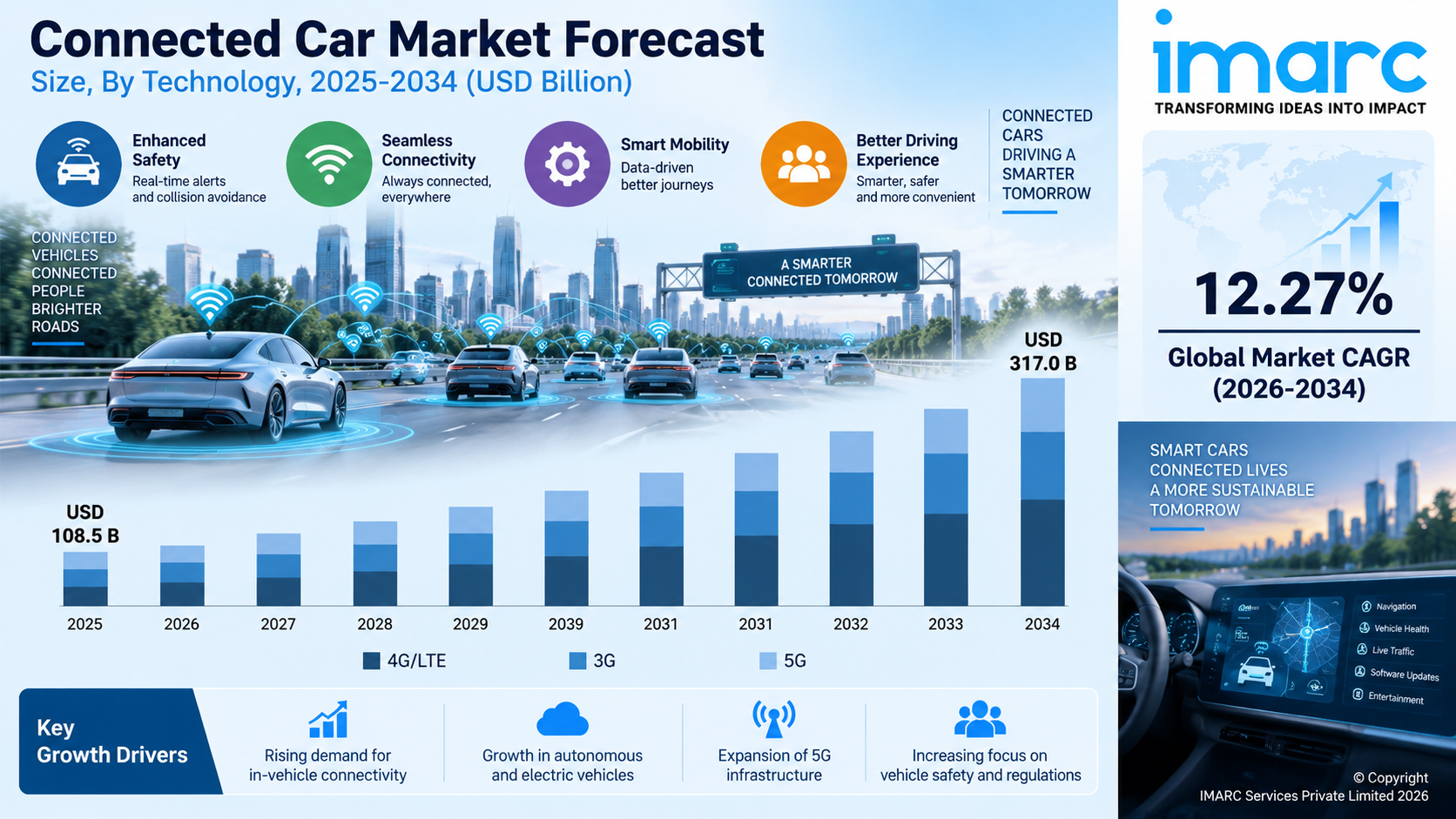
According to a research report by IMARC Group, the global connected car market size reached USD 108.5 Billion in 2025. Looking forward, IMARC Group expects the market to reach USD 317.0 Billion by 2034, exhibiting a growth rate (CAGR) of 12.27% during 2026-2034. North America currently dominates the regional landscape, accounting for a market share of 39.8% in 2025, supported by rapid advancements in 5G, V2X, and IoT technologies, rising demand for enhanced safety and personalized in-car experiences, and the increasing integration of telematics and connected services.
Market Key At a Glance
-
Base Year: 2025
-
Historical Period: 2020–2025
-
Forecast Period: 2026–2034
-
Market Size (2025): USD 108.5 Billion
-
Market Forecast (2034): USD 317.0 Billion
-
CAGR (2026–2034): 12.27%
-
Leading Region: North America
-
North America Market Share (2025): 39.8%
-
Dominant Technology: 4G/LTE
-
Leading Connectivity Solution: Integrated
-
Largest Service Segment: Driver Assistance
-
Largest End Market: Original Equipment Manufacturer (OEMs)
Request for a Sample Report for Detailed Evaluation: https://www.imarcgroup.com/connected-car-market/requestsample
Connected Car Market Report: Key Highlights
-
Market Size & Growth: The global connected car market was valued at USD 108.5 Billion in 2025 and is projected to reach USD 317.0 Billion by 2034, registering a CAGR of 12.27% during 2026–2034, according to IMARC Group.
-
Regional Leadership: North America represents the largest regional market, accounting for 39.8% of the market share in 2025, supported by advanced connectivity infrastructure, rising demand for safety and convenience features, and growing adoption of connected vehicle technologies.
-
By Technology: The market is segmented into 3G, 4G/LTE, and 5G, with 4G/LTE representing the largest segment.
-
By Connectivity Solution: The market covers integrated, embedded, and tethered solutions, with integrated connectivity solutions holding the leading position.
-
By Service: The market includes driver assistance, safety, entertainment, vehicle management, mobility management, and others, with driver assistance accounting for 36.8% of the market share.
-
By End Market: The market is divided into original equipment manufacturers (OEMs) and aftermarket, with OEMs accounting for 82.2% of the market share.
-
Key Market Drivers: Rapid advancements in 4G/5G, V2X, and IoT technologies, increasing emphasis on vehicle safety, changing user preferences, and evolving regulatory requirements.
-
Key Market Trends: Increasing integration of connected vehicles with IoT and cloud platforms, growing adoption of ADAS and V2X communication, expansion of telematics services, and rising demand for personalized in-car experiences.
-
Key Market Opportunities: Growing autonomous vehicle development, usage-based insurance models, cloud-based telematics, smart city infrastructure, and the increasing adoption of electric and connected vehicles.
What Is Driving Connected Car Market Growth in 2026?
Significant Advancements in Connectivity Technologies
The continuous evolution of connectivity technologies represents one of the key factors positively influencing the connected car market. The transition from traditional standalone vehicles toward interconnected smart cars is being enabled by high-speed internet, 4G and 5G networks, and advanced communication protocols. These technologies facilitate communication between vehicles and the wider transport infrastructure while enabling real-time data exchange.
Connected vehicles utilize these developments to provide features such as real-time traffic information, remote diagnostics, over-the-air software upgrades, and improved navigation systems. The increasing integration of vehicles with Internet of Things (IoT) platforms is further improving data collection and remote control capabilities. In addition, edge computing enables faster processing of information within vehicles, improving system response times. Strategic partnerships between automakers and telecommunications providers are also accelerating connectivity deployment and supporting market growth.
Rising Emphasis on Safety and Security
Safety and security considerations are strengthening the connected car market growth. The integration of advanced driver-assistance systems (ADAS) and vehicle-to-everything (V2X) communication is helping enhance road safety by enabling vehicles to gather and exchange information regarding surrounding conditions, traffic situations, and potential hazards.
Connected vehicles use sensors, cameras, and communication modules to collect and transmit information, which can be utilized by vehicles and shared with other connected vehicles and infrastructure. The growing adoption of driver assistance features such as lane-keeping assistance, automatic emergency braking, adaptive cruise control, and collision warnings is further supporting demand.
Telematics-based insurance policies are also encouraging connected car adoption by offering financial incentives to safe drivers. At the same time, increasing attention toward cybersecurity is driving the development of technologies designed to protect connected vehicles and the data exchanged between vehicles and external systems.
Evolving Regulatory Landscape
Governments and regulatory bodies worldwide are contributing to the growth of the connected car market through policies focused on vehicle safety, autonomous driving, and environmental standards. Regulations mandating safety features and connectivity capabilities in new vehicles are encouraging manufacturers to incorporate connected technologies.
The European Union's eCall regulation, which requires new cars to be equipped with an emergency call system, represents one example of regulatory support for connected vehicle technologies. Government incentives and funding for connected and electric vehicle innovation are also contributing to market development.
Cross-border regulatory alignment, particularly in Europe, is supporting the seamless integration of connected systems across different regions. Such regulatory frameworks encourage interoperability and compatibility among vehicles and infrastructure components, further supporting connected car adoption.
Changing User Preferences and Expectations
The rising demand for connected, personalized, and convenient driving experiences is favoring the connected car market. Modern connected cars offer features such as in-car infotainment systems, voice-controlled assistants, smartphone integration, and connectivity with smart home devices.
Users can increasingly control and monitor vehicle functions remotely, including climate settings and vehicle diagnostics. These capabilities are supporting demand among consumers seeking greater control and convenience. The broader concept of connected mobility is also gaining traction through services such as ridesharing, predictive maintenance, and automated parking.
Connected Car Market Segmentation Analysis
By Technology
-
3G
-
4G/LTE
-
5G
4G/LTE dominates the market by technology, owing to its combination of speed, dependability, and affordability for real-time communication. It supports rapid data transfer required for in-car functionalities such as navigation, entertainment, vehicle diagnostics, and over-the-air updates.
4G/LTE connectivity enables vehicles to access internet services, support streaming platforms, provide live traffic alerts, and facilitate remote vehicle tracking. Its broad coverage, particularly across urban and suburban regions, further supports its adoption. As an established and reliable connectivity technology, 4G/LTE continues to provide the connectivity infrastructure required for various connected car applications.
By Connectivity Solution
-
Integrated
-
Embedded
-
Tethered
Integrated connectivity solutions represent the largest segment. These solutions connect a vehicle's internal systems with external services such as cloud platforms and mobile applications, enabling functions including real-time navigation, remote diagnostics, and over-the-air software updates.
Integrated solutions can combine communication technologies such as 4G/LTE, Wi-Fi, and Bluetooth to keep vehicles connected to the internet and other devices. For automakers, utilizing an integrated platform can simplify implementation by providing a unified approach for managing functions ranging from in-vehicle entertainment to driver-support systems.
The growing demand for safety notifications, streaming, remote controls, and other connected functions is further supporting integrated connectivity solutions across different vehicle models and brands.
By Service
-
Driver Assistance
-
Safety
-
Entertainment
-
Vehicle Management
-
Mobility Management
-
Others
Driver assistance holds the largest share, accounting for 36.8% of the market. Driver assistance services are increasingly being integrated into vehicles to improve safety, convenience, and the overall driving experience.
Features such as lane-keeping assistance, automatic emergency braking, adaptive cruise control, and collision warnings are gaining attention among users and automakers. These technologies can provide additional support during long-distance journeys and in congested traffic conditions while contributing to road safety.
As safety becomes an increasing priority for consumers and regulators, automakers are incorporating more advanced driver assistance capabilities into their vehicles. These systems are also supporting the development of future autonomous driving technologies.
By End Market
-
Original Equipment Manufacturer (OEMs)
-
Aftermarket
Original equipment manufacturers (OEMs) account for 82.2% of the market share. OEMs are the primary suppliers of vehicles equipped with advanced connectivity technologies and oversee the integration of telematics, infotainment systems, driver assistance features, and other connected solutions into vehicles.
By incorporating connected technologies directly during vehicle production, OEMs can provide consumers with integrated and consistent experiences. They also possess the capabilities required to develop, evaluate, and implement connected car solutions across multiple models and geographic markets.
OEMs work with technology companies and other partners to integrate hardware and software supporting real-time data exchange, vehicle diagnostics, and connected services. As consumer demand for connected vehicles increases, the integration of these technologies directly by manufacturers continues to support the dominance of the OEM segment.
By Region
-
North America
-
United States
-
Canada
-
-
Asia Pacific
-
China
-
Japan
-
India
-
South Korea
-
Australia
-
Indonesia
-
Others
-
-
Europe
-
Germany
-
France
-
United Kingdom
-
Italy
-
Spain
-
Russia
-
Others
-
-
Latin America
-
Brazil
-
Mexico
-
Others
-
-
Middle East and Africa
North America holds the leading position in the global connected car market, accounting for 39.8% of the market share in 2025. The region's position is supported by advancements in 4G/5G connectivity, cloud computing, and IoT, which enable real-time data exchange, vehicle-to-vehicle communication, and enhanced driving experiences.
The growing demand for advanced safety features, autonomous driving capabilities, infotainment, navigation, and driver assistance systems is further supporting regional growth. Government regulations promoting vehicle safety, emissions control, and autonomous driving technology are also contributing to market development.
The expansion of 4G/5G networks and smart city infrastructure is improving connectivity and facilitating the integration of connected car solutions. Automakers in the region are increasingly incorporating connected technologies into their vehicles to meet consumer demand for enhanced safety, convenience, and personalization.
Key Regional Insight: North America's Strategic Position
North America's leading position in the global connected car market is anchored in advanced communication infrastructure, technological innovation, and growing consumer demand for connected driving experiences. The region benefits from widespread deployment of 4G/5G networks, cloud computing capabilities, and IoT technologies.
The United States represents a major market within the region, accounting for 82.00% of North America's market share. Modern drivers increasingly seek real-time navigation, entertainment, advanced telematics, remote vehicle monitoring, and other connected services.
The growing adoption of electric and autonomous vehicles is also contributing to demand, as these vehicles often incorporate advanced connectivity features. In addition, the expansion of smart city initiatives and connected infrastructure is creating further opportunities for connected car technologies.
United States Connected Car Market Analysis
The United States connected car market is supported by growing consumer demand for seamless integration between digital services and vehicles. Features such as real-time navigation, entertainment, advanced telematics, predictive maintenance, and driver assistance are increasingly incorporated into connected vehicles.
Technological developments in IoT and 5G are facilitating data exchange between vehicles and external devices and networks. The expansion of 5G infrastructure is particularly important for real-time data transmission and connected applications supporting autonomous driving.
In addition, safety regulations and the increasing adoption of electric and autonomous vehicles are supporting market development. Automakers are also introducing features designed to improve convenience and personalization. In January 2025, Keyvault secured USD 1 Million in funding to launch its K1 smartphone car key for motorists in the United States. The device is designed to transform compatible cars into vehicles that can be operated through a smartphone.
Asia Pacific Connected Car Market Analysis
The demand for advanced safety features and in-car connectivity is increasing across Asia Pacific, with consumers seeking real-time navigation, entertainment, and vehicle diagnostics. The rollout of 5G networks is enabling faster communication between vehicles and infrastructure and supporting technologies such as V2X communication.
Government initiatives focused on smart city infrastructure and intelligent transportation systems are also facilitating the integration of connected vehicles into urban environments. These investments are aimed at improving traffic management and supporting more efficient mobility systems.
The high adoption of electric and autonomous vehicles in several markets across the region is further creating demand for connected technologies. In India, electric vehicle sales increased by 20.88%, reaching 1.39 million units in May 2024, according to the India Brand Equity Foundation (IBEF). The continued evolution of the automotive sector is consequently supporting connected car adoption.
Europe Connected Car Market Analysis
The connected car market in Europe is being supported by consumer demand for advanced safety features, infotainment systems, and seamless connectivity. The deployment of 5G networks is enhancing vehicle communication capabilities and enabling real-time data exchange and V2X communication.
Government regulations aimed at reducing emissions and improving road safety are also supporting the adoption of connected technologies. The European Union's stringent CO2 emission targets are encouraging the adoption of hybrid and electric vehicles equipped with connected technologies for monitoring and optimizing vehicle performance.
The transition toward electric and autonomous vehicles is further contributing to regional market growth. New electric vehicle registrations in Europe approached 3.2 million in 2023, representing an increase of almost 20% compared to 2022, according to the International Energy Agency (IEA). Connected technologies support various functions in these vehicles, including battery management and over-the-air updates.
Latin America Connected Car Market Analysis
The Latin American connected car market is being driven by rising demand for enhanced safety, security, and infotainment features. Manufacturers are increasingly integrating advanced technologies into vehicles to meet changing consumer expectations.
High rates of vehicle theft in certain markets are also supporting demand for connected security applications, including real-time vehicle tracking and emergency assistance. Improvements in telecommunications infrastructure are further enabling features such as real-time navigation and vehicle diagnostics.
Government initiatives focused on intelligent transportation systems and smart city projects are also supporting market development by encouraging the integration of connected vehicle technologies to improve urban mobility and reduce traffic congestion.
Middle East and Africa Connected Car Market Analysis
The connected car market in the Middle East and Africa is supported by growing demand for advanced safety features and seamless connectivity. The deployment of 4G and 5G networks is improving vehicle communication capabilities and enabling real-time data exchange and V2X applications.
As of November 2023, the MENA region had approximately 30 million 5G connections. The continued development of telecommunications infrastructure is supporting connected vehicle applications and improving connectivity between vehicles and external systems.
Government initiatives focused on intelligent transportation systems and smart city projects are also creating opportunities for connected cars. Investments in these areas can facilitate the integration of connected vehicles into urban environments while supporting traffic management and emissions reduction.
Competitive Landscape in the Connected Car Industry
The competitive landscape of the global connected car market includes automakers, technology companies, telecommunications providers, and other industry participants. Automakers are integrating connected technologies such as infotainment systems, telematics, and driver assistance features into vehicles to improve safety, convenience, and user experience.
Technology companies provide hardware and software supporting real-time communication, data analytics, and autonomous driving capabilities, while telecommunications providers enable connectivity through 4G and 5G networks. Government agencies also influence the market through regulations and incentives related to safety and environmental standards.
Strategic collaborations between automotive, technology, and telecommunications companies are further supporting the development of connected vehicle solutions. In February 2024, Cisco partnered with TELUS to unveil new 5G capabilities in North America targeting IoT applications across multiple industries, including connected vehicles.
Key Connected Car Market Players Include:
-
AT&T Inc.
-
Audi AG
-
BMW AG
-
Continental AG
-
Ford Motor Company
-
Mercedes-Benz Group AG
-
Qualcomm Incorporated
-
Robert Bosch GmbH
-
Samsung Semiconductor, Inc.
-
Sierra Wireless
-
Tesla Inc.
-
TomTom International BV.
-
Valeo
-
Verizon Communications Inc.
-
Vodafone Limited
Recent Developments:
-
May 2025: Hyundai India launched a digital vehicle passport for its Bluelink-connected vehicles, providing information related to vehicle performance, service history, accident history, and real-time vehicle health monitoring. The solution is designed to support greater fleet transparency and proactive maintenance.
-
March 2025: Toyota partnered with NTT DATA's Transatel to equip its Latin American vehicles with multi-network (e)SIMs, enabling connected services such as telematics and Wi-Fi in Brazil and Argentina, with additional countries planned for rollout. The solution is designed to support 4G/5G in-vehicle connectivity, real-time data access, over-the-air updates, and commercial fleet management.
-
April 2024: Hyundai Motor and its subsidiary Kia collaborated with Baidu to develop innovations for connected vehicles and build the connected vehicle ecosystem in the Chinese market.
-
March 2024: Vero collaborated with Privacy4Cars to provide privacy solutions and identity safeguarding services for connected car owners. The Identi-FI system addresses data removal from connected vehicles and restoration following identity theft.
-
February 2024: HARMAN showcased connected vehicle technologies at Mobile World Congress 2024, including the HARMAN Ready Connect 5G Telematics Control Unit, designed to support automotive connectivity and provide additional benefits to vehicle manufacturers.
Market Drivers, Challenges & Opportunities
Major Market Drivers:
-
Advancements in Connectivity Technologies: The expansion of 4G, 5G, IoT, cloud computing, and V2X technologies is enabling real-time communication and data exchange between vehicles and external systems.
-
Rising Focus on Safety: Increasing adoption of ADAS, V2X communication, collision warnings, lane-keeping assistance, and automatic emergency braking is supporting demand for connected vehicles.
-
Evolving Regulatory Requirements: Government regulations promoting vehicle safety, autonomous driving, emissions control, and connected technologies are encouraging manufacturers to integrate connectivity solutions.
-
Changing Consumer Preferences: Growing demand for personalized infotainment, remote vehicle monitoring, navigation, and other connected services is supporting market expansion.
Key Challenges:
-
Cybersecurity and Data Protection: Increasing vehicle connectivity creates a greater need to protect vehicle systems and shared data against cyber threats.
-
Technology and Infrastructure Requirements: Connected vehicle functionality depends on reliable communication networks, infrastructure, hardware, software, and interoperability across different systems.
Emerging Opportunities:
-
Autonomous Vehicle Development: The increasing development of autonomous vehicles is creating opportunities for connected car technologies that support real-time data processing and vehicle-to-vehicle communication.
-
Usage-Based Insurance: Telematics-based insurance models are creating opportunities for connected vehicles by using driving data to support insurance services and incentives.
-
Cloud-Based Telematics: The increasing use of cloud platforms for vehicle data management, diagnostics, and connected services is expanding the application landscape.
-
Smart City Infrastructure: Investments in intelligent transportation systems and smart city infrastructure are supporting the integration of connected vehicles into broader mobility networks.
-
Electric Vehicle Adoption: The growing shift toward electric vehicles is creating additional opportunities for connected technologies supporting battery management, diagnostics, software updates, and other vehicle functions.
Connected Car Market FAQs
1. What is the current size of the connected car market?
The global connected car market reached USD 108.5 Billion in 2025 and is expected to grow at a CAGR of 12.27% during 2026-2034, reaching USD 317.0 Billion by 2034.
2. What is driving the growth of the connected car market?
The market is driven by rapid advancements in 4G/5G, V2X, IoT, and cloud technologies, rising demand for safety and personalized in-car experiences, evolving regulatory requirements, growing adoption of telematics, and the development of autonomous and electric vehicles.
3. Which region dominates the connected car market?
North America leads the global connected car market, accounting for 39.8% of the market share in 2025. The region benefits from advanced connectivity infrastructure, growing adoption of connected technologies, and increasing demand for safety, convenience, and autonomous driving capabilities.
4. Which segment holds the largest share in the connected car market?
4G/LTE represents the largest segment by technology. Integrated connectivity solutions lead by connectivity solution, driver assistance accounts for 36.8% of the market share by service, and OEMs account for 82.2% of the market share by end market.
5. What are the key trends in the connected car market?
Key trends include the continued development of 4G/5G connectivity, increasing integration of IoT and cloud technologies, growing adoption of V2X and ADAS, rising demand for personalized in-car experiences, expansion of telematics-based services, and increasing integration of connected technologies into electric and autonomous vehicles.
About the Author:
IMARC Group is a leading global market research company providing data-driven insights and expert consulting services to businesses seeking to achieve their strategic objectives. With a multi-disciplinary team of industry experts, IMARC delivers thorough, reliable market intelligence across sectors including Energy and Mining, Construction and Manufacturing, Automotive, Chemicals and Materials, and more.
Media & Sales Contact:
IMARC Group
United States: +1-201-971-6302
India: +91-120-433-0800
United Kingdom: +44-753-714-6104

 English
 Arabic
 French
 Spanish
 Portuguese
 Deutsch
 Turkish
 Dutch
Dutch
 Italiano
 Russian
 Romaian
 Portuguese (Brazil)