


New Infrastructure Spending Creates Momentum for Cryogenic Equipment Demand
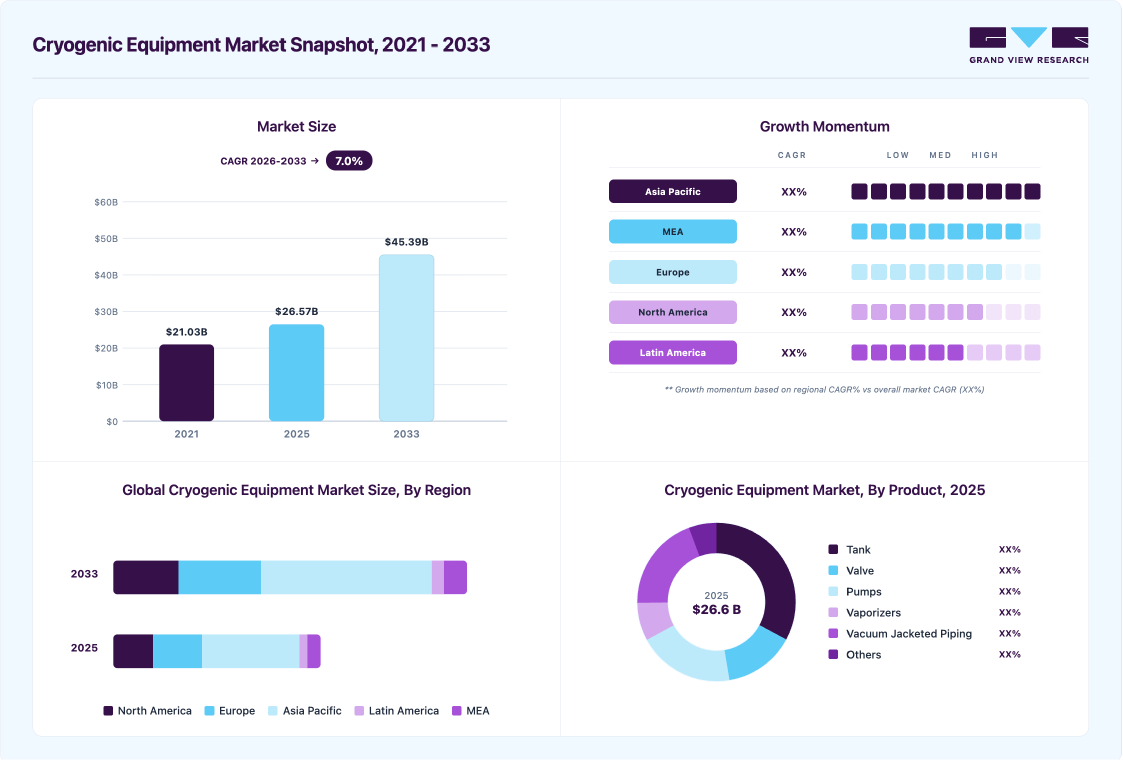
The cryogenic equipment market was estimated at USD 26.6 billion in 2025 and is projected to reach USD 45.4 billion by 2033, expanding at a CAGR of 7.0% from 2026 to 2033. The market is estimated at USD 28.3 billion in 2026, highlighting continued investment in equipment used for cryogenic storage, transportation, processing, and distribution.
LNG Infrastructure Strengthens Market Growth
One of the major factors supporting cryogenic equipment demand is the expansion of LNG infrastructure. LNG requires extremely low temperatures for storage and transportation, creating demand for specialized tanks, valves, pumps, vaporizers, and other cryogenic systems. Increasing investment in LNG import terminals, liquefaction plants, storage facilities, marine bunkering stations, and distribution networks is therefore supporting equipment deployment.
The expansion of LNG trade and regasification capacity is also creating continued demand for high-performance containment and transfer systems. At the same time, the growing use of industrial gases across medical, manufacturing, and other applications is increasing the need for reliable cryogenic infrastructure.
Tanks Remain a Major Product Segment
By product, tanks accounted for the largest market share at 32.8% in 2025. Cryogenic tanks are used to store LNG, liquid nitrogen, oxygen, hydrogen, and argon while maintaining extremely low temperatures. Double-walled and vacuum-insulated designs help minimize heat ingress and support product purity and stability.
The pumps segment is projected to grow at a CAGR of 7.7% from 2026 to 2033. Rising LNG utilization, industrial gas consumption, and hydrogen production and export projects are contributing to demand for cryogenic pumps. Growing liquefaction and regasification capacity, along with hydrogen mobility and fuel infrastructure, is also supporting pump deployment.
Hydrogen Opens New Growth Opportunities
Liquified natural gas represented the largest cryogen segment, accounting for 31.7% in 2025. However, hydrogen is becoming an important area of market development. The hydrogen segment is expected to grow at a CAGR of 7.8% from 2026 to 2033.
The expansion of electrolyzer projects, hydrogen hubs, and clean-fuel corridors is increasing requirements for liquefaction units, vacuum-insulated storage tanks, pumps, vaporizers, and specialized piping. These technologies are designed to minimize thermal losses and support safe handling at very low temperatures.
Storage Leads Application Demand
Storage accounted for the largest application share at 56.2% in 2025. Demand is supported by industrial gas consumption, LNG and hydrogen infrastructure development, and modernization across food, medical, and manufacturing facilities. Cryogenic storage systems are increasingly important where materials must be maintained at ultra-low temperatures for extended periods.
The distribution segment is expected to expand at a CAGR of 7.2% from 2026 to 2033, supported by industrial gas networks, LNG regasification facilities, fuel-distribution infrastructure, and the adoption of liquid hydrogen and other emerging cryogens.
Metallurgy and Automotive Applications Add Momentum
Metallurgy represented 26.9% of the market in 2025, making it a significant end-use segment. Steelmaking, non-ferrous refining, and alloy production require liquid oxygen, nitrogen, and argon for oxidation control, decarburization, inerting, temperature regulation, and furnace efficiency.
Automotive applications are projected to grow at a CAGR of 7.9% from 2026 to 2033. Electric vehicle manufacturing is contributing to cryogenic demand through battery-cell production, electrode processing, thermal-management testing, argon-based welding, and precision machining.
Asia Pacific Holds a Major Market Position
Asia Pacific accounted for 46.8% of the global market share in 2025, supported by increasing hydrogen development and low-carbon energy infrastructure. Large-scale electrolyzer deployments, hydrogen hubs, renewable-powered production clusters, and import and export corridors are creating requirements for advanced cryogenic equipment.
China's market is being supported by the rapid development of hydrogen production capacity and associated infrastructure. By the end of 2024, China had established roughly 125,000 tonnes per year of green hydrogen production capacity, representing about 50% of global green capacity at that time.
Technology, Costs, and Infrastructure Shape the Outlook
Technological development is focused on efficiency, safety, automation, advanced insulation materials, digital monitoring, and automated controls. At the same time, high initial and operational costs remain a restraint because cryogenic systems require specialized materials, precision engineering, skilled labor, and compliance with stringent safety requirements.
Overall, the cryogenic equipment market is positioned for continued expansion as LNG infrastructure, industrial gases, hydrogen projects, healthcare applications, food processing, metallurgy, and automotive manufacturing generate demand for specialized low-temperature equipment.
FAQ
How big is the cryogenic equipment market?
The market was estimated at USD 26.6 billion in 2025, is expected to reach USD 28.3 billion in 2026, and is projected to reach USD 45.4 billion by 2033, with a CAGR of 7.0% from 2026 to 2033.
Which segment leads the cryogenic equipment market?
The tank product segment held the largest share at 32.8% in 2025, while storage was the leading application with 56.2%, liquified natural gas accounted for 31.7% among cryogens, and metallurgy represented 26.9% among end-use segments.
Key Cryogenic Equipment Companies:
· Chart Industries Inc.
· Linde plc
· Nikkiso Co. Ltd.
· Standex International
About us:
Grand View Research, a market research and consulting company, provides syndicated research reports, customized research reports, and consulting services. Grand View Research database is used by the world's renowned academic institutions and Fortune 500 companies to understand the global and regional business environment. Our database features thousands of statistics and in-depth analysis on 46 industries in 25 major countries worldwide.

 English
 Arabic
 French
 Spanish
 Portuguese
 Deutsch
 Turkish
 Dutch
Dutch
 Russian
 Romaian
 Portuguese (Brazil)
 Greek
Greek