


Augmented Analytics Market Growth Analysis & Future Trends (2026–2034)
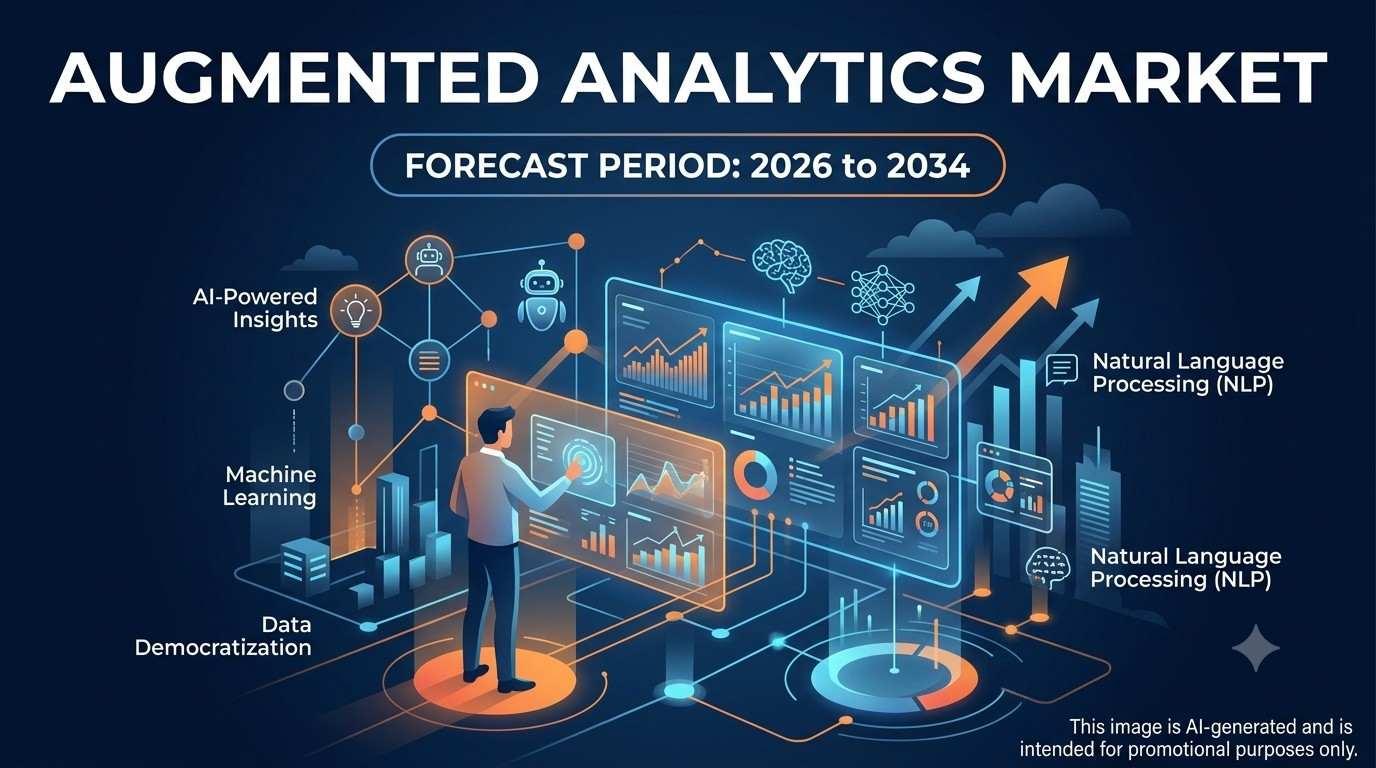
The market is expanding as enterprise leaders, data scientists, and business users adopt artificial intelligence (AI), machine learning (ML), and natural language processing (NLP) to automate data preparation, insight generation, and predictive modeling. Growth is supported by accelerating digital transformation, cloud data warehouse integration, the demand for real-time decision-making, and the drive to democratize data across non-technical business roles.
The augmented analytics market was valued at US$ 13.44 Billion in 2025 and is projected to reach US$ 70.87 Billion by 2034, growing at a CAGR of 20.29% during 2026–2034.
What is driving the market?
Rising operational data volumes, cloud infrastructure adoption, and the need for self-service analytics are the principal growth drivers. Organizations are increasingly required to automate repetitive data prep routines, eliminate analytics bottlenecks caused by reliance on scarce data engineering teams, and accelerate time-to-insight. Enterprise verticals such as Banking, Financial Services, and Insurance (BFSI), IT & Telecommunications, Retail, and Healthcare seek analytics engines that deliver automated data cleaning, anomaly detection, and natural language query capabilities without sacrificing data security or model governance.
The transition is moving beyond static dashboards toward conversational and conversational-AI-driven interfaces. Vendors are investing in generative AI integration, embedded large language model (LLM) agents, automated feature engineering, and edge-to-cloud analytics pipelines designed for multi-cloud enterprise ecosystems. Data security risks, regulatory compliance mandates, inconsistent data quality, and the cost of complex enterprise-wide deployments remain important constraints.
Which region leads?
North America leads the market, accounting for an estimated 41.5%–47.2% share in 2025. Growth is supported by robust digital infrastructure, early adoption of generative AI and cloud data architectures, high research and development spending, and the presence of major analytics software vendors. The United States presents significant opportunities as enterprise demand for real-time operational insights coincides with widespread multi-cloud modernization initiatives.
Europe holds an estimated 22%–26% share, supported by strict data governance standards, digital compliance directives, and high industrial automation investments. Asia Pacific accounts for a rapidly growing share and is identified as the fastest-expanding region with a projected CAGR of 28.1%–31.0%. Demand across China, India, and Southeast Asia is fueled by rapid e-commerce expansion, enterprise cloud migration, and large consumer datasets requiring scalable automated insights.
Which segment leads?
Software is the leading component segment, representing an estimated 77.4%–80.5% of market revenue in 2025. Its position is supported by widespread enterprise platform adoption, continuous feature releases (including embedded LLM interfaces), end-to-end data pipeline integration, and high software subscription retention. Services is identified as the fastest-growing component segment, with a projected CAGR of 28.4%–30.0%, driven by demand for custom AI model implementation, cloud integration, data governance consulting, and employee upskilling.
By deployment type, Cloud leads with an estimated 56.0%–59.1% share in 2025, reflecting high demand for elastic storage, computing power, scalable AI model training, and continuous software updates. Hybrid deployment is recognized as the fastest-growing mode as enterprises seek to balance cloud agility with on-premises data sovereignty. By vertical, IT & Telecommunications and BFSI together account for the largest revenue shares, while Healthcare is projected as a high-growth vertical expanding at over a 30.0% CAGR through 2033.
Which companies are prominent?
The report identifies Microsoft Corporation, Salesforce, Inc. (Tableau), SAP SE, International Business Machines Corporation (IBM), Oracle Corporation, QlikTech International AB, SAS Institute Inc., MicroStrategy Incorporated, TIBCO Software (Cloud Software Group), and ThoughtSpot Inc. as prominent market participants.
These companies compete across cloud BI platforms, enterprise data integration suites, natural language query interfaces, machine learning model automation, and vertical-specific analytics solutions. Strategic differentiation increasingly depends on natural language interaction quality, native generative AI capabilities, multi-cloud compatibility, data security indemnities, and the ability to convert complex data streams into actionable business recommendations at scale. The list reflects the report's competitive landscape rather than a revenue-ranked market-share table.
What is changing in 2026?
The market is shifting from experimental AI implementations toward production-grade, compliance-ready augmented analytics platforms. Enterprise procurement criteria increasingly mandate automated data lineage, explainable AI (XAI) capabilities, model governance frameworks, and strict adherence to data residency and privacy regulations such as the EU AI Act.
Software providers are accelerating embedded natural language assistants, autonomous anomaly detection agents, and real-time streaming analytics tools. Buyers are prioritizing solutions that deliver clear return on investment (ROI) by measureable productivity gains among non-technical business teams rather than raw feature density, driving strategic partnerships between analytics vendors, system integrators, and specialized AI studios.
What are the major investment opportunities?
The strongest opportunities lie in generative AI analytics integration, automated model governance tools, hybrid cloud orchestration, and domain-specific analytical workflows. Capital investments in natural language querying, vector search infrastructure, automated data preparation, and explainable AI layers can improve data trust and user adoption across non-technical business units.
Additional opportunities include edge-to-cloud analytical engines, self-service BI platforms for small and medium enterprises (SMEs), and specialized analytics suites tailored for healthcare, financial risk assessment, and supply chain monitoring. Asia Pacific offers high expansion potential driven by widespread enterprise digitalization and rapid cloud adoption. Investors should prioritize vendors that combine intuitive user interfaces, strong enterprise data security, native generative AI functionality, and proven integration with modern cloud data warehouses.
The Insight Partners provides comprehensive syndicated and tailored market research services in the healthcare, technology, and industrial domains. Renowned for delivering strategic intelligence and practical insights, the firm empowers businesses to remain competitive in ever-evolving global markets.
• Email: [email protected]
• Website: theinsightpartners.com
• Phone: +1-646-491-9876

 English
 Arabic
 French
 Spanish
 Portuguese
 Deutsch
 Turkish
 Dutch
Dutch
 Russian
 Romaian
 Portuguese (Brazil)
 Greek
Greek