


Animation Market Size & Growth Forecast: Key Industry Trends (2026–2034)
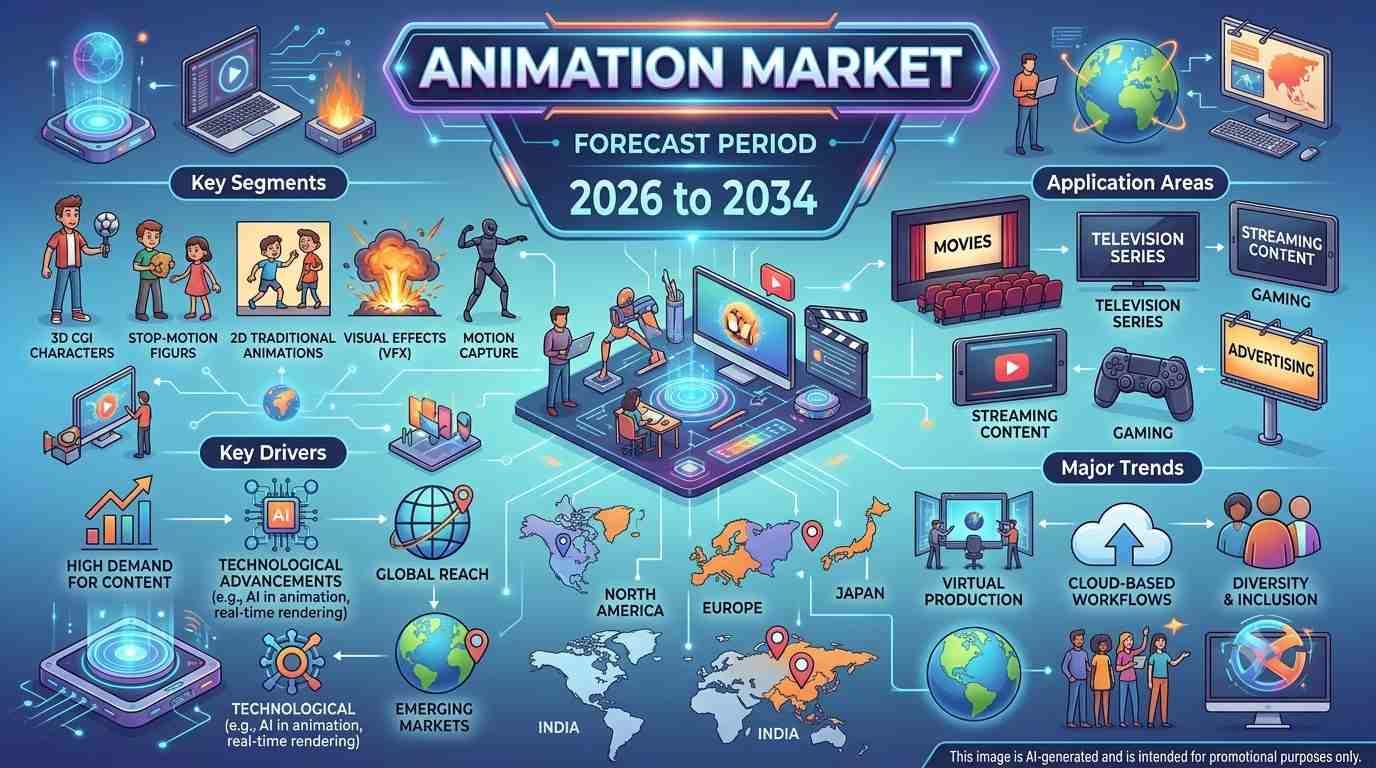
The Animation Market is expanding as streaming platforms, gaming studios, media houses, and enterprise clients move toward rich digital content, virtual production workflows, and immersive visual experiences. Growth is supported by cloud-based creative pipelines, expanding OTT content budgets, real-time rendering, and the integration of AI-assisted production tools.
The animation market was valued at US$ 488.63 Billion in 2025 and is projected to reach US$ 909.98 Billion by 2034, advancing at a CAGR of 7.15% during 2026–2034.
What is driving the market?
Streaming video consumption, mobile gaming expansion, and demand for digital marketing media are the principal growth drivers. Content creators and enterprise users are increasingly required to deliver high-quality, engaging visuals rapidly to retain viewer engagement across multi-platform ecosystems. Beyond media and entertainment, industries such as education, healthcare, architecture, and automotive are seeking animated simulations, product visualizations, and e-learning media to improve communication efficiency.
The transition is moving beyond traditional frame-by-frame production toward real-time, hybrid workflows. Content creators are investing in 3D computer graphics, motion capture systems, AI-driven automation, and cloud-based rendering pipelines. High production costs for top-tier content, intellectual property infringement, and the need for specialized technical talent remain important constraints.
Which region leads?
North America leads the market, accounting for an estimated 33%–37% share in 2025, with a projected CAGR of 6.5%–7.5% through 2034. Growth is supported by a dense concentration of major entertainment studios, gaming publishers, strong software ecosystems, and massive streaming platform investments. The United States represents 74%–78% of the North American footprint, driven by visual effects, original content streaming, and digital advertising.
Europe holds an estimated 24%–28% share, backed by established animation production cultures, public funding initiatives, and growing OTT platforms. Asia Pacific presents significant long-term expansion potential as rising smartphone adoption, expanding gaming markets, and outsourcing animation services in countries like India, China, and Japan drive strong structural demand.
Which segment leads?
3D Animation and CG tools represent the leading technology product segment, supported by high demand in feature films, AAA console gaming, VFX, and architectural modeling. Its position is bolstered by software advancements, procedural generation tools, and real-time game engine usage in traditional filmmaking.
By end-use industry, Media & Entertainment leads the market share, driven by rising demand for animated films, series, mobile games, and interactive digital advertising. E-learning and Enterprise Visualization is identified as a high-growth segment, as corporate training platforms, medical simulation developers, and ed-tech providers increasingly incorporate animated tutorials and interactive models.
Which companies are prominent?
The market features prominent participants such as The Walt Disney Company, Sony Pictures Entertainment, DreamWorks Animation (Universal), Pixar Animation Studios, Toei Animation, Ubisoft, Autodesk, Inc., Adobe Inc., Epic Games (Unreal Engine), and Unity Software.
These entities compete across content creation, visual effects, software tools, production services, game development engines, and distribution networks. Strategic differentiation increasingly depends on proprietary software tech, real-time rendering pipelines, original intellectual property creation, scalable cloud rendering, and AI-driven workflow efficiency.
What is changing in 2026?
The market is shifting from manual, labor-intensive creative pipelines toward AI-assisted, real-time production systems. Production pipelines increasingly integrate generative AI tools for storyboarding, asset generation, background rendering, and motion-capture cleanup to significantly compress production timelines and reduce operating costs.
Studios are accelerating the adoption of real-time engines (such as Unreal Engine and Unity) to bridge the gap between traditional film rendering and interactive media, allowing for virtual production and immediate scene iteration. Procurement decisions by studios are increasingly linked to remote workflow security, cloud collaboration platforms, and cross-platform asset versatility.
What are the major investment opportunities?
The strongest opportunities lie in real-time virtual production technologies, AI-assisted creative tools, cloud rendering infrastructure, and cross-platform gaming assets. Investment in automated rigging, motion capture processing, procedural asset generation, and specialized GPU clusters can dramatically improve creative throughput and lower production expenses.
Additional opportunities include animated educational content development, medical and architectural 3D simulations, immersive AR/VR experience assets, and regional content localization.
Emerging markets in Asia Pacific and Latin America offer attractive expansion potential through competitive studio labor costs, rising local content consumption, and expanding mobile media markets. Investors should prioritize entities that combine strong IP ownership, efficient AI/real-time tech pipelines, flexible remote collaboration systems, and scalable monetization models.
The Insight Partners provides comprehensive syndicated and tailored market research services in the healthcare, technology, and industrial domains. Renowned for delivering strategic intelligence and practical insights, the firm empowers businesses to remain competitive in ever-evolving global markets.
• Email: [email protected]
• Website: theinsightpartners.com
• Phone: +1-646-491-9876

 English
 Arabic
 French
 Portuguese
 Deutsch
 Turkish
 Dutch
Dutch
 Italiano
 Russian
 Romaian
 Portuguese (Brazil)
 Greek
Greek