


Have I Been Pwned Dark Web Monitoring | What It Covers and What It Misses for MSSPs
Have I Been Pwned dark web monitoring is one of the first tools security teams reach for when they want to know if an email address, domain, or password has shown up in a known data breach. It is free, widely trusted and has become something of a household name in the security community since Troy Hunt launched it in 2013. But for MSSPs and MDR providers building a client-facing monitoring service, the question is not whether Have I Been Pwned is useful it clearly is but whether it does the same job as a purpose-built dark web monitoring platform. It does not and understanding exactly where the line sits matters if you are advising clients or building your own service stack. This article breaks down what Have I Been Pwned actually monitors, how its detection model works and where a dedicated have I been pwned dark web monitoring solution picks up where a free breach checker leaves off.
What Have I Been Pwned For Dark Web Monitoring?
Have I Been Pwned is a free breach notification service that lets anyone check whether an email address or domain appears in a known, publicly indexed data breach. When people describe it as dark web monitoring, they usually mean its ability to alert you when your credentials turn up in a breach corpus that originated from a hack, leak, or dump some of which does circulate on dark web forums and marketplaces.
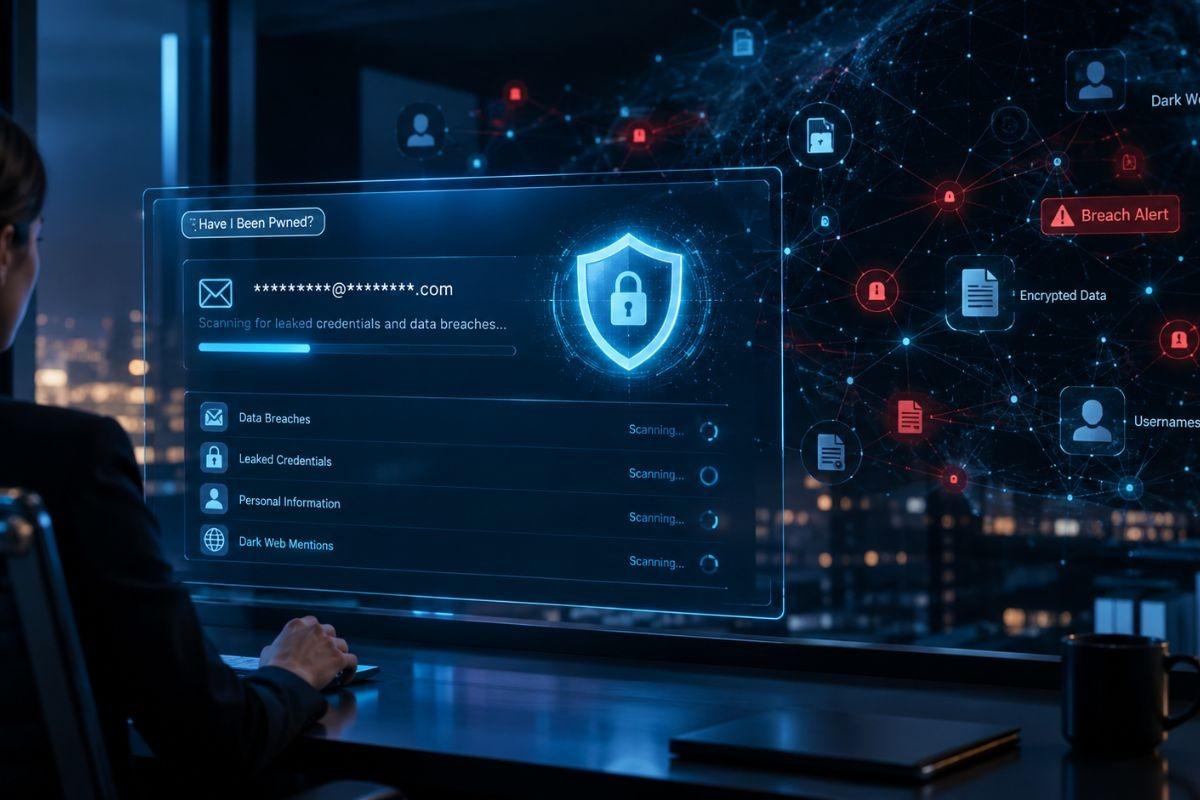
At its core, the service is a searchable database. You enter an email address and it tells you which breaches, if any, include that address. You can also register a domain to get notified any time a new breach containing an address on that domain is added. There is a companion feature, Pwned Passwords, that checks whether a specific password has appeared in a breach corpus, which is a different but related use case.
It is important to be precise about the terminology here, because "dark web monitoring" as a commercial category usually implies something broader: continuous surveillance of dark web marketplaces, breach forums, paste sites and infostealer log repositories, not just a lookup against a fixed set of indexed breaches.
How Have I Been Pwned Dark Web Monitoring Works
The mechanics are simpler than the branding suggests and understanding them is the fastest way to set correct expectations for a client.
Have I Been Pwned ingests data from breaches that have already occurred and been publicly disclosed or discovered, then loads that data into a searchable index. According to Troy Hunt's own public documentation on the project, breaches are verified before being added and the service does not display full passwords or sensitive data directly; searches return a match against a breach name and a summary of what was exposed.
The workflow generally looks like this:
-
A breach occurs at a third-party company or service.
-
The breach data surfaces publicly, whether through a security researcher, a breach forum, or media reporting.
-
The Have I Been Pwned team verifies the data is legitimate and adds it to the index.
-
Users who search an email address, or who have registered a domain for notifications, are alerted if their data appears.
This is fundamentally a reactive, batch-based model. It depends on a breach becoming publicly known and then being manually or semi-automatically added to the index. It is not scanning live dark web marketplaces in real time and it is not parsing fresh infostealer logs as they are traded on breach forums. Those logs, which capture credentials harvested directly from an infected device, are one of the fastest-growing sources of exposed corporate credentials today and they typically do not show up in a breach index the same way a leaked customer database does.
Why Businesses and MSSPs Need to Understand This Distinction
For an individual checking their personal email, Have I Been Pwned dark web monitoring is a genuinely useful first step. For an MSSP building a managed offering around credential exposure, the gap between "indexed breach lookup" and "continuous dark web monitoring" has real operational consequences.
Clients paying for a monitoring service generally expect three things: early warning, coverage across their whole employee base and client base and a report they can act on or hand to an auditor. A breach index alone struggles to deliver on the first two.
Early warning suffers because Have I Been Pwned can only alert on a breach after it has been publicly verified and indexed, which can lag the actual compromise by weeks or months. Coverage suffers because the service was built around individual and domain-level lookups rather than the kind of multi-tenant, client-segmented monitoring an MSSP needs to run dozens or hundreds of client environments at once.
This is where dark web data breach monitoring built specifically for MSSP delivery with dashboards, tenant separation and alerting workflows layered on top of the underlying exposure data starts to look meaningfully different from a lookup tool and it is the gap that platforms like this are built to close.
Key Features to Look For in Dark Web Monitoring for MSSPs
If you are evaluating Have I Been Pwned against a commercial platform, or deciding whether to build a service around either, these are the capabilities that separate a basic breach checker from an operational monitoring program.
Continuous, multi-source coverage matters more than any single feature. A monitoring program should pull from breach dumps, active breach forums, dark web marketplaces, paste sites and infostealer log repositories, not just one category.
Real-time or near-real-time alerting is the second requirement. The value of dark web monitoring drops sharply the longer credentials are exposed before anyone notices, so alerting speed should be treated as a core metric, not an afterthought.
Multi-tenant architecture with role-based access control, often shortened to RBAC, lets an MSSP manage many client environments from one console without data bleeding across tenants. This is non-negotiable for any provider managing more than a handful of clients.
White-label reporting allows an MSSP to present findings under its own brand rather than forwarding a third-party tool's output, which matters for client trust and for contract renewals.
API access and integration with existing tools, such as a PSA, SIEM, or ticketing platform, determines whether alerts actually get acted on or just pile up in an inbox nobody checks.
Contextual risk scoring helps triage. Not every exposed credential carries the same risk and a mature platform should help an analyst prioritize a compromised admin password over a years-old, already-rotated one.
Have I Been Pwned and Dedicated MSSP Dark Web Monitoring
The table below lays out how a free breach checker compares to a dedicated, MSSP-oriented dark web monitoring platform across the dimensions that matter most for a managed service.
|
Capability |
Have I Been Pwned |
Dedicated MSSP monitoring |
|
Data source scope |
Publicly verified breach dumps |
Breach dumps, forums, marketplaces, infostealer logs |
|
Alert timing |
After public verification, often delayed |
Near-real-time |
|
Multi-tenant / RBAC |
Not supported |
Built for many client environments |
|
White-label reporting |
Not available |
Typically available |
Neither tool is universally "better." Have I Been Pwned is an excellent, well-maintained resource for a quick check or for individual awareness. A dedicated platform earns its cost when the requirement shifts to managing exposure across many clients on an ongoing basis.
Common Mistakes Businesses Make With Dark Web Monitoring
A few patterns show up repeatedly when businesses and even some MSSPs set up monitoring without fully understanding the tooling behind it.
The most common mistake is treating a one-time breach check as equivalent to ongoing monitoring. Checking an email address against Have I Been Pwned today tells you nothing about a breach that surfaces next month unless domain notifications are specifically configured and maintained.
A second mistake is monitoring only email addresses and ignoring passwords, usernames and other identifiers that also circulate on breach forums and in infostealer logs. Credential stuffing attacks often succeed precisely because a password reused across services was exposed somewhere the business never checked.
A third mistake is assuming breach index coverage equals dark web marketplace coverage. As covered above, these are different data sources with different latency and different blind spots and conflating them creates a false sense of security.
A fourth mistake, specific to MSSPs, is rolling out monitoring as a checkbox feature without a defined response workflow. An alert that nobody triages, escalates, or reports to the client provides very little value regardless of how good the underlying detection is.
An Evaluation Checklist for MSSPs and IT Teams
Before selecting or standardizing on a dark web monitoring approach, it helps to work through a short checklist.
Confirm what data sources are actually covered, not just advertised, including whether infostealer logs and active breach forums are part of the collection process.
Ask how alert latency is measured and what the typical time is between a credential appearing in a breach source and a notification reaching the client.
Verify whether the platform supports the tenant separation and RBAC needed to manage multiple clients without operational risk.
Check whether reporting can be white-labeled and whether it satisfies any compliance or cyber insurance documentation your clients are likely to need.
Review integration options with your existing SIEM, PSA, or ticketing stack so alerts convert into tracked, actionable work rather than sitting unread.
Clarify pricing structure, including whether it scales predictably as client count and monitored identity count grow.
Interesting Facts and Key Stats
A few verified, publicly documented facts help frame the scale and context of breach-driven credential exposure.
Have I Been Pwned was created by security researcher Troy Hunt in December 2013 and has operated as an independent, largely free public service since then, according to Hunt's own published documentation on the project.
The Pwned Passwords feature was designed to let services check a password against known breach corpora without ever transmitting the full password itself, using a k-anonymity model, as documented on the Have I Been Pwned website.
Credential stuffing, where attackers reuse breached username and password pairs across multiple services, is consistently identified as a leading attack vector in industry breach reports published by organizations such as Verizon in its annual Data Breach Investigations Report.
Infostealer malware, which harvests saved credentials directly from an infected device, has been flagged by multiple cybersecurity research firms as a growing and increasingly significant source of the credentials later traded on dark web forums and marketplaces.
Many breaches are not discovered or disclosed until well after the initial compromise, a pattern repeatedly documented across annual breach investigation reports from multiple research firms, which underscores why alert timing is such a meaningful differentiator between tools.
Regulatory and cyber insurance requirements increasingly expect businesses to demonstrate some form of ongoing credential and breach monitoring, a trend reflected in growing MSSP and MDR industry guidance on baseline security service offerings.
Conclusion
Have I Been Pwned dark web monitoring is a genuinely useful, well-built resource and it deserves its reputation as a go-to tool for a fast breach check. What it is not is a substitute for the kind of continuous, multi-source, client-segmented monitoring that MSSPs and MDR providers need to run a credible managed service. The gap sits mainly in data source scope, alert latency and multi-tenant delivery and that gap is exactly where a purpose-built platform earns its place in a security stack. Teams that want to see how that kind of monitoring is structured for MSSP delivery, including multi-tenant management and white-label reporting, can look at what mispar.io offers as a next step beyond a free lookup tool.
Frequently Asked Questions (FAQ’s)
Have I Been Pwned for Real Dark Web Monitoring?
Not in the full commercial sense of the term. Have I Been Pwned checks email addresses and domains against a database of publicly verified breach dumps. It does not continuously scan live dark web marketplaces, breach forums, or infostealer log repositories the way a dedicated dark web monitoring platform does.
How does Have I Been Pwned dark web monitoring work for domains?
A business can register a domain with Have I Been Pwned and receive notifications when a new breach containing an email address on that domain is added to the index. This requires domain ownership verification and only covers breaches that have already been publicly disclosed and indexed by the service.
Can Have I Been Pwned detect infostealer log exposure?
Generally not directly. Infostealer logs, which contain credentials harvested from infected devices, circulate on specialized breach forums and marketplaces that are a different data source from the public breach dumps Have I Been Pwned primarily indexes. Coverage of infostealer data varies and is not the service's core focus.
What is the difference between Have I Been Pwned and a paid dark web monitoring service?
The main differences are data source scope, alert speed and delivery model. Have I Been Pwned covers verified breach dumps with alerts that follow public disclosure, while paid platforms typically add broader dark web and infostealer coverage, faster alerting, multi-tenant management and white-label reporting built for MSSP or enterprise delivery.
Should MSSPs rely on Have I Been Pwned alone for client monitoring?
It depends on the scope of the service being sold. As a supplementary or awareness-level check, it works well. As the sole basis for a managed dark web monitoring offering across many clients, it typically falls short on coverage breadth, alert timing and the tenant management features MSSPs need to operate at scale.
How often should businesses check for dark web data breach monitoring alerts?
Ongoing monitoring is preferable to periodic manual checks, since breach and infostealer data can appear at any time. Businesses without a continuous monitoring setup should at minimum register affected domains for notifications and repeat manual checks on a regular schedule, though this remains less reliable than automated, continuous monitoring.

 Arabic
 French
 Spanish
 Portuguese
 Deutsch
 Turkish
 Dutch
Dutch
 Italiano
 Russian
 Romaian
 Portuguese (Brazil)
 Greek
Greek