


EPR Registration Online in India: Process, Fees, Documents & Approval Timeline
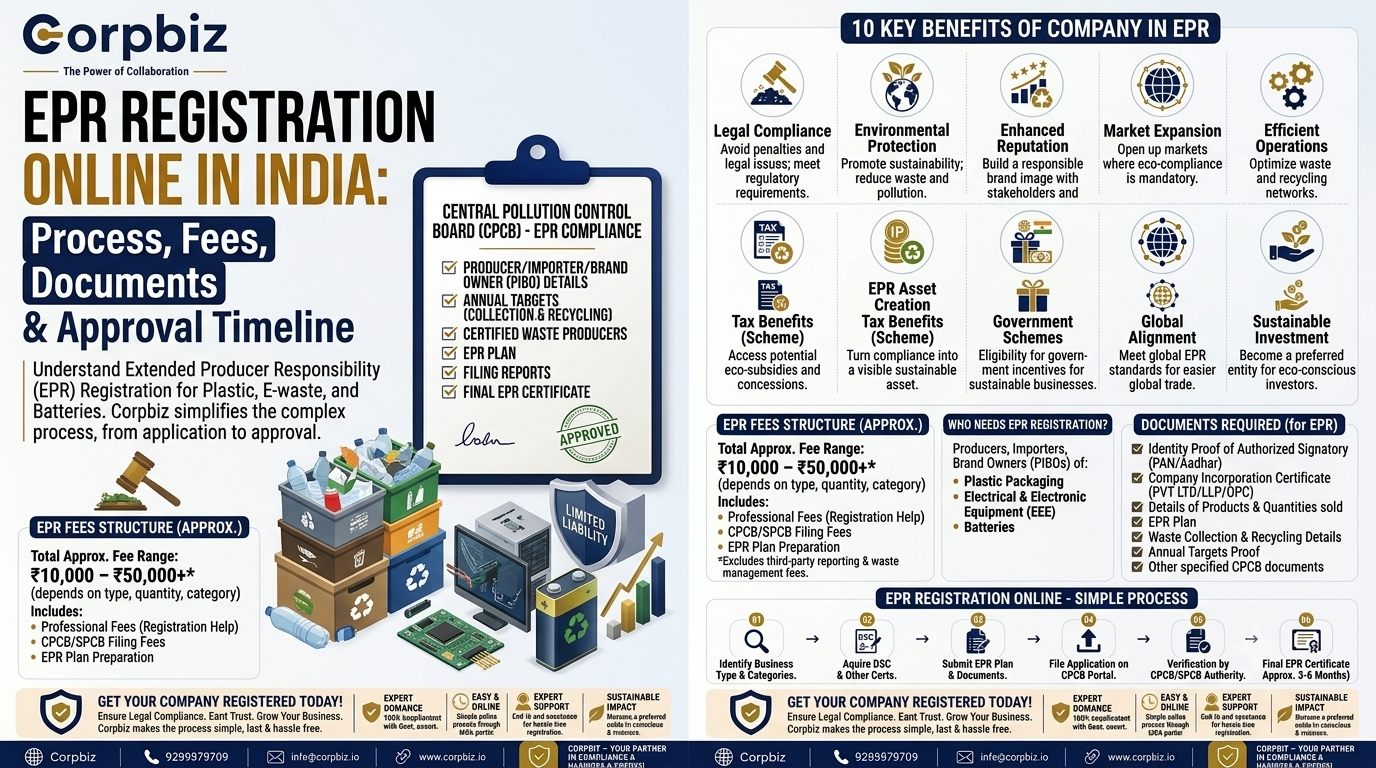
Businesses today have a big responsibility toward the environment. If a company produces, imports, manufactures, or sells products that create certain types of waste, it may need to follow Extended Producer Responsibility (EPR) rules.
EPR means that a business is responsible for managing the waste created by its products. In India, businesses covered by EPR rules may need to obtain an EPR Registration Certificate from the concerned authority.
What Is EPR Registration?
EPR stands for Extended Producer Responsibility. It is a system where producers, manufacturers, importers, and other eligible businesses are made responsible for the waste generated from their products.
For example, a business that uses plastic packaging may have certain responsibilities for collecting, recycling, or managing that plastic waste.
After successful registration, an eligible business receives an EPR Registration Certificate, which serves as proof that it has registered under the applicable EPR framework.
The exact requirements depend on the type of waste and the business activity.
Who May Need EPR Registration?
EPR requirements can apply to businesses involved in areas such as:
-
Plastic packaging
-
Batteries
-
E-waste
-
Waste tyres
-
Used oil and other regulated waste categories
Businesses should first identify which EPR rules apply to them before starting the online application.
For example, a company dealing with plastic packaging may need plastic waste authorization or registration under the applicable plastic waste EPR system.
EPR Registration Online in India: Step-by-Step Process
The online registration process generally involves the following steps:
1. Identify Your EPR Category
First, determine whether your business falls under an EPR category and identify the applicable waste-management rules.
2. Prepare the Required Information
Collect your business details, product information, waste-related information, and other documents required for the application.
3. Create an Account on the Relevant Portal
The applicant needs to register on the appropriate government EPR portal and provide basic business information.
4. Fill Out the Application Form
Enter details such as the company's name, address, contact information, business activity, product details, and estimated waste generation.
5. Upload Documents
The required supporting documents should be uploaded in the prescribed format. Make sure the information is correct and matches your business records.
6. Pay the Applicable Fee
If a government fee is applicable, it needs to be paid during the application process. The amount can vary depending on the type and category of registration.
7. Application Review
The concerned authority reviews the application and supporting documents. If clarification or additional information is required, the applicant may need to respond.
8. Receive the EPR Registration Certificate
Once the application is approved, the applicant can receive the EPR Registration Certificate through the applicable online system.
Documents Required for EPR Registration
The documents can vary depending on the EPR category and business type. Commonly requested information and documents may include:
-
PAN and other business identification details
-
GST registration details, where applicable
-
Certificate of incorporation or business registration documents
-
Address proof of the business
-
Details of directors or authorized representatives
-
Product and packaging details
-
Details of the quantity of products or waste handled
-
Details of recyclers or waste-processing partners, where applicable
-
Previous environmental registrations or approvals, if relevant
If your business already requires an NOC Pollution Control Board or another environmental approval, the applicable documents should also be kept ready.
What Is the EPR Registration Fee?
There is no single fee that applies to every business.
The cost may depend on factors such as:
-
Type of EPR registration
-
Category of waste
-
Business activity
-
Quantity of products or waste
-
Government or portal charges
-
Professional service charges, if you hire a consultant
Therefore, businesses should check the applicable fee structure before submitting the application.
How Long Does EPR Registration Take?
The approval timeline can vary from one application to another.
A straightforward application with correct information and complete documents may be processed faster. Applications with missing information, incorrect documents, or regulatory queries can take longer.
So, instead of assuming a fixed number of days, businesses should consider the application review time and any clarification period.
EPR Registration vs Plastic Waste Authorization
These terms are sometimes used together, but they are not always exactly the same.
EPR registration relates to a business's responsibilities under the applicable EPR framework. Plastic waste authorization is associated with compliance requirements for businesses covered by plastic waste-management rules.
The exact registration or authorization required depends on the business activity and applicable regulations.
Is EPR Registration Important for Businesses?
Yes. For businesses covered by EPR rules, registration is an important part of environmental compliance.
Proper compliance can help a business:
-
Meet applicable legal requirements
-
Maintain proper waste-management records
-
Work with authorized recyclers or processors
-
Avoid unnecessary compliance problems
-
Show its commitment to responsible waste management
EPR compliance is not only about obtaining a certificate. Businesses may also have ongoing reporting and waste-management responsibilities.
What About NGO Registration?
NGO registration is a separate legal process and should not be confused with EPR registration.
An NGO may work in areas such as environmental awareness, recycling, or waste management, but simply having NGO registration does not automatically provide EPR registration. The applicable requirements depend on the organization's activities and the relevant EPR rules.
Why Choose Corpbiz for EPR Compliance?
Understanding environmental regulations can be difficult, especially for a small business owner who is handling many other business tasks.
Corpbiz helps businesses understand applicable registration and compliance requirements and provides professional assistance with documentation and the application process.
Before applying, it is always better to understand which EPR category applies to your business and what documents are actually required.
Author Profile
Gaurav Sharma is a Legal Consultant and business compliance professional with over 10 years of experience helping startups, entrepreneurs, and companies with legal registrations and regulatory compliance in India. He specializes in business registrations, environmental compliance, licensing, and other regulatory services. Through his work with Corpbiz, Gaurav focuses on making complex legal procedures easier to understand so that business owners can make informed decisions and stay compliant.
Conclusion
EPR registration is an important compliance requirement for businesses covered by India's EPR regulations. The process generally involves identifying the correct category, preparing documents, submitting an online application, paying applicable fees, and responding to any queries from the concerned authority.
If your business deals with plastic, batteries, e-waste, tyres, or another regulated waste category, understanding your EPR responsibilities early can help you avoid compliance problems later.

 English
 Arabic
 French
 Spanish
 Portuguese
 Deutsch
 Turkish
 Dutch
Dutch
 Italiano
 Russian
 Romaian
 Greek
Greek