
How Water-Based Formulations Are Reshaping Coating Additive Demand
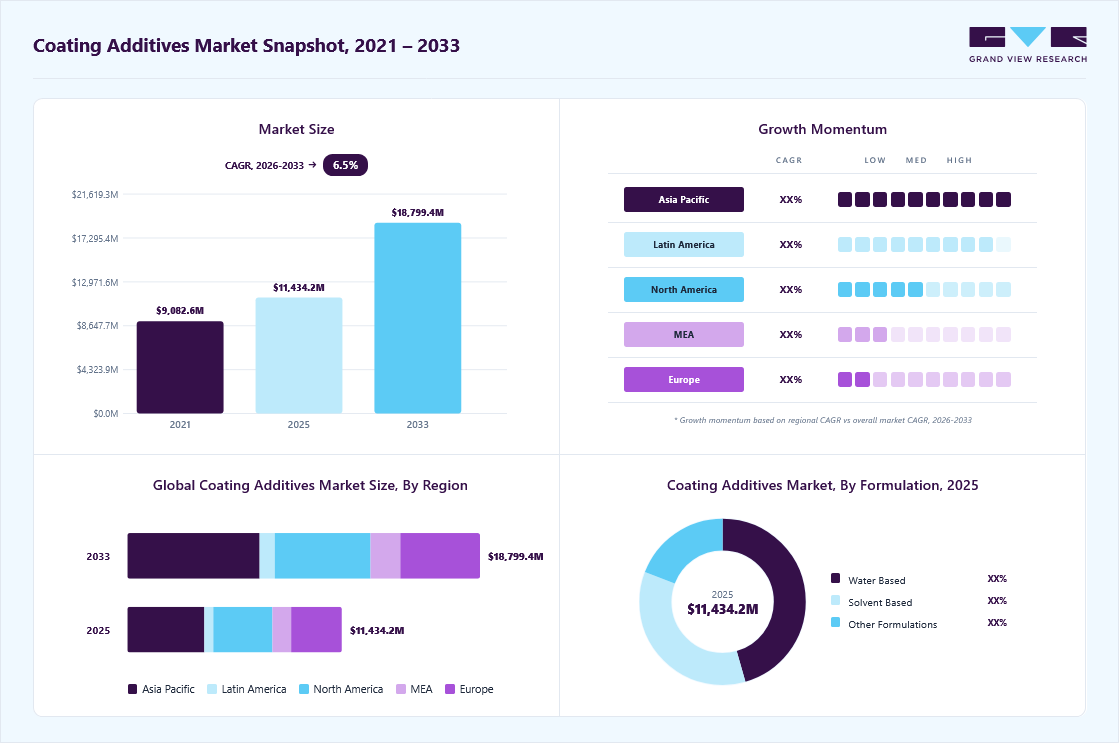
The coating additives market is entering a period of steady expansion as manufacturers increasingly focus on high-performance, environmentally responsible coating formulations. According to Grand View Research, the market was valued at USD 11.4 billion in 2025 and is projected to reach USD 12.1 billion in 2026 and USD 18.8 billion by 2033, expanding at a CAGR of 6.5% from 2026 to 2033. Growing demand for sustainable coatings, lower-VOC formulations, improved durability, and environmentally friendly additive technologies is supporting this development.
Sustainability Becomes a Major Market Growth Catalyst
The transition toward sustainable coating systems is becoming an important factor influencing demand for advanced additives. Manufacturers and end users are increasingly seeking solutions that reduce hazardous chemicals, carbon emissions, and dependence on fossil-based raw materials. National environmental regulations, corporate sustainability initiatives, and demand for safer, biodegradable, and renewable additives are reinforcing this shift.
At the same time, coating additives are being used to improve dispersion, flow, leveling, surface protection, durability, gloss retention, and application efficiency. Their role across architectural, automotive, industrial, wood, packaging, and marine coatings makes them an important component of high-performance formulations.
Thickeners Maintain a Strong Position Among Additives
Thickeners represented the largest additive segment, accounting for 37.6% of the market share in 2025. Their importance comes from their ability to control viscosity, flow behavior, film thickness, and application performance. They are used across waterborne, solvent-borne, and high-solid coating systems to improve stability and prevent sagging.
Other functional additives also contribute to formulation performance. Defoamers help eliminate surface foam and entrapped air, while dispersants support pigment stability and color consistency. Opacifiers improve hiding power and brightness, and wetting agents, slip modifiers, adhesion promoters, and anti-settling agents help optimize coating behavior and durability.
Water-Based Formulations Lead the Market
Water-based formulations held the largest formulation share at 45.5% in 2025. Their position is closely associated with the increasing preference for low-VOC and environmentally compliant coating systems. Advanced additives such as dispersants, thickeners, wetting agents, and defoamers are essential for achieving stability, flow, and film performance in aqueous environments.
Water-based coatings are used across architectural, automotive refinishing, industrial, and wood applications. Meanwhile, solvent-based formulations continue to serve applications requiring chemical resistance, fast curing, and high-performance finishes, particularly in heavy-duty industrial, marine, and protective coatings.
Architectural Applications Generate Significant Demand
Architectural coating additives represented the largest application segment, with a 53.5% revenue share in 2025. Demand is supported by residential, commercial, and infrastructure construction, where additives help improve application performance, durability, aesthetics, viscosity control, dispersion, flow, leveling, and resistance to weathering and abrasion.
General industrial finishes represent the second-largest application segment. These coatings require additives that improve corrosion resistance, abrasion durability, chemical stability, surface uniformity, film formation, and process efficiency. Increasing use of automated and high-speed coating processes is also creating demand for additives capable of supporting stable and defect-free finishes.
Industrial and Automotive Requirements Broaden Opportunities
Automotive and industrial manufacturing applications increasingly use specialty additives to improve scratch resistance, corrosion protection, UV stability, chemical resistance, and overall surface performance. Additives can also support more efficient coating processes while reducing material consumption and rework.
Marine and energy applications are another area of opportunity because coatings operating under demanding conditions require resistance to moisture, chemicals, abrasion, and other environmental stresses. Multifunctional additives can help simplify formulations and reduce additive loadings while supporting longer coating service life.
Raw Material Volatility Remains a Market Challenge
Despite favorable demand trends, raw material volatility remains an important restraint. The coating additives industry depends substantially on petrochemical-derived raw materials and specialty chemical intermediates. Changes in crude oil prices, feedstock availability, and energy costs can affect production economics and profit margins.
Regulatory scrutiny of specialty chemical components is another challenge. Environmental authorities are placing greater emphasis on factors such as ecotoxicity, persistence, and potential health impacts associated with certain additive chemistries. As a result, manufacturers must continue investing in regulatory compliance, risk assessment, research, and reformulation.
Asia Pacific Holds the Largest Market Share
Asia Pacific accounted for the largest revenue share of 35.9% in 2025 and is also identified as the fastest-growing regional market. Rapid industrialization, urbanization, construction activity, automotive manufacturing, and industrial production are supporting demand for coating additives.
China held the largest country market share in 2025, while expanding manufacturing ecosystems, infrastructure investment, environmental initiatives, and R&D activity are supporting continued adoption of advanced coating technologies.
Coating Additives Market Outlook
The coating additives market is positioned for continued growth as manufacturers balance performance requirements with sustainability and regulatory expectations. The combination of advanced additive chemistries, water-based formulations, sustainable materials, and demand for longer-lasting coatings is creating new opportunities across major applications.
FAQs
What trends are shaping the coating additives market?
Key trends include increasing adoption of water-based and low-VOC formulations, demand for sustainable and bio-based additives, multifunctional additive development, improved coating performance, and growing emphasis on environmental compliance.
What challenges are affecting the coating additives market?
Raw material price volatility, dependence on petrochemical-derived inputs, supply-related risks, and increasing environmental and regulatory scrutiny of specialty chemical formulations are among the key challenges affecting the market.
Key Coating Additives Companies:
· BASF SE
· Altana AG
· DOW Inc.
· Nouryon
About us:
Grand View Research, a market research and consulting company, provides syndicated research reports, customized research reports, and consulting services. Grand View Research database is used by the world's renowned academic institutions and Fortune 500 companies to understand the global and regional business environment. Our database features thousands of statistics and in-depth analysis on 46 industries in 25 major countries worldwide.

 English
 Arabic
 French
 Spanish
 Portuguese
 Turkish
 Dutch
Dutch
 Italiano
 Russian
 Romaian
 Portuguese (Brazil)
 Greek
Greek