


Nuclear Imaging Market Growth Reflects Rising Demand for Functional Insights
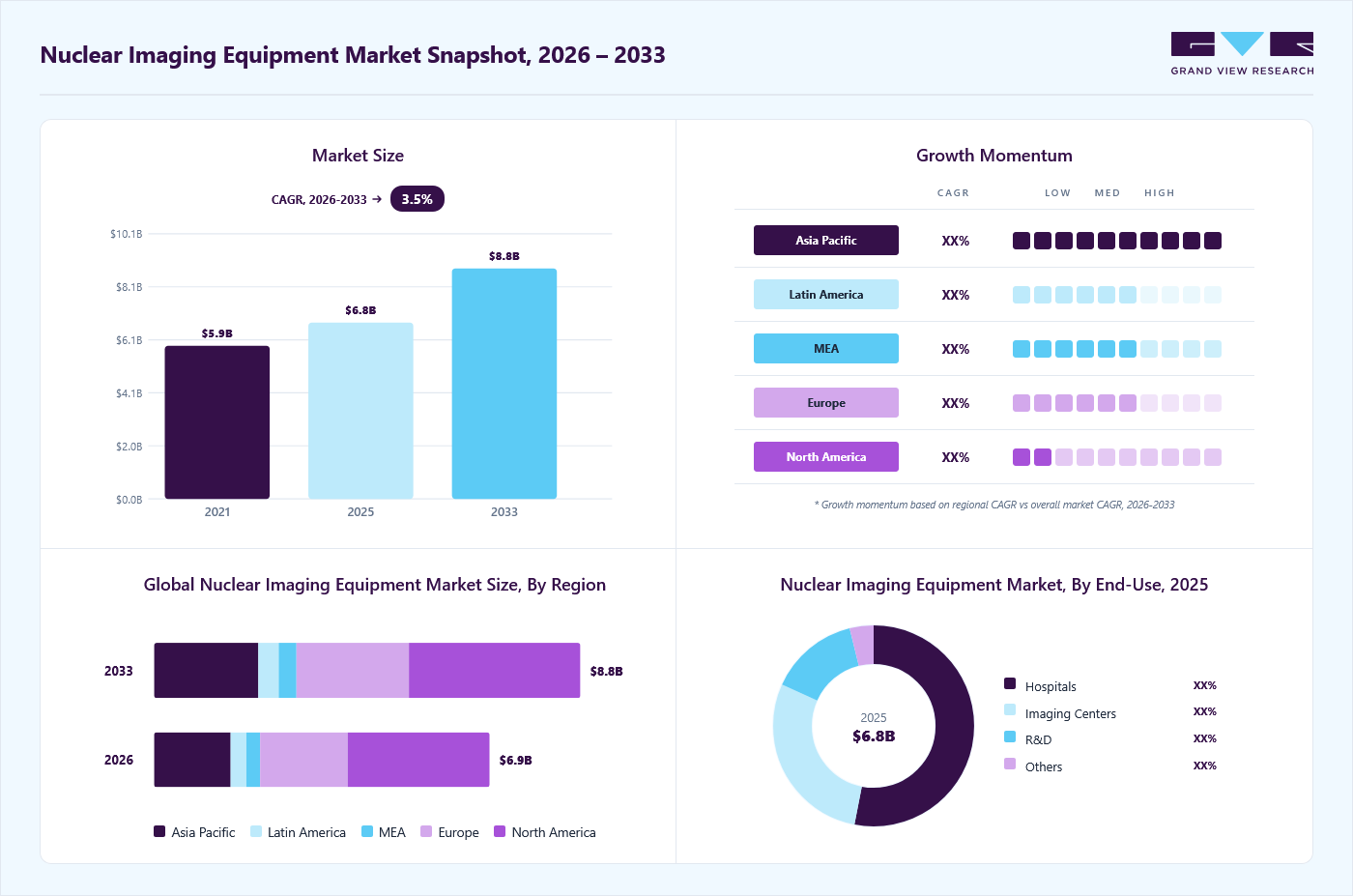
The nuclear imaging equipment market is gaining steady momentum as healthcare providers increasingly rely on advanced imaging for cancer diagnosis, cardiovascular assessment, neurological disorders, and other chronic conditions. According to Grand View Research, the market was valued at USD 6.8 billion in 2025 and is projected to grow from USD 6.9 billion in 2026 to USD 8.8 billion by 2033, representing a CAGR of 3.5% from 2026 to 2033. Increasing cancer prevalence, technological advancements, clinical applications, research activity, and rising nuclear medicine imaging procedures are supporting market expansion.
Cancer Burden Strengthens Demand for Nuclear Imaging
The increasing prevalence of cancer is one of the primary factors driving demand for nuclear imaging equipment. PET and SPECT systems provide important capabilities for cancer diagnosis, staging, treatment planning, and monitoring therapeutic responses. As healthcare systems face a growing need for early and precise cancer detection, investment in advanced imaging infrastructure is becoming increasingly important.
Nuclear imaging also supports the evaluation of cardiovascular and neurological conditions. PET and SPECT can provide information about blood flow, heart function, brain metabolism, and other functional characteristics that complement structural imaging. This expanding clinical utility is strengthening the role of nuclear imaging across multiple areas of healthcare.
SPECT Maintains Its Leading Modality Position
SPECT represented the largest modality segment, accounting for 58.1% of revenue share in 2025. Its comparatively cost-effective equipment and procedures support adoption across a broad range of healthcare settings. SPECT also uses different radiotracers and imaging agents from PET, providing distinct capabilities for specific diagnostic applications.
PET, however, is anticipated to grow at the fastest rate from 2026 to 2033. Improvements in PET imaging are supporting higher-resolution imaging and more precise metabolic information, particularly in oncology, neurology, and cardiology. Research is also exploring PET's potential for identifying people at risk of neurological disorders, further expanding its clinical possibilities.
Oncology Remains the Largest Application Area
Oncology led the application segment with a 48.7% revenue share in 2025. The growing prevalence of cancer and the ability of PET and SPECT to examine molecular characteristics associated with tumors are major factors supporting this position. Nuclear imaging also contributes to oncology research by helping evaluate tumor behavior, metabolism, and responses to experimental therapies.
Cardiology is expected to grow at the fastest rate from 2026 to 2033. The rising incidence of cardiovascular diseases and increasing awareness of nuclear imaging's diagnostic capabilities are supporting this opportunity. These developments demonstrate how nuclear imaging is expanding beyond cancer-focused applications into broader disease management.
Hospitals Continue to Anchor Equipment Adoption
Hospitals represented the leading end-use segment, accounting for 53.0% of revenue share in 2025. Their ability to manage complex cases, provide multiple medical services, and maintain larger infrastructure and budgets supports sustained investment in nuclear imaging systems.
Research and development institutes are expected to record the fastest CAGR from 2026 to 2033. These organizations serve as innovation centers for imaging methods and equipment while applying nuclear imaging to drug development, neuroscience, cardiovascular research, and oncology.
AI and Hybrid Imaging Reshape Equipment Capabilities
Technological innovation is becoming an increasingly important component of market development. Modern nuclear imaging platforms are incorporating advanced detector technologies, digital silicon photomultipliers, time-of-flight reconstruction architectures, radiation dose-optimization algorithms, and AI-driven clinical dashboards.
Artificial intelligence is also being integrated into imaging software to improve precision and efficiency. AI-supported systems can assist with image reconstruction, lesion detection, scan parameter management, and quantitative assessment. Hybrid imaging is another important development, combining nuclear imaging with CT or MRI to provide anatomical and functional information within a consolidated examination.
Regulatory Requirements Create Adoption Challenges
Despite technological progress, stringent regulatory requirements remain a significant market restraint. Nuclear imaging equipment manufacturers must comply with requirements involving device safety, radiation emissions, quality management, clinical validation, and post-market surveillance.
Nuclear imaging products can also be subject to oversight from nuclear safety and radiation protection authorities. These requirements may increase development costs, lengthen approval timelines, and delay the commercialization of new technologies, particularly for smaller manufacturers with limited regulatory resources.
Nuclear Imaging Equipment Market Outlook
The market is positioned for continued development as cancer, cardiovascular diseases, neurological disorders, and other chronic conditions increase demand for functional and molecular imaging. At the same time, AI, advanced detectors, hybrid imaging, radiation-dose optimization, and improved imaging software are creating opportunities for more precise diagnostic workflows.
With the market expected to reach USD 8.8 billion by 2033, manufacturers and healthcare providers are likely to remain focused on technological innovation, clinical utility, regulatory compliance, and improved imaging capabilities.
FAQs
What trends are shaping the nuclear imaging equipment market?
Major trends include the integration of AI into imaging software, advanced detector technologies, hybrid imaging systems, radiation-dose optimization, improved PET capabilities, and growing applications across oncology, cardiology, neurology, and research.
What challenges are affecting the nuclear imaging equipment market?
Stringent regulatory requirements are a major challenge. Manufacturers must meet standards involving device safety, radiation emissions, clinical validation, quality management, and post-market surveillance, which can increase development costs and extend approval timelines.
Key Nuclear Imaging Equipment Companies:
· GE HealthCare
· Siemens Healthineers
· Koninklijke Philips N.V.
· Canon Medical Systems Corporation
About us:
Grand View Research, a market research and consulting company, provides syndicated research reports, customized research reports, and consulting services. Grand View Research database is used by the world's renowned academic institutions and Fortune 500 companies to understand the global and regional business environment. Our database features thousands of statistics and in-depth analysis on 46 industries in 25 major countries worldwide.

 English
 Arabic
 French
 Spanish
 Portuguese
 Deutsch
 Turkish
 Dutch
Dutch
 Italiano
 Romaian
 Portuguese (Brazil)
 Greek
Greek