


Stronger Moisture Resistance Gives Synthetic Paper a Competitive Advantage
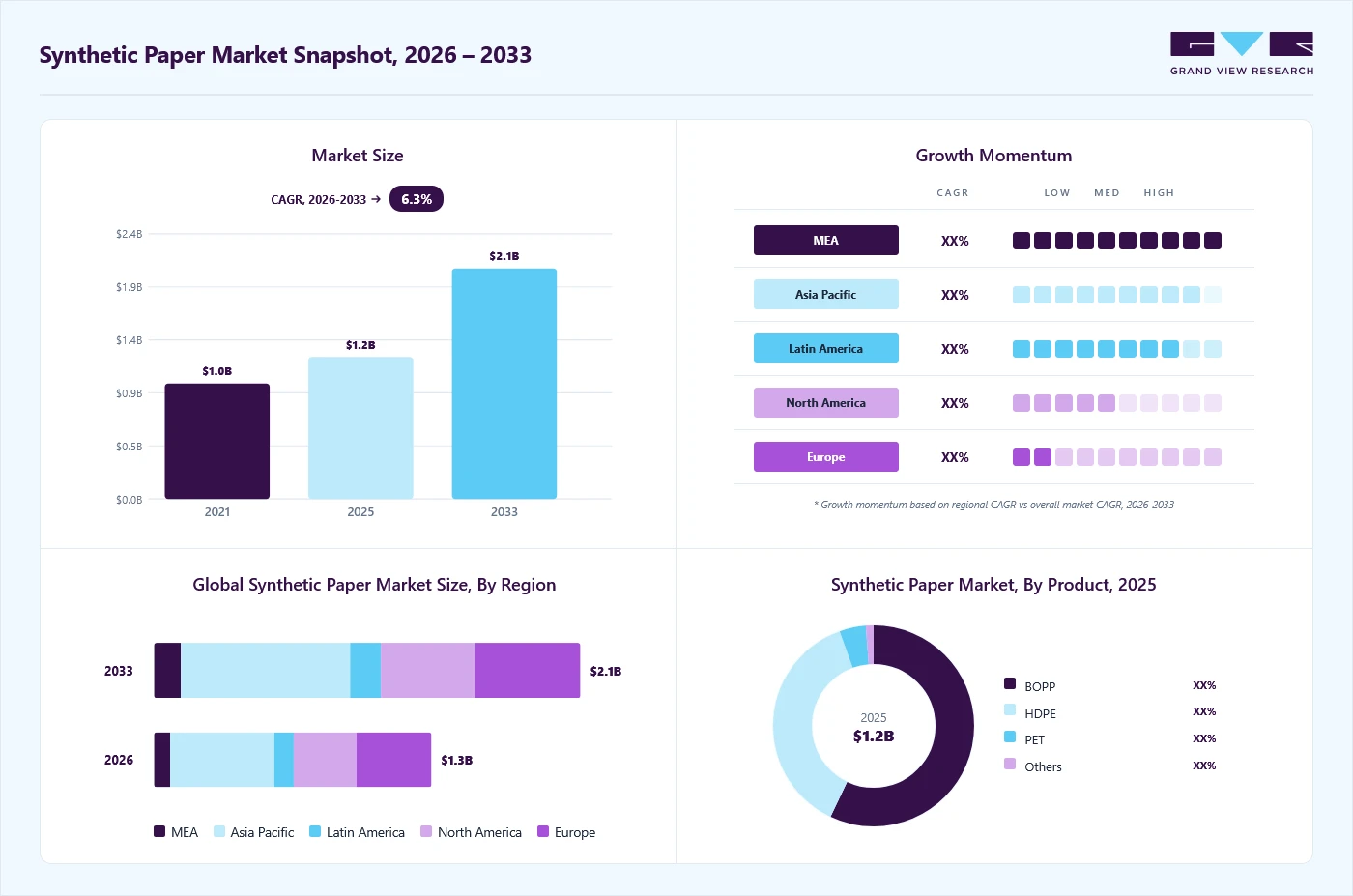
The synthetic paper market was valued at USD 1.2 billion in 2025 and is projected to reach USD 1.3 billion in 2026. By 2033, the market is expected to reach USD 2.1 billion, expanding at a CAGR of 6.3% from 2026 to 2033. Increasing preference for eco-friendly and recycled packaging, combined with demand for durable paper alternatives, is supporting this expansion.
Durability Creates a Strong Market Advantage
One of the most important factors supporting synthetic paper adoption is its ability to withstand demanding conditions. Traditional paper can be vulnerable to water, tearing, chemicals, oil, and extreme temperatures, whereas synthetic paper offers greater resistance to these conditions.
This makes it particularly useful in applications where printed materials need to maintain their appearance and structural integrity over extended periods. Packaging, labels, tags, outdoor signage, promotional products, and industrial applications can benefit from the material's durability and print quality.
The food and beverage, healthcare, and manufacturing industries are particularly important because their applications often require moisture resistance, chemical stability, and extended shelf life.
BOPP Maintains Product Segment Leadership
BOPP dominated the product segmentation with a 57.0% market share in 2025 and is forecasted to grow at a 6.1% CAGR from 2025 to 2033. Its strength makes it suitable for packaging perishable products such as snacks, fast food, vegetables, fruits, and confectionery.
BOPP is also widely used in chemical, textile, cosmetics, and food and beverage packaging. Its combination of strength and performance continues to support demand across packaging applications.
HDPE-based synthetic paper is expected to be the fastest-growing product segment, growing at over 6.9% from 2025 to 2033. It is used for powder, cheese, frozen food, and electronic parts packaging and offers moisture-barrier, temperature-resistant, non-abrasive, non-scratch, and acid-resistant properties.
Non-Label Applications Hold the Largest Share
Non-label applications accounted for 59.2% of market share in 2025 and are forecasted to grow at a 6.0% CAGR from 2025 to 2033. Packaging represents an important area because synthetic paper can provide the strength required for products that need durable packaging materials.
Its resistance to moisture and extreme heat further supports its use in packaging. The ability to print effectively using inks and adhesives also contributes to adoption across packaged products.
At the same time, label applications are expected to experience the fastest growth over the forecast period, with a CAGR of 6.7%. Medical tags are projected to be particularly strong, growing at a CAGR of over 8.0% from 2026 to 2033. These tags can be used for blood bags, test samples, test tubes, pharmaceuticals, medical devices, medical machinery, bottles, and first-aid applications.
Printing Technology Expands Application Potential
Advancements in printing compatibility are creating additional opportunities for synthetic paper. Improvements in compatibility with inkjet, flexography, offset, thermal transfer, HP Indigo, and screen printing are allowing manufacturers and end users to apply synthetic paper across a wider range of projects.
Digital printing is particularly important because it can support customized and short-run applications. Improvements in surface finish and printing performance are also increasing opportunities in premium labels, outdoor displays, industrial tags, and promotional products.
Sustainability Creates Both Opportunities and Challenges
Environmental considerations are becoming increasingly important in the synthetic paper industry. Manufacturers are focusing on recyclable and eco-friendly polymer materials to respond to regulatory requirements and changing consumer preferences.
The market nevertheless faces challenges related to production costs and recycling infrastructure. Synthetic paper requires specialized polymers and processing methods, which can increase material and manufacturing costs. Limited recycling infrastructure can also create difficulties at the end of a product's useful life.
These challenges are encouraging innovation in recyclable and biodegradable synthetic paper solutions. Sustainable materials could create new opportunities while helping manufacturers respond to environmental expectations.
Innovation Strengthens the Competitive Landscape
Companies are focusing on product development, material performance, printing compatibility, recyclability, and sustainability. Recent innovation includes Cosmo Films' September 2025 introduction of CSP Dualcoat, designed for multiple printing methods and applications such as displays, tags, labels, retail packaging, and outdoor signage.
The overall outlook remains positive as businesses seek materials that can deliver durability, high-quality printing, and resistance to challenging conditions. With the market expected to reach USD 2.1 billion by 2033, advancements in polymer formulations, surface treatments, recyclable materials, and printing technologies are likely to remain central to future growth.
FAQs
How big is the synthetic paper market?
The synthetic paper market was valued at USD 1.2 billion in 2025, is estimated at USD 1.3 billion in 2026, and is projected to reach USD 2.1 billion by 2033, growing at a CAGR of 6.3% from 2026 to 2033.
What trends are shaping the synthetic paper market?
Key trends include growing demand for durable and moisture-resistant materials, recyclable and eco-friendly polymer development, improved printing compatibility, digital printing, surface-finish innovation, and increasing use in premium labels, medical tags, industrial tags, packaging, and specialty printing.
Key Synthetic Paper Companies:
· Formosa Plastics Group
· SIHL Group
· B&F Plastics, Inc.
· Jindal Poly Films Ltd.
About us:
Grand View Research, a market research and consulting company, provides syndicated research reports, customized research reports, and consulting services. Grand View Research database is used by the world's renowned academic institutions and Fortune 500 companies to understand the global and regional business environment. Our database features thousands of statistics and in-depth analysis on 46 industries in 25 major countries worldwide.

 English
 Arabic
 French
 Spanish
 Portuguese
 Deutsch
 Turkish
 Italiano
 Russian
 Romaian
 Portuguese (Brazil)
 Greek
Greek