


From Gloves to Smart Gear, PPE Innovation Is Broadening Market Opportunities
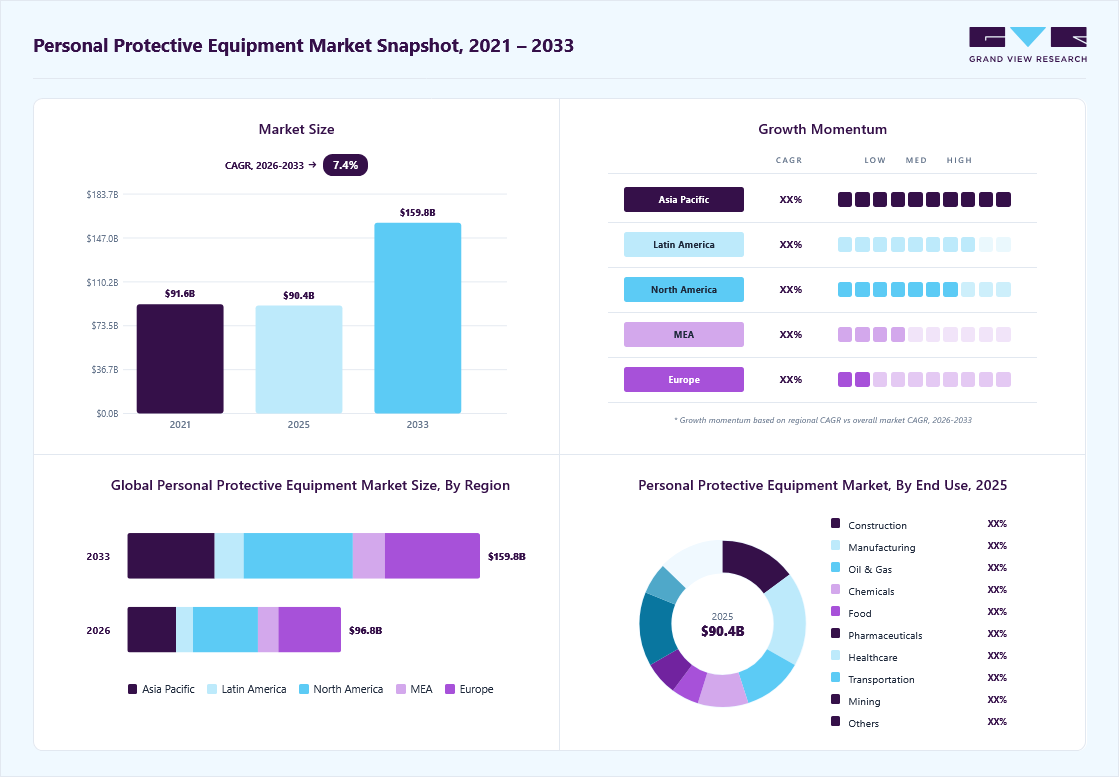
Personal protective equipment has become an essential safeguard across industries where employees face physical, chemical, biological, respiratory, and other workplace hazards. From manufacturing facilities and construction sites to healthcare environments, oil and gas operations, and chemical plants, protective equipment helps reduce exposure to occupational risks. Rising awareness of employee safety, stronger workplace regulations, and expanding industrial activity are creating sustained demand for advanced PPE solutions.
The personal protective equipment market was estimated at USD 90.4 billion in 2025 and is projected to grow from USD 96.8 billion in 2026 to USD 159.8 billion by 2033, expanding at a CAGR of 7.4% from 2026 to 2033. The market's development is being supported by growing safety awareness and continuing demand for protective products across major industrial and service sectors.
Workplace Safety Awareness Strengthens PPE Demand
Growing awareness of occupational health and safety is one of the important forces supporting PPE adoption. Industries such as manufacturing, construction, chemicals, mining, oil and gas, food, pharmaceuticals, and healthcare require workers to operate in environments where exposure to hazards can result in serious injuries or health risks.
PPE provides a critical layer of protection through products such as helmets, gloves, safety glasses, protective clothing, respirators, footwear, and fall protection equipment. As companies increasingly prioritize employee safety, demand is shifting toward products that combine effective protection with greater comfort, usability, and task-specific functionality.
Hand Protection Remains a Major Product Category
Hand protection held the largest product share, accounting for over 28.0% of revenue share in 2025. The segment benefits from demand across food, pharmaceuticals, manufacturing, construction, and chemical operations.
Workplace incidents involving cuts, punctures, abrasions, chemical exposure, and thermal burns continue to reinforce the need for specialized hand protection. Manufacturers are therefore developing products suited to different working environments, including disposable and durable gloves made from materials such as natural rubber, nitrile, vinyl, neoprene, and polyethylene.
Head protection is also expected to expand at a CAGR of 7.9% from 2026 to 2033. Hard hats and related protective products remain important in construction, mining, oil and gas, and manufacturing, where falling objects and other workplace hazards can create significant risks.
Manufacturing Leads End-Use Demand
Manufacturing accounted for 18.3% of revenue share in 2025, making it the leading end-use segment. Production facilities require multiple categories of PPE depending on the hazards associated with machinery, materials, chemicals, noise, heat, and other operational conditions.
Demand includes head protection, fall protection, eye protection, hearing protection, hand protection, and other specialized equipment. The continued need to protect workers while maintaining operational efficiency is supporting steady PPE consumption across manufacturing environments.
Healthcare is another increasingly important application area. The segment is projected to grow at a CAGR of 10.4% from 2026 to 2033, supported by demand for protective clothing, respiratory protection, and hand protection. Healthcare facilities require PPE to protect employees and patients from infections and other biological risks.
Industrialization Creates New Market Opportunities
Ongoing industrialization and infrastructure development are creating additional demand for PPE. Expanding manufacturing, construction, mining, pharmaceuticals, healthcare, and energy activities increase the number of workers operating in potentially hazardous environments.
At the same time, inadequate awareness and inconsistent enforcement of safety practices can remain challenges in some emerging economies. Limited knowledge about the benefits of protective equipment and deliberate negligence in PPE use can reduce adoption and effectiveness.
Strengthening safety regulations and workplace inspections can therefore play an important role in encouraging organizations and employees to use appropriate protective equipment consistently.
Smart PPE Brings Technology Into Workplace Safety
Technological innovation is creating new opportunities for PPE manufacturers. Smart protective equipment incorporating sensors and connected technologies can enable real-time health and safety monitoring.
This development could help transform PPE from a passive protective layer into a more intelligent workplace safety solution. Sensors can potentially support monitoring capabilities while helping organizations improve visibility into working conditions and employee safety.
Manufacturers are also focusing on advanced materials, ergonomic designs, attractive product aesthetics, and improved comfort. These developments address the need for equipment that workers can use consistently without compromising protection or productivity.
FAQs
What is driving the Personal Protective Equipment market?
Rising workplace safety regulations, greater awareness of occupational hazards, expanding industrial activity, and increased investment in infrastructure, healthcare, and manufacturing are key factors supporting PPE demand.
What trends are shaping the Personal Protective Equipment market?
Important trends include the development of smart PPE with integrated sensors, demand for more comfortable and ergonomic designs, advanced protective materials, stronger safety standards, and increasing requirements across healthcare and industrial applications.
Key Personal Protective Equipment Companies:
· 3M
· Lakeland industries, inc.
· DuPont
· PIP Global Safety
About us:
Grand View Research, a market research and consulting company, provides syndicated research reports, customized research reports, and consulting services. Grand View Research database is used by the world's renowned academic institutions and Fortune 500 companies to understand the global and regional business environment. Our database features thousands of statistics and in-depth analysis on 46 industries in 25 major countries worldwide.

 English
 Arabic
 French
 Spanish
 Portuguese
 Deutsch
 Dutch
Dutch
 Italiano
 Russian
 Romaian
 Portuguese (Brazil)
 Greek
Greek