


What Happens If a Student Misses an EMI? Penalties, CIBIL Impact & Fixes
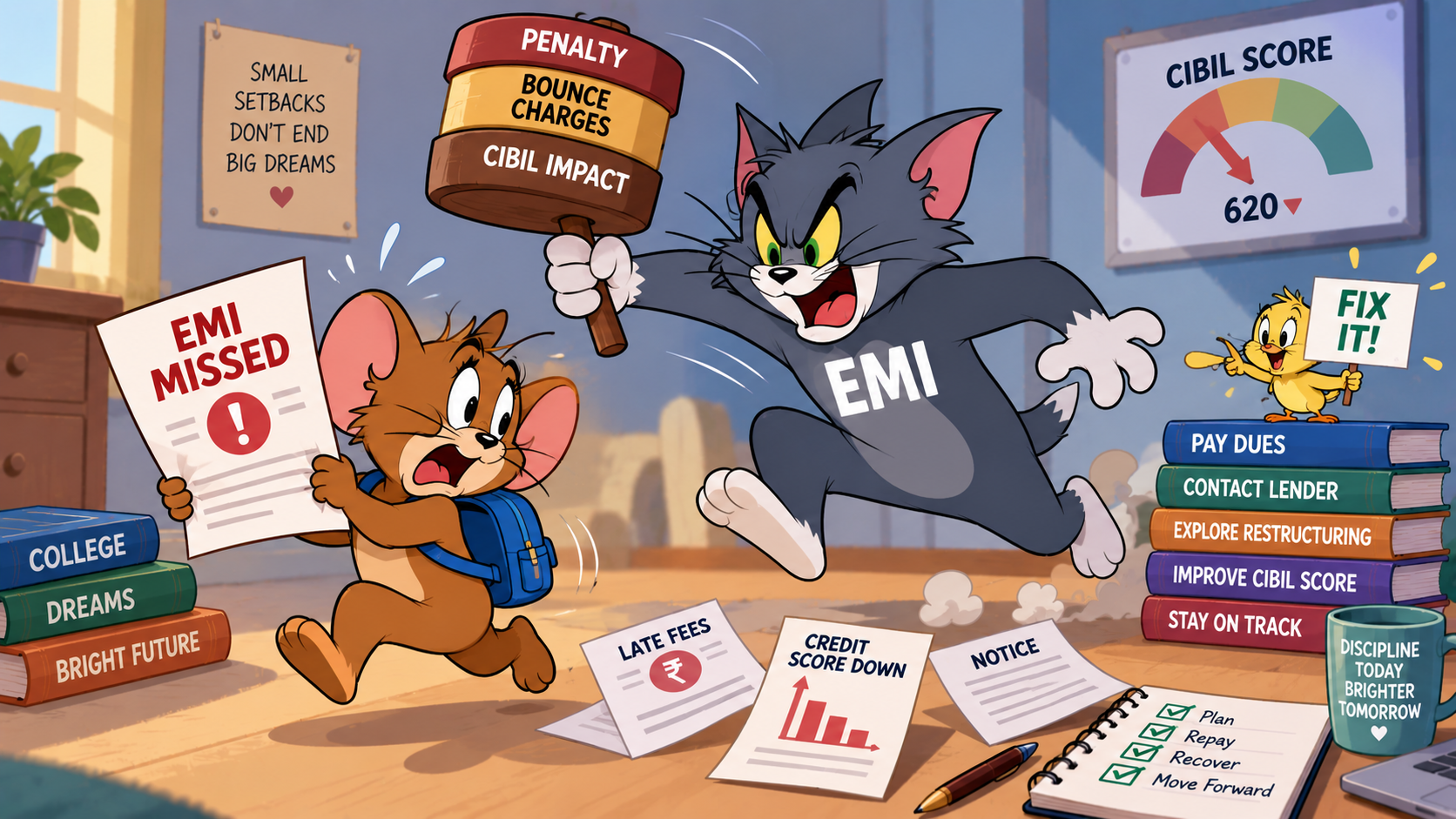
Taking a loan as a student can help manage education expenses, emergency costs, or other important needs. But borrowing also comes with a responsibility: paying every EMI on time.
If a student misses an EMI, the consequences can go beyond simply paying the instalment later. Depending on the lender and loan agreement, the borrower may face late payment charges, EMI bounce charges, additional interest or penalties, and a potential negative impact on their CIBIL profile.
The good news is that missing one EMI does not mean your financial future is ruined. Acting quickly can help limit the damage.
This guide explains the student missed EMI penalty, how late payments can affect your credit profile, and what you can do to recover.
What Happens When a Student Misses an EMI?
An EMI becomes overdue when the scheduled payment isn't received by the due date.
What happens next depends on the lender's terms and how long the payment remains unpaid.
A missed EMI may result in:
-
Late payment or penal charges
-
EMI bounce charges if the payment fails
-
Additional interest or overdue amounts
-
Collection reminders
-
Negative credit reporting, depending on the lender and reporting status
-
Difficulty obtaining credit in the future if the overdue remains unresolved
The exact charges should be checked in your loan agreement and Key Facts Statement, where applicable.
What Is a Student Missed EMI Penalty?
A student missed EMI penalty is an additional amount a lender may charge when an EMI isn't paid according to the agreed repayment schedule.
The penalty isn't necessarily the same for every loan.
For example, one lender may have a fixed late-payment charge, while another may calculate certain charges based on the overdue amount or applicable terms.
Before taking a loan, students should look beyond the advertised interest rate and check:
-
Late-payment charges
-
Penal charges
-
Bounce charges
-
Processing fees
-
Prepayment conditions
-
Other applicable fees
This gives you a clearer picture of the real cost of borrowing.
What Are EMI Bounce Charges in India?
EMI bounce charges in India may apply when an automatic repayment attempt fails.
For example, suppose your EMI is scheduled to be deducted from your bank account, but there isn't enough money available on the due date. The transaction may fail.
Depending on the lender and payment arrangement, you could potentially face:
-
A failed-payment or bounce charge
-
An overdue EMI
-
Applicable late or penal charges
-
Additional collection communication
The amount and conditions vary by lender, so don't assume that every loan has the same bounce fee.
How to avoid an EMI bounce
A few simple habits can reduce the risk:
-
Keep sufficient funds in the repayment account.
-
Check the EMI date every month.
-
Set a reminder a few days before the due date.
-
Don't transfer money out of the account immediately before an automatic debit.
-
Update the lender if your bank account or repayment method changes.
For students with irregular income or family-supported finances, keeping an EMI calendar can be especially useful.
Does Missing an EMI Affect Your CIBIL Score?
It can, particularly if the missed payment becomes overdue and is reported to the credit bureau.
This is why late payment CIBIL impact is an important consideration before taking any loan.
Your credit report can contain information about your credit accounts and repayment behaviour. Lenders may use this information when assessing future credit applications.
A history of late or missed payments can make future borrowing more difficult.
However, the impact isn't necessarily identical in every situation. It can depend on factors such as the reporting status, duration of the overdue, account history, and the lender's reporting practices.
Does One Missed EMI Ruin Your CIBIL Score?
Not necessarily.
Students sometimes assume that one missed payment automatically destroys their credit score permanently. That's not how credit history works.
However, ignoring the missed EMI can turn a small problem into a much bigger one.
For example:
Missed EMI → overdue amount → continued non-payment → increasing financial burden → potential negative credit reporting
The sooner you address the missed payment, the better.
Your future credit profile also depends on your ongoing repayment behaviour.
What If the EMI Is Only a Few Days Late?
If you've missed an EMI by a few days, don't panic. Contact the lender as soon as possible and ask for the exact outstanding amount.
Depending on the loan terms, you may need to pay:
-
The original EMI
-
Applicable charges
-
Any other overdue amount
Don't simply transfer the regular EMI amount without checking whether additional charges have been added.
Once the payment is made, keep the transaction receipt or confirmation for your records.
What If You Cannot Pay the Missed EMI?
This situation requires faster action.
If you know that you won't be able to make the payment, don't ignore calls, emails, or messages from the lender.
Instead:
1. Contact the lender
Explain your situation and ask what options are available.
2. Ask for the exact outstanding amount
Find out how much is currently due, including applicable charges.
3. Request a repayment solution if available
Depending on the lender and circumstances, there may be options for restructuring, revised repayment arrangements, or other assistance. Availability isn't guaranteed.
4. Avoid taking another expensive loan blindly
Using one high-cost loan to pay another can create a debt cycle.
5. Prioritise the overdue payment
If the loan is already overdue, resolving it should generally be higher priority than unnecessary spending.
How to Recover From a Missed Loan Payment
If you're searching for how to recover from missed loan payment, the first step is simple: don't leave the account unresolved.
Follow this process.
Step 1: Find out exactly what you owe
Contact the lender and request the current outstanding amount.
Step 2: Pay the overdue amount
If you can afford it, clear the missed EMI and applicable charges as soon as possible.
Step 3: Keep proof of payment
Save receipts, transaction IDs, emails, or other confirmation.
Step 4: Check your loan account
Make sure the payment has been correctly reflected.
Step 5: Monitor your credit report
After sufficient time has passed for reporting updates, review your credit report and check whether the account information is accurate.
Step 6: Build a stronger repayment routine
Set up reminders or automatic payments where suitable.
Recovery is less about finding a magic credit-score trick and more about creating a long streak of responsible repayments.
Can a Missed EMI Be Removed From Your CIBIL Report?
If the information reported by the lender is accurate, you generally shouldn't expect it to simply disappear because you request removal.
However, if your credit report contains incorrect information, you can raise a dispute through the appropriate process.
For example, if you paid an EMI on time but it was incorrectly reported as overdue, collect your payment evidence and contact the lender and relevant credit bureau to request correction.
Always keep documentation of your repayments.
Does Paying the EMI Later Fix Your CIBIL Score Immediately?
Not necessarily.
Paying an overdue amount resolves the outstanding debt, but it doesn't automatically erase an accurate historical record of late payment.
Your credit profile can improve over time through consistent responsible credit behaviour.
That means:
-
Pay future EMIs on time.
-
Avoid unnecessary new borrowing.
-
Keep credit card balances under control.
-
Limit excessive credit applications.
-
Monitor your credit report for errors.
Think of credit recovery as a scoreboard that updates through repeated good behaviour, not a reset button you press once.
How Students Can Avoid Missing EMIs
Prevention is much easier than repairing a damaged repayment history.
Create an EMI calendar
Record:
-
Loan name
-
EMI amount
-
Due date
-
Repayment account
-
Outstanding balance
Maintain a buffer
If possible, keep enough money in your repayment account before the due date.
Use reminders
Set an alert several days before the EMI date.
Don't borrow beyond your capacity
A small loan with an affordable EMI is generally easier to manage than a large loan that consumes most of your available funds.
Understand the repayment terms
Before signing the loan agreement, understand the interest, fees, penalties, repayment schedule, and consequences of default.
What Students Should Do After Missing an EMI
If you've already missed a payment, use this quick checklist:
Today
-
Check why the payment failed.
-
Contact the lender.
-
Find the exact overdue amount.
-
Arrange payment if financially possible.
After payment
-
Save the receipt.
-
Confirm the lender has received the money.
-
Check your account status.
Going forward
-
Set EMI reminders.
-
Maintain sufficient funds.
-
Monitor your credit report.
-
Avoid unnecessary loans.
Final Thoughts
Missing an EMI doesn't automatically destroy a student's financial future, but ignoring it can create unnecessary costs and potentially hurt their credit profile.
The student missed EMI penalty depends on the loan agreement and lender's applicable charges. Similarly, EMI bounce charges in India can vary by lender and repayment arrangement.
The most important response is to act quickly.
If you've missed an EMI, contact the lender, understand exactly what you owe, clear the overdue amount when possible, keep proof of payment, and continue making future payments on time.
For students building their first credit history, every repayment matters. A single financial mistake can happen, but a consistent repayment habit is what ultimately builds a stronger credit profile.

 English
 Arabic
 French
 Portuguese
 Deutsch
 Turkish
 Dutch
Dutch
 Italiano
 Russian
 Romaian
 Portuguese (Brazil)
 Greek
Greek