


Energy-Efficient Heating and Cooling Drive New HVAC Market Opportunities
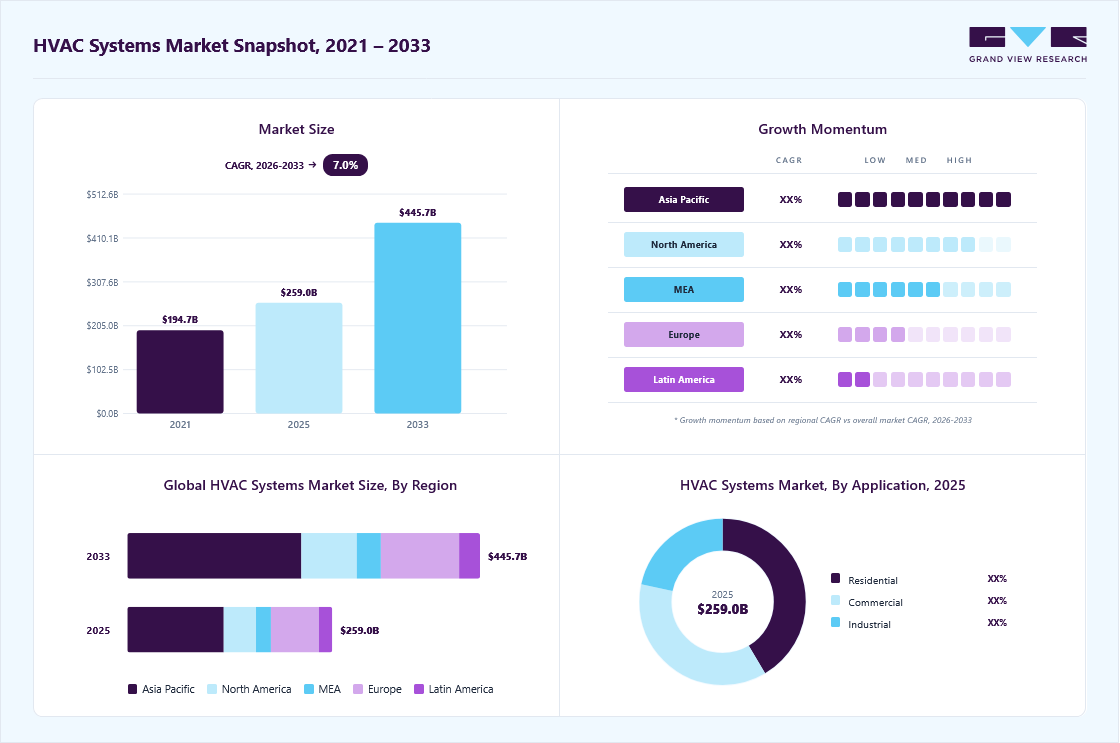
The HVAC systems market is entering a strong growth phase as construction activity, urbanization, energy-efficiency requirements, and demand for thermal comfort reshape heating, ventilation, and cooling infrastructure. The market was estimated at USD 258.96 billion in 2025 and is projected to reach USD 445.73 billion by 2033, expanding at a CAGR of 7.0% from 2026 to 2033. The market is estimated at USD 277.79 billion in 2026, highlighting the continued investment flowing into modern climate-control systems.
Energy Efficiency Becomes a Major Market Growth Engine
The increasing focus on energy-efficient buildings and smart infrastructure is one of the key factors supporting HVAC systems adoption. Commercial buildings, residential complexes, data centers, healthcare facilities, and industrial plants are increasingly adopting advanced systems to reduce energy consumption, improve indoor air quality, and support environmental sustainability goals.
Stricter building energy codes and carbon-reduction targets are also encouraging the installation of high-efficiency heating, ventilation, and air conditioning equipment. Government incentives, rebates, and programs supporting clean heating and cooling technologies are adding further momentum to system upgrades. At the same time, growing awareness of indoor air quality is increasing investment in air filtration and ventilation technologies.
Heating Equipment Maintains a Strong Position
Heating equipment accounted for the largest equipment share, representing 51.5% in 2025. Demand is being supported by the transition toward energy-efficient and sustainable heating solutions. Heat pumps and hybrid systems are gaining attention as conventional fossil fuel-based heating technologies face stricter emissions and energy-efficiency requirements.
The cooling equipment segment is expected to grow at a CAGR of 6.9% from 2026 to 2033. Rising ambient temperatures, urban population growth, and increasing demand for thermal comfort are supporting advanced air-conditioning adoption. Data centers, hospitals, and temperature-sensitive industrial facilities are also contributing to demand for precision and industrial cooling systems.
Residential Applications Continue to Shape Demand
The residential segment dominated the market in 2025 with a 41.4% market share. Rising housing construction, higher disposable incomes in emerging markets, and increasing consumer awareness of indoor air quality and energy efficiency are supporting HVAC installations.
Ductless mini-splits and integrated HVAC systems are seeing strong demand because they can support zoning and remote management through smart thermostats. Energy-efficient appliance incentives, green home certifications, renovation activity, and smart-home adoption are also encouraging consumers to replace older systems with more advanced equipment.
Commercial applications represent another important growth opportunity. The segment is expected to expand at a CAGR of 7.5% from 2026 to 2033, supported by construction and refurbishment of office complexes, hotels, hospitals, retail spaces, and educational institutions. Requirements surrounding indoor air quality, energy performance, and ESG investment are strengthening demand for high-performance HVAC solutions.
Digital Technologies Transform HVAC Performance
Technological innovation is becoming increasingly important to the HVAC systems market. IoT-enabled monitoring, AI-driven optimization, remote diagnostics, demand-controlled ventilation, inverter-driven compressors, heat pumps, and AI-integrated building automation systems are creating more connected and efficient HVAC environments.
Smart HVAC solutions can support predictive maintenance and lifecycle optimization while helping building operators improve system performance. Manufacturers are increasingly developing modular, scalable, and connected systems to meet changing requirements across residential, commercial, and industrial applications.
Online Distribution Gains Ground
Retail stores held the largest distribution-channel share at 40.5% in 2025, supported by multi-brand outlets, big-box stores, dealer networks, installation services, and localized after-sales support.
However, online distribution is projected to grow at a CAGR of 7.7% from 2026 to 2033. Digital procurement is making product discovery, comparison, ordering, and access to energy ratings more convenient. Manufacturers are also developing direct-to-consumer platforms with customization, live support, and AR-based product visualization capabilities.
Regional Demand Strengthens the Market Outlook
Asia Pacific accounted for the largest market share at 47.0% in 2025, supported by rapid urbanization, population growth, expanding housing, rising temperatures, and increasing air-conditioning adoption. The HVAC systems industry in India is projected to grow at a CAGR of 8.3% from 2026 to 2033, while China is projected to expand at a CAGR of 7.9%.
Across other markets, demand is being influenced by energy-efficiency regulations, retrofit requirements, climate conditions, construction activity, and smart-building adoption. The U.S. HVAC systems industry is projected to grow at a CAGR of 6.9%, while the UK is expected to expand at 7.3% and Saudi Arabia at 7.7% over the forecast period.
FAQs
How big is the HVAC systems market?
The HVAC systems market was estimated at USD 258.96 billion in 2025 and is expected to reach USD 277.79 billion in 2026. It is projected to reach USD 445.73 billion by 2033, growing at a CAGR of 7.0% from 2026 to 2033.
What trends are shaping the HVAC systems market?
Key trends include growing adoption of energy-efficient systems, smart HVAC controls, IoT-enabled monitoring, AI-driven optimization, heat pumps, low-GWP refrigerants, demand-controlled ventilation, connected building automation, and increasing demand for improved indoor air quality.
Key HVAC Systems Companies:
· Carrier Corporation
· DAIKIN INDUSTRIES Ltd.
· Fujitsu
· Haier Group
About us:
Grand View Research, a market research and consulting company, provides syndicated research reports, customized research reports, and consulting services. Grand View Research database is used by the world's renowned academic institutions and Fortune 500 companies to understand the global and regional business environment. Our database features thousands of statistics and in-depth analysis on 46 industries in 25 major countries worldwide.

 English
 Arabic
 French
 Spanish
 Portuguese
 Deutsch
 Turkish
 Dutch
Dutch
 Italiano
 Russian
 Portuguese (Brazil)
 Greek
Greek