


Surgical Simulation Market Eyes Rapid Growth as Training Needs Intensify
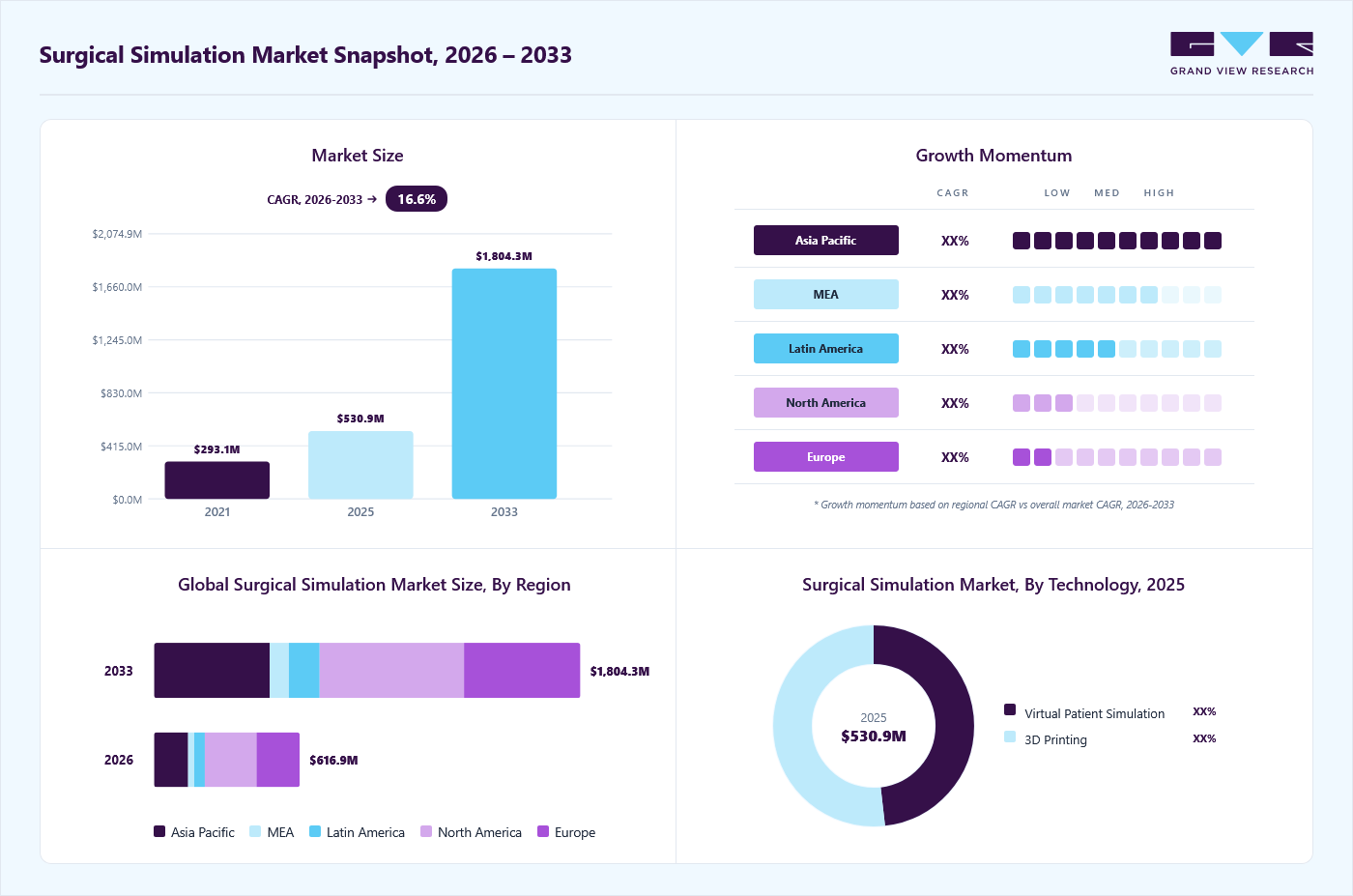
The surgical simulation market is entering a period of strong expansion as healthcare institutions increasingly prioritize surgical training, procedural accuracy, and patient safety. The market was valued at USD 530.7 million in 2025 and is projected to reach USD 1,804.4 million by 2033, growing from USD 616.9 million in 2026 at a CAGR of 16.6% from 2026 to 2033. The increasing complexity of surgical procedures, demand for minimally invasive treatments, and advancements in medical technology are contributing to this growth.
Training Requirements Create a Strong Foundation for Market Growth
The shortage of skilled surgeons and the growing complexity of surgical procedures are increasing the need for realistic and risk-free training environments. Traditional surgical education can require more than seven years in high-income countries, while up to 30% of trainees report feeling insufficiently prepared for independent practice after residency. These challenges are encouraging healthcare institutions to adopt simulation-based learning tools that allow professionals to repeatedly practice procedures before treating patients.
Surgical simulation also addresses broader workforce-training requirements. The Lancet Commission on Global Surgery 2030 has highlighted significant gaps in access to safe surgical care and recommended expanding the surgical, anesthetic, and obstetric workforce in low- and middle-income countries. Simulation technologies can support workforce readiness by providing controlled environments for developing technical and procedural skills.
3D Printing and Virtual Simulation Transform Surgical Practice
Technology remains a central component of market development. The 3D printing segment accounted for the largest technology share, representing 51.9% in 2025. Increasing awareness of 3D printing simulation and strategic initiatives by industry participants are supporting adoption. Anatomically accurate models can provide healthcare professionals with realistic training environments while supporting education and procedural preparation.
Virtual patient simulation is expected to register the fastest CAGR during the forecast period. Advances in immersive learning, artificial intelligence, and virtual reality are enabling interactive environments where healthcare professionals can practice procedures repeatedly without exposing patients to procedural risks. These systems can also support personalized training and improve skill acquisition.
The industry's high level of innovation is being reinforced by developments in virtual reality, artificial intelligence, augmented reality, and haptic feedback. These technologies are helping simulation platforms provide more realistic experiences and actionable performance feedback.
Orthopedic Procedures Remain a Major Application Area
Orthopedic surgery represented the largest specialty segment, accounting for 31.8% of revenue share in 2025. The growth of this segment is associated with the prevalence of orthopedic conditions such as osteoporosis, osteoarthritis, rheumatoid arthritis, and ligament injuries. The increasing need for specialized training in orthopedic procedures is encouraging the development of advanced simulators.
At the same time, reconstructive surgery is expected to record the fastest specialty growth, with a CAGR of 17.36% over the forecast period. Demand for sophisticated training solutions for facial, craniofacial, and breast reconstruction procedures is supporting this expansion. High-fidelity simulation, 3D modeling, and virtual reality are further improving the realism of training environments.
Academic Institutes Lead Adoption While Hospitals Gain Momentum
Academic institutes held the largest revenue share among end-use segments in 2025. Medical universities and academic medical centers are increasingly incorporating high-fidelity simulators, virtual reality, and augmented reality into surgical education. Dedicated simulation laboratories and training centers are also supporting procurement of advanced systems.
Hospitals, however, are expected to witness the fastest growth over the forecast period. Increasing attention to advanced learning, procedural accuracy, and error reduction is encouraging hospitals to incorporate simulation technologies into clinical training.
Outlook
With the market projected to reach USD 1,804.4 million by 2033, surgical simulation is becoming an increasingly important component of modern medical education and professional skill development. Continued advances in immersive technologies, demand for minimally invasive procedures, and stronger emphasis on patient safety are expected to sustain market expansion through the forecast period.
FAQs
How big is the surgical simulation market?
The surgical simulation market was valued at USD 530.7 million in 2025 and is estimated to reach USD 616.9 million in 2026. It is projected to reach USD 1,804.4 million by 2033.
What trends are shaping the surgical simulation market?
Key trends include the adoption of 3D printing, virtual patient simulation, virtual reality, artificial intelligence, augmented reality, and haptic feedback. These technologies are supporting realistic, repeatable, and risk-free surgical training while strengthening skill development and patient safety.
Key Surgical Simulation Companies:
· Materialise
· Stratasys
· CAEInc.
· SurgicalScience
About us:
Grand View Research, a market research and consulting company, provides syndicated research reports, customized research reports, and consulting services. Grand View Research database is used by the world's renowned academic institutions and Fortune 500 companies to understand the global and regional business environment. Our database features thousands of statistics and in-depth analysis on 46 industries in 25 major countries worldwide.

 English
 Arabic
 French
 Spanish
 Portuguese
 Deutsch
 Turkish
 Italiano
 Russian
 Romaian
 Portuguese (Brazil)
 Greek
Greek