


Battery-as-a-Service (BaaS) Market Size, Share, Industry Overview, Trends and Forecast 2026-2034
Market Overview
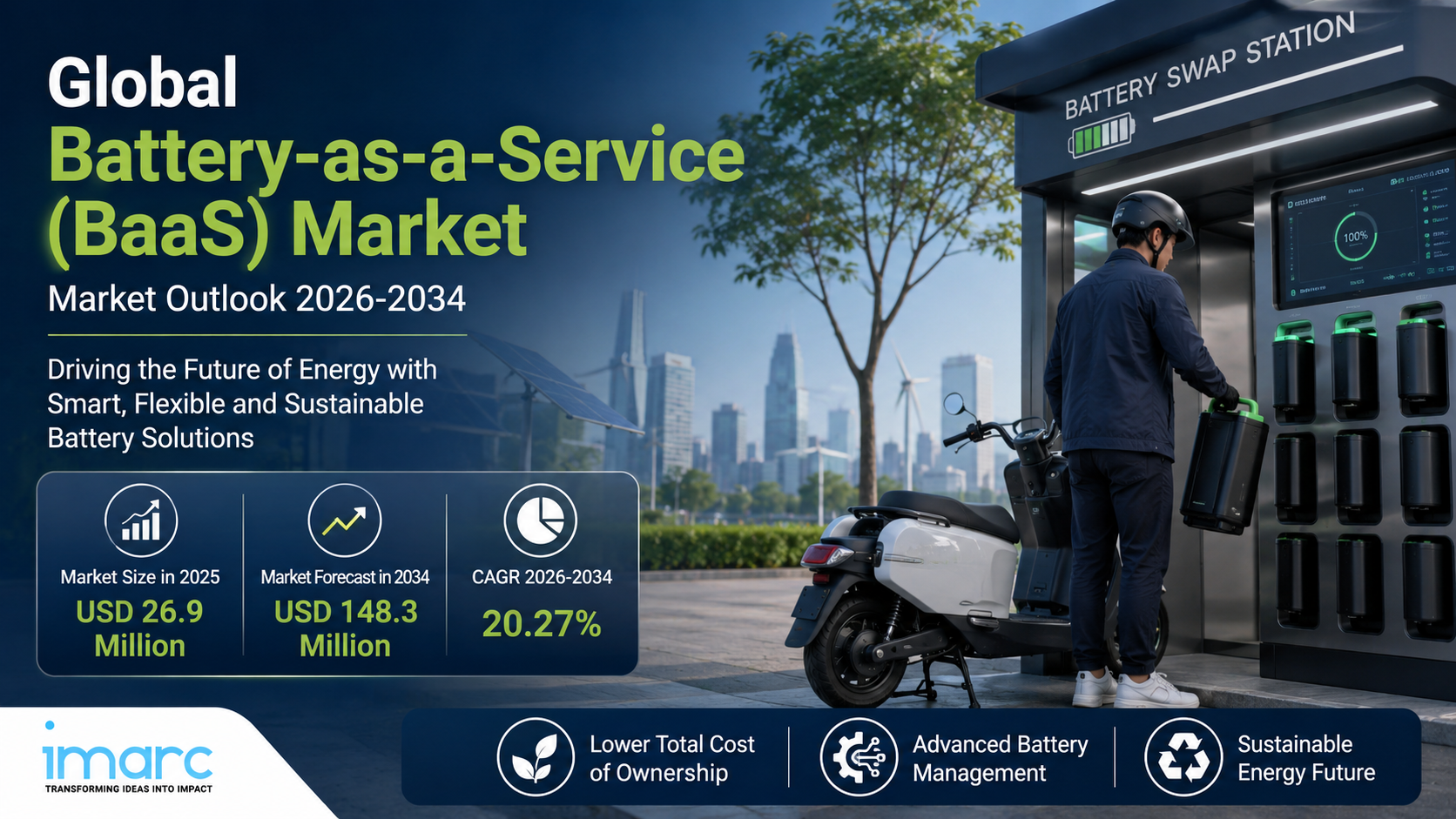
According to a research report by IMARC Group, the global battery-as-a-service (BaaS) market size reached USD 26.9 Million in 2025. Looking forward, the market is projected to reach USD 148.3 Million by 2034, exhibiting a growth rate (CAGR) of 20.27% during 2026-2034. Europe currently leads the regional landscape, supported by ambitious sustainability goals, stringent environmental regulations, increasing renewable energy adoption, advanced infrastructure, and the growing shift toward electric vehicles (EVs). Market growth is primarily attributed to the rising demand for alternative energy solutions, increasing focus on renewable energy, growing concerns regarding grid instability, stringent environmental regulations, escalating EV sales, lower total cost of ownership, and continual technological advancements in battery and monitoring systems.
Battery-as-a-Service (BaaS) Market Key At a Glance
-
Base Year: 2025
-
Historical Period: 2020–2025
-
Forecast Period: 2026–2034
-
Market Size (2025): USD 26.9 Million
-
Market Forecast (2034): USD 148.3 Million
-
CAGR (2026–2034): 20.27%
-
Leading Region: Europe
-
Dominant Type: Stationary Equipment
-
Leading Service: Swappable and Upgradable Batteries
-
Leading Application: Automotive and Transport
Request For Sample Report: https://www.imarcgroup.com/battery-as-a-service-market/requestsample
Battery-as-a-Service (BaaS) Market Report: Key Highlights
-
Market Size & Growth: The global battery-as-a-service (BaaS) market reached USD 26.9 Million in 2025 and is projected to reach USD 148.3 Million by 2034, registering a CAGR of 20.27% during 2026–2034.
-
Regional Leadership: Europe represents the largest regional market, supported by regulatory frameworks, sustainability goals, renewable energy initiatives, EV adoption, advanced infrastructure, and investments in smart grid technologies.
-
By Type: The market is segmented into stationary equipment and mobile equipment, with stationary equipment accounting for the majority of the market share.
-
By Service: The market covers vehicle-battery separation, battery subscription, chargeable, and swappable and upgradable batteries, with swappable and upgradable batteries holding the largest share.
-
By Application: The market spans automotive and transport, energy, industrial, and others, with automotive and transport representing the leading segment.
-
Key Market Drivers: Rising demand for alternative energy solutions, growing renewable energy adoption, stringent environmental regulations, increasing EV sales, and concerns regarding grid instability are supporting market expansion.
-
Key Market Trends: Increasing integration of renewable energy, lower total cost of ownership, growing adoption of battery subscription models, advancements in battery technology, and the integration of IoT-based monitoring systems are shaping the market.
-
Key Market Challenges: The need to manage battery performance, maintenance, replacement, and recycling while offering economically attractive service models remains important for BaaS providers.
-
Emerging Opportunities: Growth in electric mobility, renewable energy deployment, battery swapping, smart grid technologies, and advanced battery management systems is creating new avenues for market participants.
What Is Driving Battery-as-a-Service (BaaS) Market Growth in 2026?
Increasing Focus on Renewable Energy
The accelerating shift toward renewable energy sources such as solar and wind is one of the primary factors driving the Battery-as-a-Service (BaaS) market. Renewable energy generation is inherently variable, as solar and wind systems generate electricity according to weather and environmental conditions. This creates a growing requirement for efficient energy storage solutions capable of balancing electricity supply and demand.
BaaS provides scalable and professionally managed battery storage systems that can store excess energy generated during periods of high renewable production and release it when generation declines or demand increases. This helps provide a more reliable flow of electricity while supporting the integration of renewable energy into energy systems.
Furthermore, governments worldwide are increasingly supporting renewable energy through subsidies, tax incentives, and regulations aimed at reducing greenhouse gas emissions. These initiatives are encouraging businesses and consumers to adopt renewable energy and associated storage solutions, thereby creating a positive outlook for BaaS.
Lower Total Cost of Ownership
The potential for a lower total cost of ownership (TCO) compared with conventional battery ownership models represents another major factor supporting market growth. Purchasing battery systems outright generally requires significant upfront investment, in addition to ongoing expenses associated with maintenance, monitoring, and eventual replacement.
The BaaS model enables customers to avoid substantial initial capital expenditure by spreading battery-related costs through subscription or lease agreements. This creates a more manageable financial structure for businesses and consumers while providing access to professionally managed battery systems.
In addition, BaaS providers assume responsibility for maintaining and optimizing battery performance. Professional management can help extend battery life and improve system performance, further enhancing the attractiveness of the service model.
Continual Technological Advancements
Continual advancements in battery technology and monitoring and management systems are significantly contributing to BaaS market growth. As batteries become more efficient, lightweight, and durable, their applicability across automotive, utilities, residential, and industrial applications continues to expand.
Advancements in Internet of Things (IoT) technology are also enabling more effective monitoring and management of battery performance. These systems can provide real-time information on battery conditions, predict potential failures, and optimize charging and discharging cycles to improve battery performance and longevity.
The combination of improved battery technologies and increasingly sophisticated monitoring systems is making BaaS a more compelling solution across a wider range of applications.
Battery-as-a-Service (BaaS) Market Trends
Rising Demand for Alternative Energy Solutions
The escalating demand for alternative energy solutions is one of the key factors supporting the BaaS market. Growing concerns regarding grid instability are increasing the need for dependable energy storage systems that can provide businesses and consumers with greater resilience against supply interruptions and fluctuating energy prices.
BaaS enables customers to access professionally managed energy storage without the need for direct ownership, supporting efficient energy management while reducing the burden associated with battery installation, maintenance, and replacement.
Growing Adoption of Battery Subscription Models
Battery subscription and lease-based models are gaining traction as businesses and consumers increasingly seek flexible alternatives to outright battery ownership. Under the BaaS model, customers can access battery storage while spreading costs over time.
The service provider remains responsible for battery installation, maintenance, monitoring, and eventual replacement or recycling. This approach can make advanced battery storage solutions more accessible while helping customers manage their energy requirements efficiently.
Increasing Integration of Smart Monitoring Technologies
The integration of advanced monitoring technologies is becoming increasingly important across the BaaS industry. IoT-enabled systems can continuously monitor battery conditions and provide information that helps providers optimize performance.
The ability to predict battery degradation or potential failure also allows service providers to take preventive action, including timely replacement, thereby improving reliability and extending the useful life of battery systems.
Growing Focus on Sustainable Battery Management
The increasing focus on sustainability is encouraging the adoption of BaaS models that incorporate battery lifecycle management. Providers can take responsibility for maintenance, replacement, recycling, and other aspects of battery management, helping customers avoid the complexity associated with battery ownership.
The ability to upgrade battery units rather than replace complete systems can also contribute to longer product lifecycles and reduced waste, supporting the broader transition toward circular economy models.
Battery-as-a-Service (BaaS) Industry Segmentation Analysis
IMARC Group provides an analysis of the key trends in each segment of the market, along with forecasts at the global, regional, and country levels from 2026-2034. The report has categorized the market based on type, service, and application.
By Type
-
Stationary Equipment
-
Mobile Equipment
Stationary equipment accounts for the majority of the market share.
The market has been segmented into stationary equipment and mobile equipment, with stationary equipment representing the largest segment.
Stationary Equipment
The stationary equipment segment is driven by the growing need for dependable energy storage solutions across utilities, data centers, industrial operations, and other sectors. Stationary battery systems provide reliable backup power during outages and fluctuations, helping businesses maintain operational continuity.
The increasing integration of renewable energy into electricity grids is also generating demand for stationary battery systems capable of storing excess energy and releasing it during periods of peak demand or low supply. In addition, regulatory pressures supporting clean energy adoption and improvements in battery technology are making stationary BaaS solutions increasingly efficient and cost-effective.
By Service
-
Vehicle-Battery Separation
-
Battery Subscription
-
Chargeable
-
Swappable and Upgradable Batteries
Swappable and upgradable batteries hold the largest share in the industry.
A detailed breakup and analysis of the market based on service has been provided, covering vehicle-battery separation, battery subscription, chargeable, and swappable and upgradable batteries.
Swappable and Upgradable Batteries
Swappable and upgradable batteries are gaining traction due to the rapid adoption of electric vehicles and e-bikes. These systems allow users to quickly replace depleted batteries with charged units, reducing downtime and enhancing convenience.
The model is particularly useful in commercial applications such as delivery services and vehicle fleets, where maintaining high vehicle availability is essential. The upgradability feature also supports sustainability and circular economy objectives by enabling battery units to be upgraded rather than entirely replaced.
Furthermore, swappable and upgradable batteries provide flexibility and scalability, allowing businesses and individuals to adapt their energy storage requirements as needs evolve.
By Application
-
Automotive and Transport
-
Energy
-
Industrial
-
Others
Automotive and transport represents the leading market segment.
The market has been segmented based on application into automotive and transport, energy, industrial, and others, with automotive and transport representing the largest segment.
Automotive and Transport
The automotive and transport sector is a significant driver of the BaaS industry as electric vehicle adoption continues to increase. Rising EV sales are creating greater demand for efficient and cost-effective battery management solutions.
BaaS can reduce the burden associated with battery ownership, maintenance, and disposal for vehicle owners and fleet managers. This allows customers to focus on transportation operations while ensuring professional battery management.
The growth of autonomous vehicles and connected transportation systems is also increasing the importance of reliable energy storage solutions. Furthermore, government policies, tax incentives, and subsidies supporting electric and zero-emission vehicle adoption are contributing to the expansion of BaaS in the automotive and transport sector.
By Region
-
North America: United States, Canada
-
Asia Pacific: China, Japan, India, South Korea, Australia, Indonesia, Others
-
Europe: Germany, France, United Kingdom, Italy, Spain, Russia, Others
-
Latin America: Brazil, Mexico, Others
-
Middle East and Africa
Europe currently leads the global Battery-as-a-Service market, supported by strong regulatory frameworks, sustainability goals, renewable energy initiatives, EV adoption, advanced infrastructure, and growing investment in smart grid technologies.
North America is supported by increasing demand for alternative energy solutions, growing EV adoption, and the need for reliable energy storage systems. The region's focus on technological advancement and efficient battery management is also supporting market development.
Asia Pacific is benefiting from the increasing adoption of electric vehicles, renewable energy deployment, and growing energy storage requirements. The region's expanding transportation and energy sectors are creating additional opportunities for BaaS solutions.
Europe represents the largest regional market, driven by ambitious climate targets and policies such as the European Green Deal. The increasing adoption of renewable energy is creating demand for efficient battery storage systems, while the region's strong automotive sector is supporting BaaS adoption in electric transportation.
Latin America is witnessing opportunities arising from increasing interest in renewable energy and the need for dependable energy storage solutions. Growing adoption of electric mobility and sustainable energy practices is expected to support market development.
The Middle East and Africa are experiencing increasing demand for reliable energy storage solutions as businesses and consumers seek alternatives that can improve energy management and support renewable energy integration.
Key Regional Insight: Europe's Strategic Position
Europe's leading position in the global Battery-as-a-Service market is supported by its strong regulatory framework, ambitious sustainability objectives, and growing renewable energy deployment. Policies aimed at reducing carbon emissions and increasing the adoption of clean energy are encouraging demand for energy storage solutions.
The region's leadership in automotive innovation and growing adoption of electric vehicles are creating additional opportunities for BaaS providers. European governments are also supporting EV adoption through incentives and subsidies, while advanced infrastructure and investments in smart grid technologies are creating a favorable ecosystem for BaaS solutions.
These factors collectively strengthen Europe's position as a leading market for Battery-as-a-Service solutions.
Competitive Landscape in the Battery-as-a-Service (BaaS) Industry
Leading BaaS companies are focusing on strategic partnerships, technological innovation, service portfolio expansion, and flexible pricing models to strengthen their market positions.
Companies are forming partnerships with players across the energy sector, automotive industry, and technology space to integrate BaaS solutions into existing platforms and expand their market reach. Continued investment in research and development is also enabling companies to improve battery efficiency, reliability, and cost-effectiveness.
Market participants are increasingly developing software solutions to optimize battery usage and extend battery life. In addition, companies are broadening their service portfolios to address requirements across utilities, transportation, industrial, and residential applications.
Flexible commercial models, including subscriptions, pay-as-you-go arrangements, and lease agreements, are also becoming increasingly important as BaaS providers seek to make battery services more accessible to a wider range of customers.
Key Battery-as-a-Service (BaaS) Market Players Include
-
Clean Energy Global GmbH
-
Contemporary Amperex Technology Co. Ltd.
-
Epiroc AB
-
Global Technology Systems Inc.
-
Hyundai Motor Company
-
Nio
-
Octillion Power Systems Inc.
Recent Developments
-
11 December 2024: Mahindra Last Mile Mobility (MLMML) entered into a strategic partnership with Bangalore-based startup Vidyut to launch Battery-as-a-Service financing for electric vehicles. The initiative aims to lower the initial cost of EV ownership by offering customers flexible options to continue renting the battery or purchase it outright at a nominal battery rental cost.
-
15 October 2024: ChargeZone introduced the Battery Passport System, a digital record covering the lifecycle of an EV battery to support its Battery-as-a-Service program for large commercial electric vehicles such as trucks and buses. The system is designed to maximize battery value while supporting recycling, reuse, and the transition toward a circular economy.
-
30 September 2024: Vidyut partnered with JSW MG Motor India to introduce a new payment model for passenger vehicles. Under the agreement, the companies launched a Battery-as-a-Service program for EV models including the MG Windsor, with the objective of making electric vehicles more accessible and affordable for consumers.
-
21 September 2024: JSW MG Motor India expanded its Battery-as-a-Service program to include the Comet EV and ZS EV. The service allows customers to purchase an EV without paying the battery cost upfront, substantially reducing the initial cost of ownership.
-
February 2022: Contemporary Amperex Technology Co. Ltd. launched the EVOGO battery-switching service for electric cars, allowing drivers to quickly swap depleted batteries with charged units.
-
September 2020: Hyundai Motor Company and SK Innovation Co. announced a collaboration focused on creating a sustainable environment for EV batteries, which are considered important to the future development of the mobility sector.
-
July 2020: Epiroc AB concluded a Batteries as a Service (BaaS) contract designed to enable predictive maintenance and reduce downtime by monitoring batteries used in mining operations.
Market Drivers, Challenges & Opportunities
Major Market Drivers
-
Rising Demand for Alternative Energy Solutions: Growing concerns regarding grid instability and energy supply reliability are increasing demand for professionally managed battery storage solutions.
-
Increasing Renewable Energy Adoption: The growing use of solar and wind energy is creating a need for storage systems capable of balancing variable energy generation and demand.
-
Stringent Environmental Regulations: Regulations aimed at reducing carbon emissions and increasing renewable energy adoption are encouraging businesses to adopt sustainable energy storage solutions.
-
Growing Electric Vehicle Adoption: Increasing EV sales are strengthening demand for efficient battery management, subscription, swapping, and related services.
-
Lower Total Cost of Ownership: Subscription and lease-based models reduce upfront battery costs while transferring maintenance and lifecycle responsibilities to service providers.
-
Technological Advancements: Improvements in battery technology, IoT, monitoring systems, and battery management solutions are expanding the applicability of BaaS.
Key Challenges
-
Battery Lifecycle Management: BaaS providers must effectively manage battery maintenance, monitoring, replacement, and recycling throughout the battery lifecycle.
-
Service Model Economics: Providers need to balance flexible pricing structures and customer affordability with the costs associated with professional battery management and replacement.
Emerging Opportunities
-
Growth in Electric Mobility: Increasing EV and e-bike adoption is creating significant opportunities for battery subscription and swapping services.
-
Renewable Energy Integration: Growing solar and wind deployment is increasing demand for professionally managed energy storage solutions.
-
Battery Swapping: Increasing demand for reduced vehicle downtime is creating opportunities for swappable battery services, particularly in commercial fleets and transportation.
-
Smart Grid Technologies: Investments in smart grids and advanced energy infrastructure are creating opportunities for integrated BaaS solutions.
-
Advanced Battery Management: Improvements in IoT-enabled monitoring and predictive battery management are enabling providers to optimize battery performance and lifecycle.
-
Circular Economy Models: Battery upgrading, reuse, and recycling initiatives are creating opportunities for sustainable BaaS offerings.
Battery-as-a-Service (BaaS) Market FAQs
1. What is the current size of the Battery-as-a-Service market?
The global Battery-as-a-Service market reached USD 26.9 Million in 2025 and is projected to reach USD 148.3 Million by 2034, exhibiting a CAGR of 20.27% during 2026–2034.
2. What is driving the growth of the Battery-as-a-Service market?
The market is driven by rising demand for alternative energy solutions, increasing renewable energy adoption, stringent environmental regulations, growing EV sales, concerns regarding grid instability, lower total cost of ownership, and continual technological advancements.
3. Which region dominates the Battery-as-a-Service market?
Europe leads the market, supported by ambitious sustainability objectives, regulatory frameworks, renewable energy adoption, EV innovation, advanced infrastructure, and growing investment in smart grid technologies.
4. Which type holds the largest share in the Battery-as-a-Service market?
Stationary equipment accounts for the majority of the market share, driven by demand for dependable energy storage solutions across utilities, data centers, industrial operations, and renewable energy applications.
5. Which service segment leads the Battery-as-a-Service market?
Swappable and upgradable batteries hold the largest share, supported by the increasing adoption of EVs and e-bikes, the need to reduce downtime, and growing interest in flexible and sustainable battery solutions.
6. Which application represents the largest segment in the Battery-as-a-Service market?
Automotive and transport represents the leading application segment, supported by the increasing adoption of electric vehicles and the growing need for efficient battery management solutions.
7. What are the key trends in the Battery-as-a-Service market?
Key trends include increasing renewable energy integration, growing adoption of battery subscription models, lower total cost of ownership, advancements in battery and monitoring technologies, increasing battery swapping, and the integration of IoT-enabled battery management systems.
Conclusion: Battery-as-a-Service (BaaS) Market Outlook to 2034
The global Battery-as-a-Service market is poised for significant growth through 2034, supported by increasing demand for alternative energy solutions, the accelerating adoption of renewable energy, stringent environmental regulations, growing electric vehicle sales, and continued advancements in battery and monitoring technologies.
The BaaS model provides customers with an alternative to outright battery ownership by reducing upfront capital requirements and transferring installation, maintenance, monitoring, replacement, and recycling responsibilities to service providers. This approach is increasingly attractive across automotive, transport, energy, industrial, and other applications.
While effective battery lifecycle management and the economics of flexible service models remain important considerations, continued advances in battery technologies, IoT-based monitoring, predictive maintenance, battery swapping, and sustainable lifecycle management are creating new opportunities for industry participants.
Europe is expected to maintain its leading position, supported by strong sustainability objectives, renewable energy initiatives, EV adoption, advanced infrastructure, and smart grid investments. Meanwhile, North America, Asia Pacific, Latin America, and the Middle East and Africa offer further growth opportunities as demand for reliable energy storage and electric mobility solutions continues to increase.
Companies investing in advanced battery technologies, flexible subscription models, intelligent monitoring systems, battery-swapping infrastructure, and sustainable lifecycle management will be well positioned to capture opportunities as the Battery-as-a-Service ecosystem continues to evolve through 2034.
About the Author
IMARC Group is a leading global market research company providing data-driven insights and strategic consulting services across diverse industries. The company delivers comprehensive research reports covering automotive, technology, healthcare, chemicals, packaging, food & beverages, consumer goods, and industrial sectors, helping organizations make informed business decisions and identify emerging growth opportunities.
Media & Sales Contact
IMARC Group
United States: +1-201-971-6302
India: +91-120-433-0800
United Kingdom: +44-753-714-6104

 English
 Arabic
 French
 Spanish
 Portuguese
 Deutsch
 Turkish
 Dutch
Dutch
 Italiano
 Russian
 Romaian
 Greek
Greek